Hello! Welcome to the final synthesis module of your course on scalable systems.
Over the past ten modules, you have built a comprehensive understanding of parallel computing, from the fundamentals of computer architecture to hands-on programming in OpenMP, MPI, and CUDA. In our last lesson, you learned to trace the execution of CUDA kernels, solidifying your grasp of the GPU's unique execution and memory models.
Now, we bring everything together. This lesson addresses a critical skill for any engineer or scientist working with high-performance computing: to select and justify the most appropriate parallel model (OpenMP, MPI, CUDA, MapReduce) for various problem scenarios. You've learned how each model works; today, you'll learn when to use each one. This is about moving from analysis to design—making strategic decisions based on a problem's characteristics and a model's strengths.
1. A Framework for Choosing Your Model
Selecting a parallel model is an engineering trade-off. You balance performance, scalability, development effort, and hardware costs. The four major models we've studied occupy different points in this trade-off space. The best choice depends entirely on the problem you're trying to solve.
The following resource provides an excellent overview of the key frameworks and their characteristics. As you read, pay close attention to the descriptions of each model and the comparison in Table 1.
High-Performance Data Computing: Parallel Frameworks, Execution...
To start, please read the section 'Frameworks and Tools' from the paper 'High-Performance Data Computing'. This will serve as a concise review of MPI, OpenMP, CUDA, and Hadoop MapReduce, highlighting their core features and use cases. Focus on Table 1, which provides a direct comparison.
Read Section 3, titled 'Frameworks and Tools', starting from 'This section presents a curated review...' and ending with Table 1. This section succinctly summarizes each of the four main models we're comparing today.
Building on that reading, here is a more detailed framework that considers additional dimensions crucial for making a decision. Think of this as your "cheat sheet" for model selection.
| Criterion | OpenMP | MPI | CUDA | Hadoop MapReduce |
|---|---|---|---|---|
| Core Paradigm | Shared-Memory, Threads | Distributed-Memory, Message Passing | SIMT (Single Instruction, Multiple Thread), Device Offloading | Data-Parallel, Batch Processing |
| Hardware Target | Single multi-core/many-core CPU node | Cluster of interconnected nodes | GPU accelerator | Cluster of commodity servers |
| Memory Model | All threads access a single shared address space | Each process has its own private memory | Separate host (CPU) and device (GPU) memory hierarchies | Distributed file system (HDFS) |
| Programming Effort | Low: Add pragmas to existing serial code. | High: Explicitly manage data distribution and communication. | High: Manage host/device data, write kernels, tune for architecture. | Medium: High-level API hides complexity, but requires thinking in Map/Reduce terms. |
| Scalability | Limited to cores on a single node (strong scaling focus). | Highly scalable to thousands of nodes (weak scaling focus). | Massively parallel on one device; can scale with MPI for multi-GPU/node. | Highly scalable to petabytes of data on thousands of nodes. |
| Fault Tolerance | None. The application fails if the node fails. | None. The application fails if a process fails. | None. Application state is lost if the GPU or node fails. | Built-in: Automatic data replication and task retries. |
| Best For... | Quickly parallelizing loops in existing code on a single machine (e.g., scientific desktop apps, local FEA solvers). | Tightly-coupled problems requiring inter-process communication (e.g., large-scale CFD, climate models). | Massively data-parallel, high arithmetic-intensity tasks (e.g., image processing, deep learning, linear algebra). | Large-scale, fault-tolerant batch data processing (e.g., log analysis, ETL, indexing). |
2. Deeper Dive: Justifying Your Choice
Let's unpack the "why" behind these characteristics.
OpenMP: The Path of Least Resistance
OpenMP is designed for simplicity on shared-memory systems. Its main advantage is incremental parallelization. You can take a working serial C++ program, identify a computationally expensive loop, and parallelize it with a single #pragma omp parallel for.
- When to choose: You have existing serial code running on a single multi-core workstation, and you need a performance boost without a complete rewrite. The problem's data fits comfortably within the machine's RAM.
- Justification: "The problem fits on a single node, and OpenMP provides the lowest development overhead for leveraging its multiple cores. Data sharing is implicit and efficient through shared memory."
MPI: For Scaling Out
MPI is the standard for high-performance computing on distributed-memory clusters. It addresses problems that are too large or computationally demanding for a single machine. Every process has its own memory, and all communication is explicit. This is more difficult to program but is fundamental to achieving massive scale.
- When to choose: You are working on a large-scale, tightly-coupled simulation—like a CFD analysis of airflow over an entire vehicle or a complex structural analysis—that must run on a supercomputer or cluster.
- Justification: "The problem's memory and compute requirements exceed a single node. MPI provides the necessary framework to distribute the workload and manage communication across hundreds or thousands of nodes, enabling us to solve a much larger problem."
CUDA: For Massive Throughput
CUDA is for offloading massively parallel computations to a GPU. A GPU isn't just a "faster CPU"; it's an entirely different architecture designed for throughput, not latency. It has thousands of simple cores optimized for arithmetic, making it ideal for problems where you perform the same operation on many different pieces of data.
This video explains the architectural differences that make GPUs so specialized.
comparing GPUs to CPUs isn't fair
The video 'comparing GPUs to CPUs isn't fair' by Low Level explains why GPUs excel at specific tasks. It highlights the SIMD/SIMT model and the trade-offs made in GPU design (less caching, simple cores) to achieve high throughput, which helps justify when to use CUDA.
Watch from 02:18 to the end. Focus on how a GPU 'warp' executes instructions (SIMD) and how this design differs from a general-purpose CPU core. This explains why GPUs are so powerful for some problems but not others.
- When to choose: Your problem has high arithmetic intensity and data parallelism. Think of matrix multiplication, image processing (applying a filter to millions of pixels), or training a neural network.
- Justification: "The core of this problem involves performing millions of independent, identical calculations. This data-parallel structure is a perfect match for the GPU's SIMT architecture, allowing us to leverage thousands of cores for a massive throughput gain that is unachievable on a CPU."
MapReduce: For Big Data and Fault Tolerance
MapReduce is a programming model, with Hadoop as its most famous implementation, designed for processing enormous datasets on clusters of commodity hardware. Its key innovations are its high-level abstraction and built-in fault tolerance. You don't manage individual processes or messages; you define map and reduce functions, and the framework handles distribution, scheduling, and failure recovery.

- When to choose: You need to perform batch processing on a dataset that is terabytes or petabytes in size (e.g., analyzing years of sensor data from an EV fleet). The job will run for hours or days, so recovering from hardware failure is essential.
- Justification: "Given the massive dataset size and the need for fault tolerance during a long-running batch job, MapReduce is the ideal model. It allows us to scale out horizontally on a commodity cluster, and its built-in data replication and task retry mechanisms ensure the job completes reliably, even if individual nodes fail."
Hybrid Models: The Best of Both Worlds
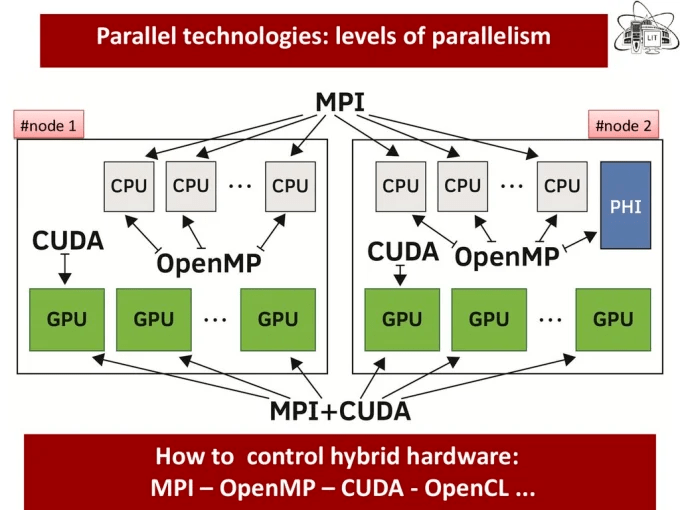
In modern HPC, it's common to mix these models. A typical configuration on a supercomputer is MPI + OpenMP: MPI handles communication between nodes, and OpenMP handles parallelism within each multi-core node. Another powerful combination is MPI + CUDA, where MPI distributes work across nodes, and each node uses its GPU(s) for the heavy computation.
3. Situational Analysis: Putting Theory into Practice
Let's apply this framework to a few scenarios. This exercise is adapted from the "Situational Analysis" in the Princeton Research Computing primer.
A Primer on Parallel Programming
To see how these decisions are made in practice, review the 'Situational Analysis' section of 'A Primer on Parallel Programming'. It presents two distinct problems and walks through the reasoning for selecting an appropriate model.
Find the section titled 'Situational Analysis' (it's on page 8 of the PDF). Read through the two scenarios presented and the suggested approaches. This will give you a template for how to justify your choices.
Now, let's analyze some scenarios relevant to your work in mechanical engineering and EV development.
Scenario A: Crash Simulation
- Problem: You need to run a high-fidelity finite element analysis (FEA) to simulate the structural deformation of a new EV chassis during a frontal impact. The model has millions of elements, requiring hundreds of gigabytes of RAM and days of computation on a single workstation. Your company has access to a multi-node cluster.
- Analysis:
- Scale: The problem is too large for a single machine. This rules out using only OpenMP.
- Data Dependencies: This is a tightly-coupled problem. The state of each element depends on its neighbors. This requires frequent communication between the processes handling different parts of the mesh. This is a poor fit for MapReduce's high-latency model.
- Computation Type: While there is parallelism, the control flow can be complex, and memory access patterns may not be as regular as in image processing, making it a less-than-perfect fit for a pure CUDA approach, although parts could be accelerated.
- Recommended Model: MPI (or MPI + OpenMP).
- Justification: "The problem requires the memory and compute power of a distributed cluster. MPI is the standard for tightly-coupled domain decomposition problems like FEA, allowing for efficient communication of boundary conditions between processes on different nodes. A hybrid MPI+OpenMP approach could further optimize performance by using OpenMP for parallelism within each node."
Scenario B: Battery Performance Analytics
- Problem: Your team has collected 50 terabytes of time-series data from battery management systems across thousands of test vehicles. You want to run a batch job to identify charging patterns that correlate with premature battery degradation. The analysis involves parsing logs, filtering for specific events, and aggregating statistics.
- Analysis:
- Scale: 50 TB is far too large for a single machine's RAM.
- Fault Tolerance: The job could run for many hours. The risk of a node failure during this time is significant, so fault tolerance is critical. This rules out MPI/OpenMP/CUDA, which lack this feature.
- Data Dependencies: The analysis of one vehicle's logs is independent of another's. This is an "embarrassingly parallel" data processing task.
- Recommended Model: Hadoop MapReduce (or a more modern alternative like Apache Spark, which we'll discuss in a future course).
- Justification: "This is a large-scale, offline data analytics problem where fault tolerance is paramount. The MapReduce model is perfectly suited for this 'filter-and-aggregate' task on a massive, independent dataset. Its ability to scale on commodity hardware and automatically handle failures makes it the most robust and cost-effective choice."
Scenario C: Real-Time Lane Detection
- Problem: You are developing the perception system for a driver-assist feature. A core component needs to process a 1920x1080 video stream at 30 frames per second. The algorithm involves applying edge detection filters and Hough transforms to each frame to identify lane markings.
- Analysis:
- Scale: The data per frame is small (a few megabytes), but the computational throughput requirement is very high (must process a frame in under 33ms).
- Data Dependencies: The operations (e.g., applying a filter) are performed on millions of pixels independently. This is a massively data-parallel task.
- Hardware: In-vehicle systems often have specialized hardware, including embedded GPUs.
- Recommended Model: CUDA (or OpenCL).
- Justification: "The lane detection algorithm is characterized by high arithmetic intensity and massive data parallelism. The SIMT architecture of a GPU is designed for exactly this kind of workload, enabling the millions of pixel-level operations per frame to be executed in parallel to meet the strict real-time deadline. This problem is an ideal candidate for GPU acceleration."
Conclusion
You have now reached a major milestone in the course. You have not only learned the mechanics of the dominant parallel programming models but also developed a framework for choosing among them.
Key Takeaways:
- No Single Best Model: The choice of a parallel model is a trade-off driven by the problem's characteristics: data size, data dependencies, computational intensity, and scalability needs.
- Match the Model to the Architecture: OpenMP is for shared-memory CPUs, MPI is for distributed-memory clusters, CUDA is for GPUs, and MapReduce is for data-centric commodity clusters.
- Identify the Bottleneck: Is your problem compute-bound (needs more flops), memory-bound (needs more RAM), or I/O-bound (needs more data throughput)? The answer guides your choice.
- Justification is Key: Being able to clearly articulate why you chose a particular model, based on these technical trade-offs, is as important as implementing the solution itself.
In our final lesson, we will step back from programming models and look at the underlying hardware. We will compare the architectural trade-offs of shared-memory, distributed-memory, and data-parallel systems, connecting the software models you've learned to the physical systems they run on.