Hello! Welcome to the first lesson of our "Synthesis and Exam Preparation" module.
In the last module, we concluded our exploration of specific parallel programming models by designing join algorithms for MapReduce. As we discussed, the focus now shifts to synthesizing the concepts from across the course and applying them to solve practical, exam-style problems.
Today, we'll dive back into the world of computer architecture to tackle a core topic: cache performance. This lesson directly builds on the concepts you learned in Module 2, where we first discussed the memory hierarchy, cache organization, hits, and misses. Our goal today is to master the quantitative side of this topic.
The learning outcome for this lesson is to solve numerical problems involving cache performance metrics and average memory access time. We will review the essential formulas and then work through a series of problems that cover single-level caches, multi-level caches, and the overall impact of cache performance on CPU execution time.
1. Revisiting Average Memory Access Time (AMAT)
The entire purpose of a cache is to reduce the time it takes to access data from memory. We measure its effectiveness using a metric called Average Memory Access Time (AMAT).
The key variables involved are:
- Hit Time (T_hit): The time required to access data that is found in the cache (a cache hit).
- Miss Rate (R_miss): The fraction of memory accesses that are not found in the cache (a cache miss). The hit rate is simply
1 - R_miss. - Miss Penalty (P_miss): The extra time required to handle a cache miss. This usually involves fetching the data from the next level of the memory hierarchy (e.g., a lower-level cache or main memory).
The following video provides a concise review of these concepts and derives the fundamental formula for AMAT.
This video, 'Caches' from MIT OpenCourseWare, provides an excellent refresher on the basics of cache operation and the derivation of the AMAT formula.
Please watch the first 1 minute and 54 seconds (00:00 - 01:54). Focus on the definitions of hit time and miss penalty, and how they combine to form the AMAT equation.
As the video explains, the formula for AMAT in a system with a single-level cache is:
This formula is intuitive: every memory access pays the hit time (since we always check the cache first). On top of that, we pay an additional miss penalty, but only for the fraction of accesses that result in a miss.
Let's put this to use with a quick example.
Example Problem:
A processor has a cache with a hit time of 2 ns. A main memory access takes 50 ns. If the miss rate of the cache is 4% (0.04), what is the AMAT?
Solution:
- Hit Time = 2 ns
- Miss Rate = 0.04
- Miss Penalty: This is the extra time for a miss. It's the time to access main memory after failing to find the data in the cache. So, Miss Penalty = 50 ns.
(Note: Sometimes the problem states the total miss latency, e.g., "a miss takes 52 ns". In that case, the total miss latency is Hit Time + Miss Penalty. Be sure to read the problem carefully to distinguish between the two). - Calculate AMAT:
2. Cache Performance and Overall CPU Execution Time
AMAT tells us about the memory system's performance, but how does that translate to the overall execution time of a program? To answer this, we need to connect AMAT to the CPU performance equation.
Recall from our earlier lessons that CPU execution time can be defined as:
Where CPI is the average number of clock cycles per instruction. Cache misses directly impact CPI by causing the processor to stall while waiting for data. We can separate the base CPI from the stalls caused by memory access:
The number of memory stall cycles can be calculated as:
The following reading material provides a more formal presentation of these formulas and walks through detailed examples. It also introduces an important related metric, Misses Per Kilo-Instruction (MPKI).
[PDF] CMPT 450/750: Computer Architecture Fall 2021 Memory Hierarchy ...
These slides from a Simon Fraser University course on Computer Architecture provide excellent worked examples connecting cache metrics to overall CPU performance.
Please read the slides under the headings 'Revisiting Processor Performance', 'Cache Performance Metrics', 'Cache Performance Example', and 'MPKI vs. Miss Rate Example'. Focus on how miss rate and MPKI are used to calculate total CPI and execution time.
As you saw in the reading, a lower miss rate doesn't always mean better performance. The number of memory accesses per instruction is crucial. A program with a low miss rate but many memory accesses could perform worse than a program with a higher miss rate but fewer memory accesses.
3. Analyzing Multi-Level Caches
Modern processors don't have just one cache; they have a hierarchy (L1, L2, L3). The AMAT calculation extends naturally to this hierarchy.
When a miss occurs in the L1 cache, we don't go directly to main memory. We first check the L2 cache. The "miss penalty" for the L1 cache is therefore the time it takes to access the L2 cache. The AMAT of the L2 cache then becomes the miss penalty for the L1 cache.
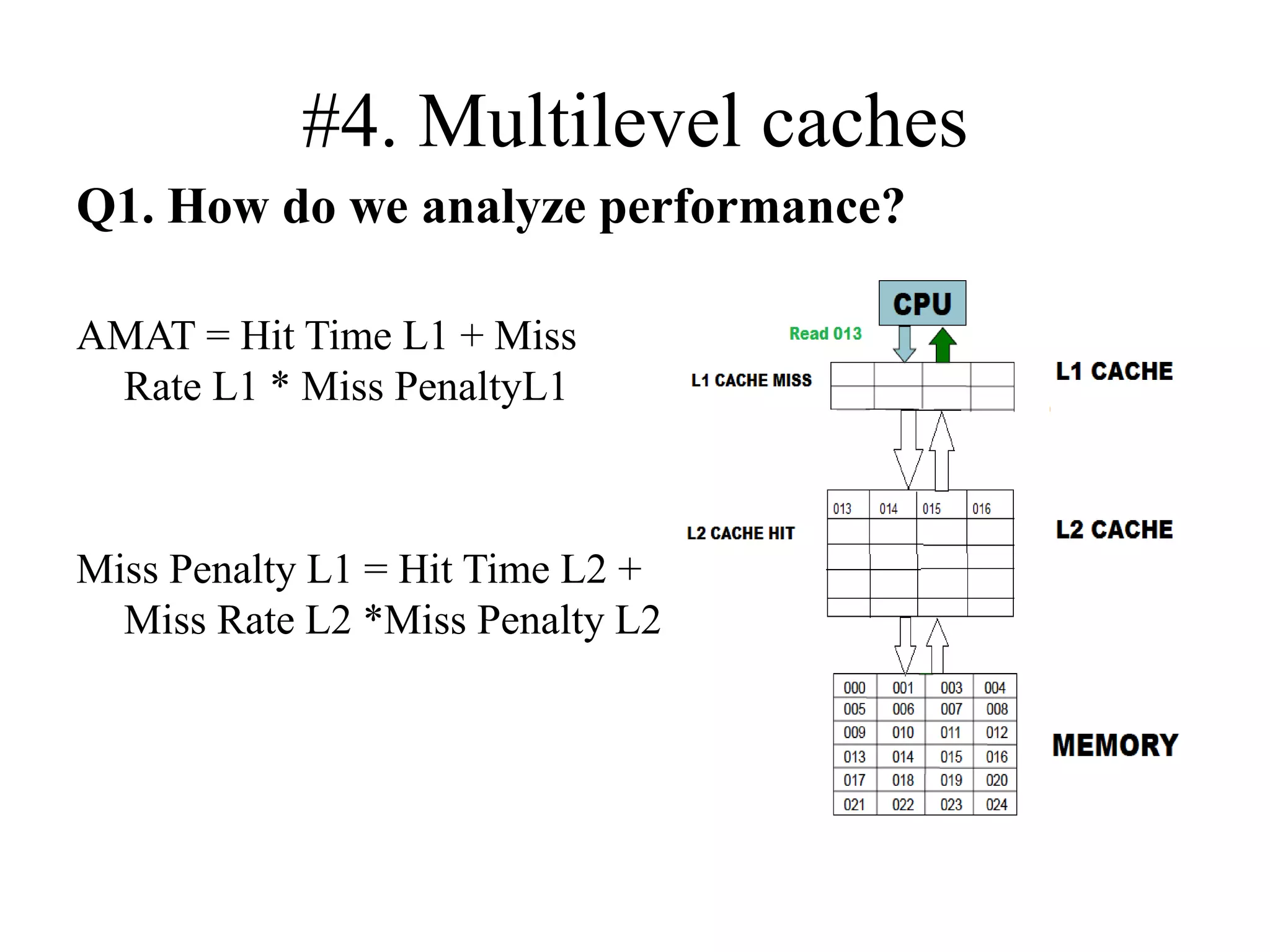
This creates a recursive relationship. For a two-level cache system:
And the L1 miss penalty is simply the AMAT of the L2 cache:
where Miss Penalty_L2 is the time to access main memory.
Combining these gives the full formula:
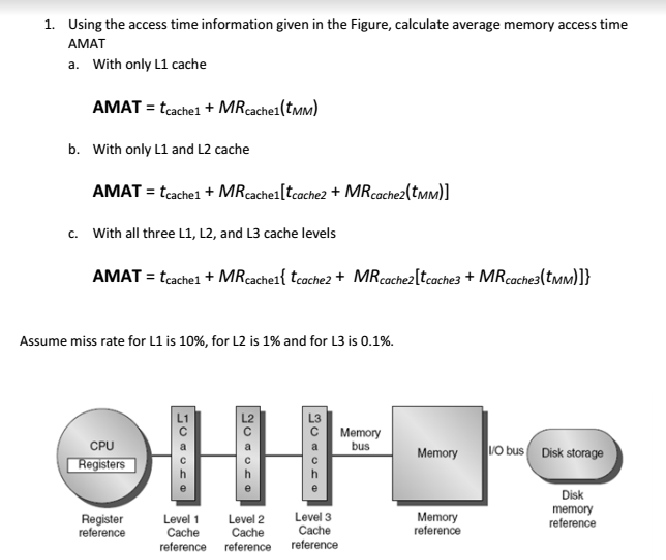
It's important to distinguish between local miss rate (the miss rate for a specific cache level) and global miss rate (the number of misses in a cache level divided by the total number of CPU memory accesses). The formulas above use local miss rates.
The image below summarizes the AMAT formulas for systems with one, two, and three levels of cache.
Now, let's see a complete numerical example for a multi-level cache system.
[PDF] CMPT 450/750: Computer Architecture Fall 2021 Memory Hierarchy ...
This section of the SFU slides provides a detailed worked example of calculating AMAT for systems with L1-only, L1+L2, and L1+L2+L3 caches.
Please study the 'Multi-Level Cache Example' section carefully. Trace how the AMAT is calculated for each of the three scenarios.
4. Practice Problem Set
Now it's time to apply what you've learned. The following problems are taken from a set of exercises designed to test these concepts. Try to solve each one on your own before looking at the solution steps. All necessary formulas are in the text above.
Problem 1: Single-Level Cache Performance
A program executes 500 million instructions on a processor with a base CPI of 1.8. The cache has a hit time of 3 cycles and a miss penalty of 80 cycles. The miss rate is 6%, and memory accesses per instruction is 35%. Calculate:
a) The total memory stall cycles.
b) The total CPI including memory stalls.
c) The total CPU execution time, assuming a clock cycle time of 2 ns.
Solution Steps
a) Total Memory Stall Cycles:
Stalls = Instructions × Mem. Accesses/Inst. × Miss Rate × Miss PenaltyStalls = (500 × 10^6) × 0.35 × 0.06 × 80Stalls = 840,000,000cycles
b) Total CPI:
Memory Stall Cycles per Instruction = (Mem. Accesses/Inst.) × Miss Rate × Miss PenaltyStalls per Inst. = 0.35 × 0.06 × 80 = 1.68Total CPI = Base CPI + Stalls per Inst.Total CPI = 1.8 + 1.68 = 3.48
c) Total CPU Execution Time:
Time = Instructions × Total CPI × Clock Cycle TimeTime = (500 × 10^6) × 3.48 × (2 × 10^-9 s)Time = 3.48seconds
Problem 2: Multi-Level Cache Performance
A processor has an L1 cache with a hit time of 2 cycles and a local miss rate of 5%. The L2 cache has a hit time of 10 cycles and a local miss rate of 20% (this is the rate of misses in L2 for accesses that come from L1). The miss penalty from the L2 cache to main memory is 100 cycles.
a) What is the average memory access time (AMAT) in cycles?
b) If 40% of instructions are memory accesses, what is the number of memory stall cycles per instruction?
Solution Steps
a) Average Memory Access Time (AMAT):
AMAT = Hit Time_L1 + Miss Rate_L1 × (Hit Time_L2 + Miss Rate_L2 × Miss Penalty_L2)AMAT = 2 + 0.05 × (10 + 0.20 × 100)AMAT = 2 + 0.05 × (10 + 20)AMAT = 2 + 0.05 × 30 = 2 + 1.5 = 3.5cycles
b) Memory Stall Cycles per Instruction:
- The average time for a memory access is 3.5 cycles. The ideal access time (always hit in L1) is the L1 hit time, which is 2 cycles.
- The average stall per memory access is
AMAT - Hit Time_L1 = 3.5 - 2 = 1.5cycles. Stalls per Instruction = Memory Accesses/Inst. × Average Stall per AccessStalls per Instruction = 0.40 × 1.5 = 0.6cycles
These problems are representative of what you might encounter in an exam. If you'd like more practice, the resource LINK in the resource list contains an extensive list of exercises (problems #16-45) with solutions.
Conclusion
In this lesson, we transitioned into our exam preparation by focusing on the quantitative analysis of cache performance. You've reinforced your understanding of the key metrics and practiced applying them to solve numerical problems for both single and multi-level cache systems.
Key Takeaways:
- Average Memory Access Time (AMAT) is the fundamental metric for cache performance, calculated as:
AMAT = Hit Time + (Miss Rate × Miss Penalty). - For multi-level caches, the AMAT formula is applied recursively, where the miss penalty of a higher-level cache is the AMAT of the next-lower-level cache.
- Cache performance directly impacts total CPU execution time by introducing memory stall cycles, which increase the effective Cycles Per Instruction (CPI).
- Solving these problems requires careful reading to correctly identify each variable (hit times, miss rates, penalties in cycles vs. seconds) and apply the correct formula for the given scenario.
In our next lesson, we will continue our focus on performance analysis by tackling another crucial topic: calculating the theoretical speedup of parallel algorithms using Amdahl's Law and Gustafson's Law.