Hello! Welcome to your next lesson in the "Synthesis and Exam Preparation" module.
In our last lesson, we dove into the shared-memory world of OpenMP. We traced how multiple threads, created through a fork-join model, could cooperate by reading and writing to shared variables. The key challenges were managing data scope (shared vs. private) and preventing race conditions using synchronization.
Today, we shift our focus from a shared-memory system to a distributed-memory system. This lesson addresses the learning outcome: Trace the execution of MPI code involving point-to-point and collective communication.
Instead of threads sharing memory, we will now deal with independent processes, each with its own private memory. These processes can't simply access each other's variables. Instead, they communicate by explicitly sending and receiving messages. This is the core paradigm of the Message Passing Interface (MPI). Our main task will be to follow these messages and track the state of variables within each process.
1. The MPI Execution Model: SPMD
MPI programs typically follow the Single Program, Multiple Data (SPMD) model. This means you write one C++ source file, compile it once, and then use a special launcher like mpirun to start multiple copies of your program simultaneously. Each running copy is a separate process.
While all processes run the same code, they are not identical. Each process has a unique ID, called its rank, from 0 to N-1, where N is the total number of processes. A process uses its rank to determine its specific role and what data it should work on.
The fundamental MPI functions for this are:
MPI_Init(): Initializes the MPI environment. Must be called at the beginning.MPI_Comm_size(): Gets the total number of processes (N).MPI_Comm_rank(): Gets the current process's unique rank (from0toN-1).MPI_Finalize(): Cleans up the MPI environment. Must be called at the end.
Let's start with a foundational video that covers these core concepts.
This video, from the channel MPI Basics, provides a clear walkthrough of the fundamental MPI functions and the SPMD concept. It's a great starting point for understanding how an MPI program is structured.
Watch from the beginning to 11:05. Pay close attention to how MPI_Init, MPI_Finalize, MPI_Comm_size, and MPI_Comm_rank are used to establish the parallel environment and give each process its identity.
As you saw, the key to tracing MPI code is to think from the perspective of a single process, identified by its rank, executing the same block of code as all other processes.
2. Point-to-Point Communication and Deadlock
Processes exchange data using point-to-point communication. The most basic pairing is a blocking MPI_Send and MPI_Recv.
MPI_Send: Sends data from a buffer in the current process to a specified destination process.MPI_Recv: Waits to receive data from a specified source process and stores it in a buffer.
These operations are blocking.
MPI_Recvwill wait until the message arrives.MPI_Sendwill often wait until the correspondingMPI_Recvhas been posted by the destination process. This ensures the data has been safely received before the sending process continues (and potentially modifies its send buffer).
This blocking behavior is the source of a classic parallel programming problem: deadlock. If two processes are both waiting for each other to do something, they will wait forever.
Consider two processes, Rank 0 and Rank 1, wanting to exchange data.
Deadlocking Code:
// Executed by both Rank 0 and Rank 1
int my_rank, other_rank;
MPI_Comm_rank(MPI_COMM_WORLD, &my_rank);
other_rank = 1 - my_rank;

// Both processes try to send first.
MPI_Send(/* ... */, other_rank, /* ... */); // Rank 0 sends to 1, Rank 1 sends to 0
MPI_Recv(/* ... */, other_rank, /* ... */); // Both now wait for a message that will never be sent
In this scenario, Rank 0 is blocked on MPI_Send, waiting for Rank 1 to post a receive. But Rank 1 is also blocked on its own MPI_Send, waiting for Rank 0 to post a receive. They are stuck in a deadly embrace.
Correct Code:
The solution is to break the symmetry. One process sends first, while the other receives first.
int my_rank;
MPI_Comm_rank(MPI_COMM_WORLD, &my_rank);

if (my_rank == 0) {
    MPI_Send(/* to Rank 1 */);
    MPI_Recv(/* from Rank 1 */);
} else { // my_rank == 1
    MPI_Recv(/* from Rank 0 */);
    MPI_Send(/* to Rank 0 */);
}
Now, the communication is ordered. Rank 0 sends, Rank 1 receives it, then Rank 1 sends, and finally Rank 0 receives that. No deadlock.
Let's trace a slightly more complex example: a "round-robin" or ring communication pattern.
Tracing a Ring Communication
Imagine 4 processes arranged in a logical ring: 0 -> 1 -> 2 -> 3 -> 0. Each process p will send a value to process (p+1)%4. To avoid deadlock, we can't have everyone send at once. A common strategy is to have even-ranked processes send first while odd-ranked processes receive, and then they swap roles.
Let's trace the state with 4 processes (nprocs=4), where each process p wants to send the value p*10 to its right neighbor (p+1)%4.
Code Logic:
// Simplified logic
int my_rank = /* ... */;
int my_val = my_rank * 10;
int received_val;
int next_rank = (my_rank + 1) % nprocs;
int prev_rank = (my_rank - 1 + nprocs) % nprocs;

if (my_rank % 2 == 0) { // Even ranks
    MPI_Send(&my_val, 1, MPI_INT, next_rank, 0, MPI_COMM_WORLD);
    MPI_Recv(&received_val, 1, MPI_INT, prev_rank, 0, MPI_COMM_WORLD, MPI_STATUS_IGNORE);
} else { // Odd ranks
    MPI_Recv(&received_val, 1, MPI_INT, prev_rank, 0, MPI_COMM_WORLD, MPI_STATUS_IGNORE);
    MPI_Send(&my_val, 1, MPI_INT, next_rank, 0, MPI_COMM_WORLD);
}
Trace:
-
Initial State:
- Rank 0:
my_val = 0,next = 1,prev = 3 - Rank 1:
my_val = 10,next = 2,prev = 0 - Rank 2:
my_val = 20,next = 3,prev = 1 - Rank 3:
my_val = 30,next = 0,prev = 2
- Rank 0:
-
Phase 1: Even ranks send, Odd ranks receive.
- Rank 0 (even): Executes
MPI_Sendof value0to Rank 1. - Rank 2 (even): Executes
MPI_Sendof value20to Rank 3. - Rank 1 (odd): Executes
MPI_Recvfrom Rank 0. It receives0. Itsreceived_valbecomes0. - Rank 3 (odd): Executes
MPI_Recvfrom Rank 2. It receives20. Itsreceived_valbecomes20. - At the end of this phase, the sends and receives are complete.
- Rank 0 (even): Executes
-
Phase 2: Even ranks receive, Odd ranks send.
- Rank 1 (odd): Now executes
MPI_Sendof itsmy_val(10) to Rank 2. - Rank 3 (odd): Now executes
MPI_Sendof itsmy_val(30) to Rank 0. - Rank 0 (even): Now executes
MPI_Recvfrom Rank 3. It receives30. Itsreceived_valbecomes30. - Rank 2 (even): Now executes
MPI_Recvfrom Rank 1. It receives10. Itsreceived_valbecomes10.
- Rank 1 (odd): Now executes
-
Final State:
- Rank 0:
my_val = 0,received_val = 30 - Rank 1:
my_val = 10,received_val = 0 - Rank 2:
my_val = 20,received_val = 10 - Rank 3:
my_val = 30,received_val = 20
- Rank 0:
Each process has successfully received the value from its predecessor in the ring without causing a deadlock.
4 MPI topic: Point-to-point - Review questions
The concept of blocking communication and deadlock is critical. This resource, 'The Art of HPC', provides some excellent review questions with C code snippets that test your ability to spot deadlocks. This is great practice for exam-style questions.
Navigate to the end of the webpage, to section 4.5 'Review questions'. Focus on the first set of C code fragments under the 'Review' heading that begins 'In the following fragments...'. For each of the five code blocks, trace the execution with at least 2 processes and determine if it deadlocks or not. Think about which processes will be blocked waiting for which other processes.
3. Collective Communication
While point-to-point communication is flexible, many parallel algorithms use standard communication patterns that involve all processes. MPI provides a rich set of collective operations for these patterns. They are not only convenient but also highly optimized.
A key rule for collectives is that all processes in the communicator must call the same collective function.
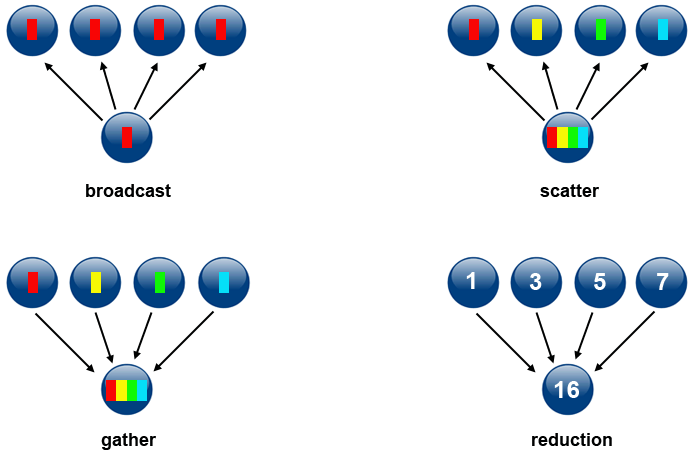
Let's trace the execution of a program that uses collectives to perform a parallel sum reduction. This is a very common pattern: an array of numbers is distributed among processes, each process sums its local portion, and then the local sums are combined to get a global total.
Parallel C++: MPI Collective Communication
This video walks through a C++ program that implements a sum reduction using two key collectives: MPI_Scatter to distribute the data and MPI_Reduce to collect the partial results. It's a perfect example for us to trace.
Watch from 01:37 to 10:28. The video explains the problem, the code structure, and the exact roles of MPI_Scatter and MPI_Reduce. Follow along with the code as the narrator explains each step.
Tracing a Sum Reduction
Let's trace the logic from the video with a concrete example. Assume we have 4 processes and Rank 0 starts with an array of 8 integers: data = [10, 20, 30, 40, 50, 60, 70, 80]. The chunk_size will be 8 / 4 = 2.
1. MPI_Scatter: Rank 0 "scatters" the data array. Each process receives a unique chunk of size 2 into its recv_buffer.
- Initial State:
- Rank 0
data:[10, 20, 30, 40, 50, 60, 70, 80]
- Rank 0
- State after
MPI_Scatter:- Rank 0
recv_buffer:[10, 20] - Rank 1
recv_buffer:[30, 40] - Rank 2
recv_buffer:[50, 60] - Rank 3
recv_buffer:[70, 80]
- Rank 0
2. Local Computation: Each process computes the sum of its recv_buffer and stores it in a local_result variable.
- State after local computation:
- Rank 0
local_result:10 + 20 = 30 - Rank 1
local_result:30 + 40 = 70 - Rank 2
local_result:50 + 60 = 110 - Rank 3
local_result:70 + 80 = 150
- Rank 0
3. MPI_Reduce: All processes provide their local_result. MPI combines them using the MPI_SUM operation and places the final answer into the global_result variable on the root process (Rank 0).
- State after
MPI_Reduce:- Rank 0
global_result:30 + 70 + 110 + 150 = 360 - Rank 1, 2, 3
global_result: Unchanged/uninitialized. Only the root process receives the final result.
- Rank 0
If the goal were to have all processes know the final sum, we would use MPI_Allreduce.
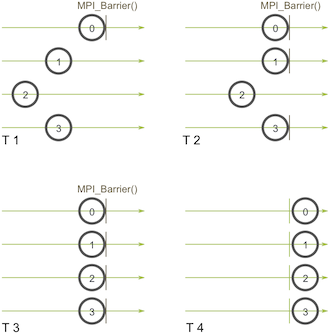
Conclusion
Today we explored the distributed-memory paradigm of MPI. Unlike OpenMP where threads implicitly share data, MPI processes operate in isolation and must explicitly communicate. Tracing MPI code requires you to adopt the mindset of a single process, keeping track of its rank, its local data, and the messages it sends and receives.
Key Takeaways:
- SPMD Model: MPI programs consist of multiple independent processes running the same code, distinguished by their unique rank.
- Point-to-Point Communication: Blocking
MPI_SendandMPI_Recvare the fundamental building blocks. Tracing them requires careful attention to the order of operations to identify potential deadlocks. - Collective Communication: Operations like
MPI_Bcast,MPI_Scatter,MPI_Gather, andMPI_Reduceorchestrate communication among all processes. Tracing them involves understanding how they distribute, collect, and compute on data across the entire system. - Tracing Strategy: For any MPI program, the core task is to track the state of variables within each process, step-by-step, as messages are exchanged.
In our next lesson, we will explore our third and final major parallel architecture: the GPU. You will learn to trace the execution of simple CUDA kernels, tracking values in global and shared memory, which introduces yet another distinct and powerful model of parallel computation.