Introduction
Hello! Welcome back to our module on distributed-memory parallelism with MPI.
In our last lesson, you learned how to use the collective operations MPI_Bcast and MPI_Reduce. MPI_Bcast is a powerful tool for one-to-all communication, allowing a root process to send the exact same piece of data to every other process. This is perfect for distributing configuration parameters or a shared initial state.
However, a very common pattern in parallel computing involves dividing a large dataset, like an array or a matrix, into smaller, unique chunks and assigning one chunk to each process. MPI_Bcast can't do this, as it only duplicates data.
This is where today's topic comes in. We will explore two fundamental collective operations designed for this exact purpose:
MPI_Scatter: To distribute, or "scatter," different parts of an array from a root process to all processes in the communicator.MPI_Gather: To collect, or "gather," the processed chunks from all processes back onto the root process.
By the end of this lesson, you will be able to use MPI_Scatter and MPI_Gather to efficiently distribute and collect array data, a core skill for parallelizing many scientific and engineering computations.
1. Distributing Data Chunks with MPI_Scatter
MPI_Scatter is a one-to-many collective operation. A single root process starts with an array of data, and MPI_Scatter divides this array into contiguous blocks, sending one block to each process (including itself).
The key difference from MPI_Bcast is that each process receives a unique piece of the original data.
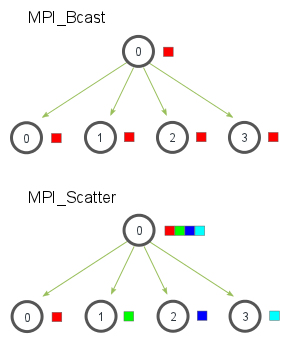
The C++ function signature for MPI_Scatter is:
int MPI_Scatter(
    const void* sendbuf,
    int sendcount,
    MPI_Datatype sendtype,
    void* recvbuf,
    int recvcount,
    MPI_Datatype recvtype,
    int root,
    MPI_Comm comm
);
Let's analyze the parameters.
MPI Scatter, Gather, and Allgather - MPI Tutorial
This article from the MPI Tutorial series provides a clear explanation of the MPI_Scatter function and its parameters. It's a great reference to understand the details.
Please read the section 'An introduction to MPI_Scatter'. Pay close attention to the explanation of the send_count parameter and how it determines the size of the chunks being distributed.
As you've read, here are the crucial points to remember for MPI_Scatter:
sendbuf: Pointer to the large array on the root process. It's ignored for all other processes.sendcount: The number of elements sent to each process. This is not the total number of elements insendbuf. For an array of sizeNdistributed amongPprocesses,sendcountwould beN / P.recvbuf: Pointer to a buffer on every process where the received chunk will be stored.recvcount: The number of elements each process will receive. This is usually the same assendcount.root: The rank of the process that is doing the scattering.
2. Collecting Data Chunks with MPI_Gather
MPI_Gather is the inverse operation of MPI_Scatter. It performs a many-to-one communication, collecting data from a buffer on each process and concatenating it into a single, larger buffer on the root process. The data is assembled in rank order.
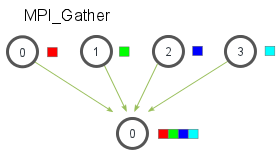
The function signature is identical to MPI_Scatter:
int MPI_Gather(
    const void* sendbuf,
    int sendcount,
    MPI_Datatype sendtype,
    void* recvbuf,
    int recvcount,
    MPI_Datatype recvtype,
    int root,
    MPI_Comm comm
);
MPI Scatter, Gather, and Allgather - MPI Tutorial
The same MPI Tutorial article also provides an excellent breakdown of MPI_Gather.
Now, read the section 'An introduction to MPI_Gather'. The most important point to focus on here is the meaning of recv_count on the root process. It's a common source of bugs for beginners.
Key points for MPI_Gather:
sendbuf: Pointer to the local data chunk that each process will send.sendcount: The number of elements each process is sending.recvbuf: Pointer to the large buffer on the root process where all the data will be collected. This buffer must be large enough to hold all the data from all processes. It's ignored for non-root processes.recvcount: The number of elements to be received from each individual process. LikesendcountinMPI_Scatter, this is not the total size ofrecvbuf. It should generally be equal tosendcount.
For a quick video overview of both concepts, the following resource provides a concise explanation.
Practical Parallelism in C++: MPI Fundamentals
This video provides a great visual and conceptual summary of how MPI_Scatter and MPI_Gather work.
Please watch the segment from 09:11 to 12:01. The first part (09:11-10:44) covers MPI_Scatter, and the second (10:44-12:01) covers MPI_Gather. Focus on how the data is being moved from and to the root process.
3. A Complete Scatter/Gather Example
Now let's see how these two functions work together in a complete C++ program. The typical workflow is:
- Root: Creates a global data array.
- All: Call
MPI_Scatterto distribute the array. The root sends, and all processes (including the root) receive their chunk. - All: Each process performs some computation on its local chunk of data.
- All: Call
MPI_Gatherto collect the modified chunks. Each process sends its result, and the root receives them all into the original global array. - Root: The root process now has the final, fully processed array.
The following resource provides a clean, well-commented C++ code example that follows this exact pattern.
[PDF] MPI Collective communication
This set of presentation slides contains a complete, self-contained C++ program that demonstrates the use of MPI_Scatter and MPI_Gather. Let's walk through it step-by-step.
Please review the code on slides 23 through 28, which are labeled 'Scatter/Gather example'. I will break down the key parts below.
Let's dissect the code from the slides:
Slide 25: Initialization and Allocation
// Master process allocates array and fills it with data.
u = new int[num_proc * num_to_send];
// ... loop to fill u ...
Only the master process (rank 0) allocates and initializes the full source array u. All processes, however, allocate a smaller receive buffer v, which is large enough to hold their individual chunk (num_to_send elements).
Slide 26: The Scatter Operation
// Each process participates in the scatter
MPI_Scatter(u, num_to_send, MPI_INT,
            v, num_to_send, MPI_INT,
            MASTER, MPI_COMM_WORLD);
Here, the master process sends num_to_send integers from u to each process. The data is placed into each process's v array.
Slide 26: Local Computation
// Each process, including the master, adds a
// distinguishable value to received data.
for (int i = 0; i < num_to_send; i++) {
    v[i] += 1000 * (my_rank + 1);
}
This is the "work" phase. Each process modifies its local v array. The modification depends on the process's rank, making it easy to verify that the data was correctly distributed and gathered.
Slide 27: The Gather Operation
// Each process participates in the gather.
MPI_Gather(v, num_to_send, MPI_INT,
           u, num_to_send, MPI_INT,
           MASTER, MPI_COMM_WORLD);
Finally, each process sends its modified v array back to the master. The master collects these chunks and stores them back into the original u array, in rank order. The recvcount is again num_to_send, as it specifies the size of the chunk received from each process.
This example perfectly illustrates the standard "distribute-compute-collect" pattern that you will use frequently in parallel programming.
4. Hands-on Practice: Parallel Array Processing
Now it's your turn to apply these concepts. Your task is to write a C++ program that performs a simple element-wise operation on a large array in parallel.
Your Task:
- Define a constant for the number of elements per process (e.g.,
ELEMENTS_PER_PROC = 25). - In
main, determine the number of processes (world_size) and the current process rank (world_rank). - Calculate the total size of the array:
total_elements = ELEMENTS_PER_PROC * world_size. - On the root process (rank 0) only:
- Dynamically allocate a
floatarray of sizetotal_elements. - Initialize this array with values from
0.0tototal_elements - 1.0. - Print the initial array content (or a part of it) for verification.
- Dynamically allocate a
- On all processes:
- Dynamically allocate a local
floatarray of sizeELEMENTS_PER_PROCto serve as the receive buffer.
- Dynamically allocate a local
- Call
MPI_Scatterto distribute the data from the root's large array into each process's local buffer. - On all processes:
- Iterate through your local buffer and calculate the square of each element (i.e.,
local_buffer[i] = local_buffer[i] * local_buffer[i]).
- Iterate through your local buffer and calculate the square of each element (i.e.,
- Call
MPI_Gatherto collect the modified local buffers back into the original large array on the root process. - On the root process only:
- Print the final, modified array content (or a part of it) to verify that all chunks were processed and collected correctly.
- Clean up all dynamically allocated memory.
This exercise will solidify your understanding of the data flow and memory management required for MPI_Scatter and MPI_Gather. Take about 15 minutes to complete it.
Conclusion
Congratulations on completing this lesson! You've added two of the most practical and widely-used MPI collective operations to your toolkit. These functions are the backbone of the "domain decomposition" strategy, where a problem's data is split among processes for parallel computation.
Key Takeaways:
MPI_Scatteris for one-to-many distribution of distinct data chunks from a root process.MPI_Gatheris the inverse, a many-to-one collection of distinct chunks back to a root process.- The
sendcountandrecvcountparameters specify the number of elements per process, not the total. This is a crucial detail. - Only the root process needs to allocate the full data buffer for
Scatter(as a send buffer) andGather(as a receive buffer). All processes need to allocate a local buffer for their chunk.
Preview of the Next Lesson
So far, we've learned the building blocks: point-to-point messages, broadcast, reduction, scatter, and gather. In the next lesson, we will use these tools to implement a complete, practical algorithm: parallel matrix-vector multiplication. This will require you to combine data distribution strategies with computation and see how these MPI primitives come together to solve a real-world problem efficiently.