Introduction
In our last lesson, you learned how to use profiling tools like gprof and perf to scientifically identify the "hot spots" in your C++ code—the parts that consume the most execution time. This is a crucial first step in optimization: knowing where to focus your efforts.
Now, we'll shift our focus from what is slow to why it is slow, by looking at how a modern CPU actually executes your code. This lesson addresses the learning outcome: Explain how instruction-level parallelism and CPU pipelining improve performance. We'll explore the fundamental technique that CPUs use to execute instructions at an incredible rate, a concept analogous to a factory assembly line.
Understanding these hardware-level mechanisms is the key to moving beyond simply identifying bottlenecks to understanding their root causes, which will empower you to write faster code.
The Core Idea: Pipelining as an Assembly Line
At its heart, a CPU's job is to execute a stream of instructions. A naive approach would be to execute one instruction completely before starting the next. However, this is inefficient. Modern CPUs use a technique called pipelining.
To build an intuition for this, let's start with a familiar analogy: doing laundry.
Lecture 3: Pipelining and Instruction-Level Parallelism
This article introduces pipelining with a clear and effective laundry analogy. It will help you grasp the core concepts of throughput versus latency before we apply them to CPUs.
Please read the section titled "The Laundry Example". Pay close attention to how overlapping the tasks (washing, drying, folding) improves the overall completion time for multiple loads, even though the time for a single load doesn't change.
The laundry example highlights two critical performance metrics:
- Latency: The time it takes for a single task to complete from start to finish (e.g., the time for one load of laundry). In our analogy, this did not improve.
- Throughput: The rate at which tasks are completed (e.g., the number of laundry loads finished per hour). In our analogy, this did improve significantly.
Pipelining is all about improving throughput by overlapping the execution of multiple independent tasks.
The CPU Pipeline
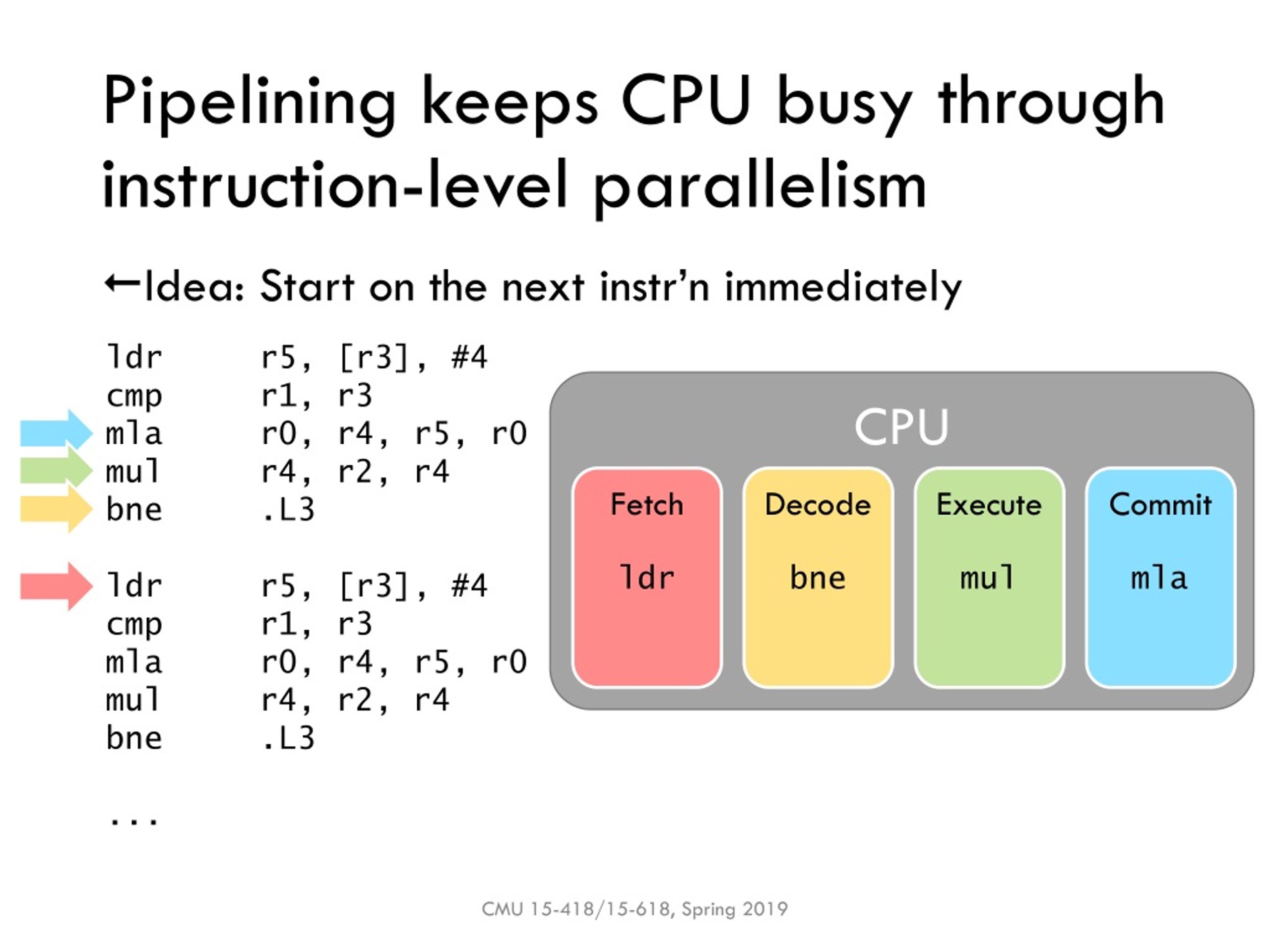
Just as doing laundry can be broken into stages, executing a single machine instruction can also be divided into a sequence of steps. A classic model for a RISC (Reduced Instruction Set Computer) processor is a five-stage pipeline.
Lecture 3: Pipelining and Instruction-Level Parallelism
Let's see how the assembly line concept is applied inside a CPU. This text explains the standard five-stage pipeline.
Read the section "Pipelined CPUs". Focus on understanding the purpose of each of the five stages: IF: Instruction Fetch ID: Instruction Decode EX: Execute MM: Memory Access WB: Write Back
By breaking instruction execution into these stages, the CPU can work on different stages of multiple instructions simultaneously.
To see the performance gain mathematically, let's watch a short video that models the speedup.
Ep 085: Introduction to the CPU Pipeline
This video provides a great visualization of non-pipelined vs. pipelined execution and derives the theoretical speedup. Your background in mathematics will make the limit calculation particularly intuitive.
Watch the video from the beginning until 17:44. Pay attention to: The drive-through analogy, which reinforces the concept. The timing diagrams comparing non-pipelined and pipelined execution. The calculation showing how the speedup of an N-stage pipeline approaches N as the number of instructions increases.
Instruction-Level Parallelism (ILP)
Pipelining works because there is often Instruction-Level Parallelism (ILP) in a program. ILP is the potential to execute multiple instructions in parallel because they are independent of each other. The pipeline is the hardware mechanism that exploits this parallelism.
For example, consider these two C++ lines:x = a + b;y = c * d;
Since the calculation of y does not depend on the result of x, a pipelined processor can have both of these operations "in-flight" at the same time, greatly speeding up their combined execution.
The Reality: When the Pipeline Stalls (Hazards)
The ideal speedup of a pipeline is rarely achieved because the assembly line can be disrupted. These disruptions are called hazards.
Lecture 3: Pipelining and Instruction-Level Parallelism
To get a complete picture, we need to understand the limitations of pipelining. This resource introduces the three main types of hazards that can force the pipeline to slow down or 'stall'.
Read the sections "Obstacles to Pipelining: Hazards" and "Dependences". Focus on understanding the three main types of hazards: Structural Hazards: Contention for a hardware resource. Data Hazards: An instruction depends on the result of a previous, unfinished instruction. Pay attention to the Read-After-Write (RAW) hazard and the solution of forwarding. Control Hazards: The pipeline doesn't know where to fetch the next instruction from due to a branch (like an if statement or for loop).
Control hazards, caused by branches, are a particularly significant problem in modern, deep pipelines. When the CPU encounters a conditional branch, it doesn't know whether the condition will be true or false. If it guesses wrong about which instructions to fetch next, it must flush the incorrect instructions from the pipeline and start over, wasting valuable cycles. This problem is so important that it's the entire topic of our next lesson.
Advanced ILP: Superscalar and Out-of-Order Execution
Modern high-performance CPUs don't just stop at a simple pipeline. They employ even more sophisticated techniques to find and exploit ILP.
21.2.1 Instruction-level Parallelism
Let's explore two key advancements that build upon basic pipelining: superscalar execution and out-of-order execution. This video from MIT OpenCourseWare provides a concise explanation.
Watch the following three clips: (Superscalar) 04:52 - 05:20 and 08:52 - 10:05: This explains the idea of a 'wider' pipeline, known as superscalar execution, where the CPU has multiple execution units to process several instructions in the same stage simultaneously. (Out-of-Order) 05:20 - 05:48 and 10:58 - 12:18: This introduces out-of-order execution, a powerful technique where the CPU can skip over a stalled instruction to execute later independent instructions, improving efficiency. (Recap) 02:12 - 02:57: Though out of sequence, this clip provides a good summary of different ways to improve performance, putting pipelining into a larger context.
To summarize these advanced concepts:
- Pipelining is like having one assembly line to work on multiple products at once.
- Superscalar Execution is like having multiple parallel assembly lines.
- Out-of-Order Execution is like allowing workers on the assembly line to work on a later product if the one they're supposed to be working on is waiting for a part.
These techniques, managed entirely by the CPU hardware, work together to extract as much parallelism as possible from a single stream of instructions.
The Limits of ILP
For a time, processor designers increased performance by making pipelines deeper and wider. However, this approach has diminishing returns. Deeper pipelines mean a higher penalty for control hazards (branch mispredictions), and wider pipelines increase hardware complexity and power consumption exponentially.
This "ILP wall" is the primary reason the industry shifted focus from making single cores faster to putting multiple cores on a single chip. This moves the challenge of parallelism from the hardware (ILP) to the software, requiring programmers to explicitly use Thread-Level Parallelism (TLP), which we will explore with OpenMP and MPI in later modules.
Conclusion
In this lesson, we've pulled back the curtain on how a modern CPU achieves its remarkable performance. You've seen that it's not by executing instructions one by one, but by using an assembly-line approach to work on many instructions at once.
Key Takeaways:
- Pipelining improves instruction throughput (not latency) by breaking execution into stages and overlapping them.
- Pipelining works by exploiting Instruction-Level Parallelism (ILP), the inherent independence among instructions in a program.
- Hazards (Data, Control, and Structural) are disruptions that can stall the pipeline and degrade performance.
- Modern CPUs use advanced techniques like superscalar (wider pipelines) and out-of-order execution to find even more ILP.
- There are practical limits to how much performance can be gained from ILP, which led to the rise of multi-core processors.
Preview of the Next Lesson
We briefly touched upon control hazards as a major obstacle to pipeline performance. In our next lesson, we will dive deep into this problem. You will learn about branch prediction, the sophisticated guessing game that CPUs play to mitigate the cost of if statements and loops, and how its effectiveness can dramatically impact your code's speed.