Introduction
Hello! In our last lesson, we explored loop interchange and loop unrolling, two powerful techniques for optimizing code to work in harmony with the CPU's hardware. We saw how loop interchange improves spatial locality by ensuring sequential memory access, and how loop unrolling boosts Instruction-Level Parallelism (ILP) by giving the CPU's scheduler more independent work.
However, these techniques have a limitation. They are most effective when the data we're working with fits into the fastest level of cache (L1). What happens when our problem, like multiplying two large matrices, involves data sets that are far too large for the L1 or even the L2 cache? Even with a perfectly ordered loop, the CPU will constantly have to fetch data from the much slower main memory, leading to capacity misses.
This lesson directly addresses that challenge. Our learning outcome is to apply loop tiling (blocking) to optimize for multiple levels of the memory hierarchy. We will learn how to restructure our loops to process data in small "tiles" or "blocks" that are sized to fit within a specific level of cache. This strategy maximizes data reuse within a fast cache level before the data is evicted, dramatically reducing the traffic to slower memory and unlocking significant performance gains.
The Problem with Large Datasets: Cache Thrashing
Let's revisit our i-k-j matrix multiplication. The memory access is sequential, which is great for spatial locality. However, consider the access to matrix B. For each outer loop iteration i, we stream through the entire B matrix. If B is 8MB (a 1024x1024 matrix of doubles) and our L2 cache is only 1MB, then by the time we start processing the next i value, the parts of B we need first have long been evicted from the cache.
This phenomenon is sometimes called cache thrashing or cache pollution: we repeatedly fill the cache with data, only to have it pushed out by new data before we can reuse it. Loop tiling is the solution.
The core idea is to break the large matrix multiplication into a series of smaller matrix multiplications on sub-matrices (tiles) that do fit in the cache.
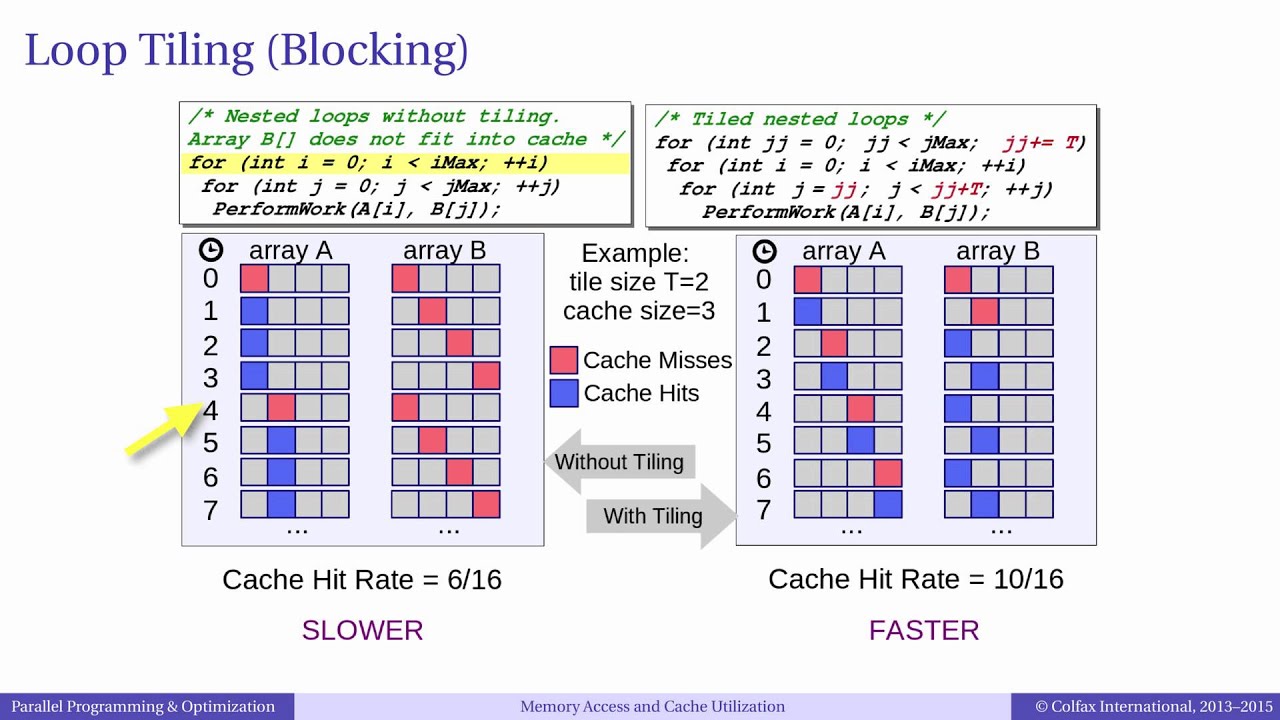
To get a more formal definition and see how this applies to matrix multiplication, the following video explains the concept and the problems it solves.
Performance x64: Cache Blocking (Matrix Blocking)
This video from Creel introduces cache blocking and the concepts of cache thrashing and pollution.
Please watch from 04:52 to 08:05. Focus on the definition of blocking as splitting a large problem into smaller ones that fit in cache, and the visual explanation of how processing a small block of the result matrix only requires small blocks of the input matrices.
Implementing Loop Tiling
So, how do we transform our code to implement tiling? We introduce additional outer loops that iterate over the tiles, and the original inner loops now iterate within a tile.
Let's first look at a simple 2D loop, separate from the complexity of matrix multiplication, to see the pattern clearly.
The article 'Loop tiling' provides a clear, step-by-step guide to the code transformation.
Read the first two sections of this article, up to 'The careful reader might notice...'. Pay attention to how the simple nested loop is transformed by adding an outer jj loop that iterates in steps of TILE_SIZE. This shows the fundamental pattern of the optimization.
Now, let's apply this pattern to the three nested loops of matrix multiplication. This involves adding tiling loops for multiple dimensions.

The video below provides a formal introduction to this transformation and then analyzes the significant reduction in cache misses that it achieves. Given your background in mathematics, you may find the quantitative analysis of cache misses particularly interesting.
3 2 6 Reduce Miss Rate by Blocking
This lecture from Prof. Dr. Ben H. Juurlink formally introduces blocking for matrix multiplication and provides a mathematical analysis of its effectiveness.
Please watch the entire video. It's broken into two main parts: (00:00 - 03:04): This section shows the code transformation from a standard triple-nested loop to a six-nested tiled version. This is the core implementation you need to understand. (03:04 - End): This section provides a detailed, step-by-step calculation of the number of cache misses for both the unblocked and blocked versions. The key takeaway is that misses are reduced by a factor proportional to the block size, B.
The transformation results in code that looks something like this, using a block size B:
// Tiled Matrix Multiplication
for (int i_tile = 0; i_tile < N; i_tile += B) {
    for (int k_tile = 0; k_tile < N; k_tile += B) {
        for (int j_tile = 0; j_tile < N; j_tile += B) {
            // Mini matrix multiplication on tiles of size B x B
            for (int i = i_tile; i < i_tile + B; i++) {
                for (int k = k_tile; k < k_tile + B; k++) {
                    for (int j = j_tile; j < j_tile + B; j++) {
                        C[i][j] += A[i][k] * B[k][j];
                    }
                }
            }
        }
    }
}
// Note: Boundary checks using min() are omitted for clarity but are needed in a real implementation.
Practical Considerations: Tile Size and Cache Hardware
The theory is elegant, but how does it work in practice? Two key questions arise:
- How do we choose the optimal tile size?
- Does our simplified model of the cache hide any real-world complexities?
1. Choosing the Tile Size
The tile size, B, is the most critical parameter.
- If
Bis too small, the overhead of the extra outer loops can dominate, and we don't get enough data reuse. - If
Bis too large, the working set—the threeB x Btiles of matricesA,B, andC—won't fit in the target cache level, and we're back to thrashing.
The working set size is approximately 3 * B * B * sizeof(double). If you are targeting your L2 cache, which might be 1MB, you would choose B such that this value is comfortably less than 1MB.
However, the absolute best way to find the optimal tile size is empirical. You test a range of values and measure the performance.
The following resource walks through this exact process.
Optimizing matrix multiplication
This blog post, 'Optimizing matrix multiplication', provides a fantastic hands-on perspective on tiling.
Read the section titled 'Tiling'. Notice the practical approach: the author tries a bunch of tile sizes (4, 8, 16, 32, 64, 128, 256) and benchmarks them to find the best performer (128). This experimental approach is standard practice in performance engineering.
2. The Reality of Cache Hardware: Conflict Misses
There's a fascinating and subtle issue that can arise. Our analysis assumes a "fully associative" cache, where a block of data from memory can be placed anywhere in the cache. Real-world caches are N-way set-associative, meaning a memory address can only be mapped to a small set of locations within the cache.
What happens if different parts of our data tiles all map to the same cache set? Even if the cache is large enough overall, that one set can fill up, causing data to be evicted. These are called conflict misses. This can happen with matrix operations if the matrix dimensions and tile sizes align in an unlucky way with the cache's geometry.
The same blog post that discussed finding the tile size also has an excellent, detailed explanation of this phenomenon. This is a deeper dive that connects our high-level C++ code directly to the low-level hardware behavior.
Optimizing matrix multiplication
This final reading will give you a much deeper appreciation for the complexities of cache optimization.
Read the sections 'Tile size analysis' and 'Cache hardware'. The key insight is how memory addresses are mapped to cache sets using their bits. The author shows that with a 4096x4096 matrix, columns 0, 32, 64, and 96 of a tile can all compete for the same cache set, causing unexpected conflict misses. This explains why performance doesn't always scale perfectly with tile size.
Conclusion
In this lesson, we added a crucial and powerful technique to our optimization toolbox. Where loop interchange and unrolling help fine-tune performance for data that's already in the L1 cache, loop tiling manages the flow of data across the entire memory hierarchy.
Key Takeaways:
- Loop Tiling (Blocking) is a loop transformation that partitions a large iteration space into smaller blocks, or tiles.
- The primary goal is to improve temporal locality and data reuse. By processing a small tile of data intensively, we minimize capacity misses to slower levels of memory.
- The size of the tile is chosen so that the working set of data for that tile's computation fits within a targeted level of the cache (e.g., L2 or L3).
- For matrix multiplication, this transforms one large operation into a sequence of many small matrix multiplications, drastically reducing the total data moved from main memory.
- Finding the optimal tile size is often an experimental process, and performance can be affected by low-level hardware details like cache associativity, which can cause conflict misses.
Preview of the Next Lesson
So far, our single-core optimizations have focused on making the most of the memory system and instruction pipeline. In our next lesson, we will explore a different dimension of parallelism available on a single core: data-level parallelism. We will explain the concept of SIMD (Single Instruction, Multiple Data) and learn how modern CPUs can perform a single operation (like an addition or multiplication) on multiple pieces of data simultaneously using vector registers and instructions.