Hello! In our last lesson, we looked at how to use filler words to make your English sound more natural and fluent. We're continuing that journey today by focusing on another key element of friendly, everyday conversation.
Today's lesson is about how to make and respond to simple compliments. Giving someone a compliment is a wonderful way to show appreciation and connect with people. Receiving one gracefully is just as important. Mastering this skill will help you build positive relationships in your daily life and better understand the social interactions you see in movies and TV shows.
The Basics of Giving and Receiving Compliments
At its core, giving a compliment is about sharing something nice you think or notice about someone. Responding is about accepting that kindness with gratitude.
This simple guide illustrates the basic steps.
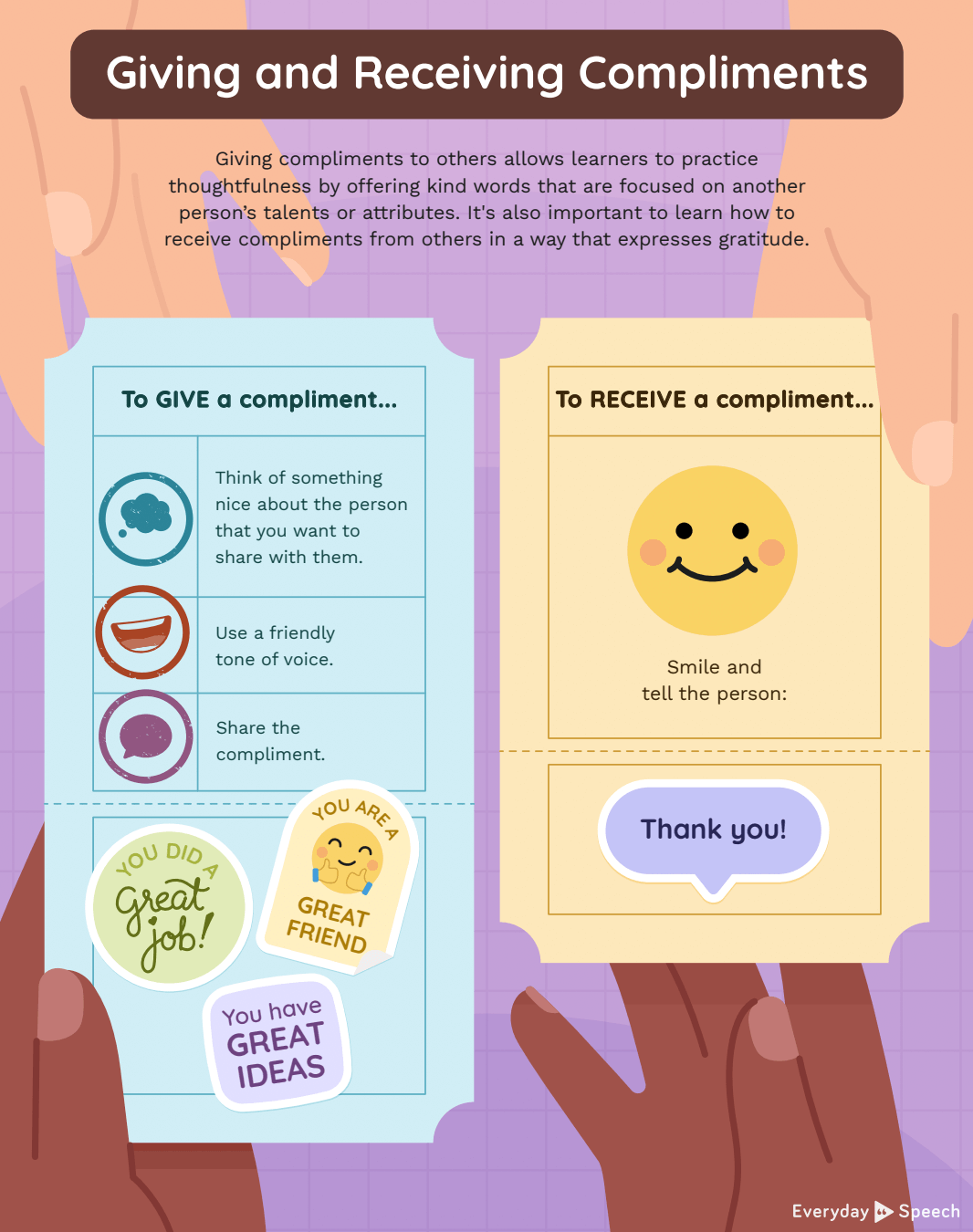
Giving a compliment can make someone's day, and it's a common way to start or continue a conversation. Let's explore some specific phrases you can use.
How to Give a Compliment
There are many situations where you can give a compliment. We'll focus on some of the most common ones: appearance, cooking, and work performance.
The following video from Espresso English provides excellent examples for each of these situations. As you watch, pay attention to the specific words used.
English Compliments Explained | 50 Phrases for Appearance, Work & Character
This video offers clear examples of compliments for various everyday situations.
Please watch these three short segments: First, see how to compliment someone's clothes or appearance (examples). Next, learn phrases for complimenting someone's cooking (examples). Finally, watch the section on complimenting someone's work or performance (examples).
Simple Formulas for Compliments
Did you notice any patterns in those phrases? You don't need to memorize hundreds of compliments. Instead, you can learn a few simple sentence structures. This is a great way to practice grammar in a very practical way.
Let's review these structures from the Espresso English video and an accompanying article.
50 Phrases For Compliments in English
This article clearly lays out the "formulas" you can use to create your own compliments.
Scroll down to the heading "Sentence Structures for Giving Compliments" and read the four formulas.
To summarize, here are the four common patterns:
-
Your + Noun Phrase + is/looks + (really) + Adjective
- Example: "Your presentation was really interesting."
- Example: "Your new haircut looks great."
-
I + (really) + like/love + Noun Phrase
- Example: "I really like your shirt."
- Example: "I love this music."
-
This/That + is + (really) + Adjective + Noun Phrase
- Example: "This is a delicious cake."
- Example: "That is a great idea."
-
What a/an + Adjective + Noun Phrase!
- Example: "What a beautiful home!"
- Example: "What a lovely day!"
Your work in data analysis involves finding patterns in data; here, we are finding patterns in language. Once you know these structures, you can create many different compliments just by changing the nouns and adjectives.
How to Respond to a Compliment
Now, what do you say when someone gives you a compliment? As we saw in the first image, the simplest and best response is often just "Thank you!" However, there are other phrases you can use to sound more natural.
Let's watch the final part of the Espresso English video to learn some of these responses.
English Compliments Explained | 50 Phrases for Appearance, Work & Character
This segment shows you how to respond to compliments gracefully.
Watch the section that begins with the question "How can we respond to compliments?".
Here are some of the most useful responses:
- Simple and effective: "Thank you." / "Thanks."
- A little warmer: "That's so kind of you."
- For compliments on things you own or made: "Thanks! I'm glad you like it."
- For compliments on your work or personality: "Thank you, I appreciate that."
Practice in Action
Let's see these compliments and responses in short, realistic dialogues. Watch these two clips and try to identify the compliment and the response in each one.
Make Compliment in English - English speaking Course
These short dialogues show how compliments are exchanged in natural conversation.
First, watch this conversation about food between a husband and wife (dinner compliment). Next, see how friends compliment each other's new hairstyles (haircut compliment).
In the first clip, you heard compliments like "This soup is out of this world!" and the response, "Seriously, you like it that much?". In the second, you heard "Your new hair looks great" and the simple reply, "Oh really? Thanks guys." These examples show how these phrases fit perfectly into everyday conversations.
Key Takeaways
- Compliments build connections: They are a simple and powerful way to be positive and friendly.
- Use simple formulas: You can create many compliments using structures like "I really like your..." or "That is a great...".
- Focus on common topics: Start by complimenting appearance, work, food, or someone's home.
- Respond with gratitude: A simple "Thank you" is always a perfect response. You can add phrases like "That's kind of you" or "I'm glad you like it" to sound more fluent.
This lesson concludes our first module on Conversation Basics! You have learned how to start and end conversations, ask questions, use pronouns, make small talk, use filler words, and now, give compliments.
In our next lesson, we will begin a new module, Daily Life and Routines. We will start by learning how to describe your daily activities using the Present Simple tense. This will be a fundamental step towards talking about your life in more detail.