Hello! Welcome to your second lesson.
In our first session, we mapped out the editorial process as a series of sequential stages, moving from the big picture to the finest details. We established the "what" and "when" of editing a book.
Today, we'll build on that foundation by focusing on the distinct roles of the people who perform that work. Our learning outcome is to distinguish between the roles of developmental editor, line editor, copyeditor, and proofreader. While one person might occasionally wear multiple hats, these are fundamentally different specializations, each requiring a unique skillset and mindset. We're moving from the workflow to the professionals who execute it—the "who" and "why" of the editorial team.
From Stages to Specialists
As we discussed, the editing process resembles a funnel. At the top, broad, structural changes are made. At the bottom, the focus narrows to individual words and punctuation marks. Each of the four main editorial roles corresponds to a different level of this funnel.
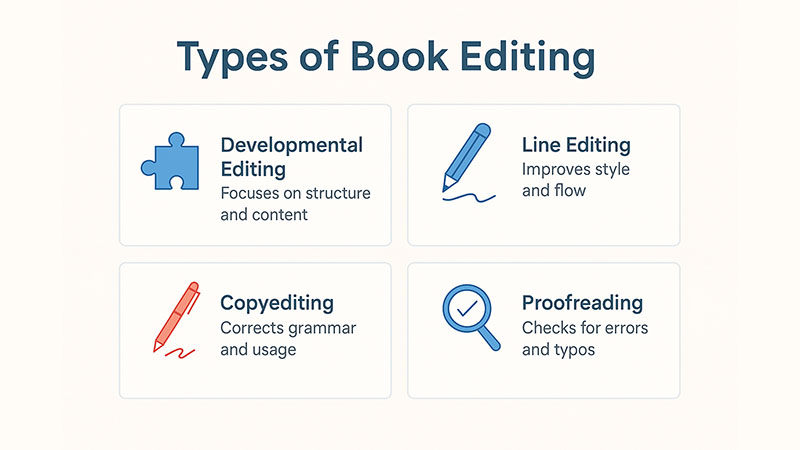
It's important to recognize that the terminology in publishing can be fluid. For instance, what one publisher calls "substantive editing," another might call "developmental editing." Similarly, "stylistic editing" is often used for "line editing." Part of becoming an editor is learning to navigate these variations. Our goal today is to understand the core function behind each title.
An Editor's Perspective on the Four Roles
To begin, let's watch a video where a professional editor breaks down her definitions of these roles. This will give you a practical, first-person perspective on the distinctions.
Editor Talk | 4 Types of Editing
In 'Editor Talk | 4 Types of Editing,' editor Mollie from the Mollie Reads channel explains the four main categories of editing she encounters in the book world.
Please watch from 01:12 to 07:37. Pay close attention to the specific tasks and questions she associates with each type of editor. Notice how she differentiates between the 'big picture' focus of developmental editing and the 'stylistic' focus of line/content editing.
As you saw, while the stages are related, the focus of each editor is quite different. A developmental editor asks, "Is this story working?" A line editor asks, "Is this sentence beautiful?" A copyeditor asks, "Is this sentence correct?" And a proofreader asks, "Are there any mistakes in this final version?"
A Deeper Dive into Editorial Roles
Now, let's explore these roles in more detail with a comprehensive guide from Jane Friedman's blog, a highly respected resource for writers and publishers. This article digs into the history, purpose, and practical application of each editorial function.
The Comprehensive Guide to Finding, Hiring, and Working with an Editor
The article 'The Comprehensive Guide to Finding, Hiring, and Working with an Editor' provides an excellent breakdown of the different specializations. We will read the sections defining each of the four main editor types.
Please read the following sections: Start at the beginning and read to the end of the introduction, ending just before the heading 'The Four Kinds of Editors'. This sets the stage for why these distinctions matter. Read 'The Four Kinds of Editors', including the subsections on '1. Developmental editing', '3. Copy editing', and '4. Proofreading'. Under 'Common Questions and Misconceptions,' read the parts that address 'Aren’t there even more than four kinds of editing, though?' (This explains where line editing fits) and 'How do I know what kind of editing I need?'. Focus on how the author distinguishes between developmental editing (working on an incomplete idea) and substantive editing (working on a complete draft). Also, note how line editing is treated as a distinct, prose-focused skill.
The Professional Standard
To ground these concepts in a formal context, many editorial associations publish professional standards. These documents define the core competencies for editors. Let's look at the definitions from Editors Canada, which provide a concise, industry-standard summary.
Professional Editorial Standards: A. The Fundamentals of Editing
This resource from Editors Canada outlines the official definitions for the core editorial roles as part of their professional standards.
Please read section 'A3 Editorial stages', focusing on the five definitions listed under A3.1. Note that they use 'Structural editor' for the developmental role and 'Stylistic editor' for the line editing role.
Comparing the Four Roles
You've now seen these roles defined in several ways. Let's consolidate that information. The table below summarizes the key distinctions.
| Criterion | Developmental Editor | Line Editor | Copyeditor | Proofreader |
|---|---|---|---|---|
| Primary Focus | Structure, content, concept, and coherence | Style, voice, rhythm, and flow | Correctness, consistency, and clarity | Final errors and formatting |
| Scope | The entire manuscript (the "big picture") | Paragraphs and sentences | Sentences, words, and punctuation | Individual characters and layout |
| Key Question | "Does this book work as a whole?" | "Is this prose elegant and effective?" | "Does this sentence follow the rules?" | "Is this page perfect?" |
| When It Happens | Early, on a rough or incomplete draft | After the structure is set, before copyediting | After line editing, on a "final" manuscript file | At the very end, on the typeset proofs |
| Analogy | Architect | Interior Stylist | Building Inspector | Final Walk-Through Inspector |
Check Your Understanding
Based on what you've learned about the mindset and focus of each role, answer the following questions.
- An author has written a compelling historical novel, but the timeline has inconsistencies, and a major character's motivation feels unclear in the second half. Which editor is best suited to help them?
- A non-fiction manuscript has a strong argument and is well-organized. However, the writing is dense with jargon, and the sentences are long and convoluted. The author's voice feels buried. Which specialist should be called in?
- After several rounds of revision, a manuscript is structurally sound and the prose is polished. Now it needs a thorough check to ensure it follows The Chicago Manual of Style, that all character names are spelled consistently, and that there are no grammatical mistakes. Who does this job?
- A designer has just delivered the typeset pages for a cookbook. The recipes and stories are all in place. The publisher needs one last person to check for typos, make sure every photo has the right caption, and confirm the page numbers in the index are correct before it goes to the printer. Who is this final gatekeeper?
Answer Key
- A Developmental Editor. Their job is to tackle big-picture issues like plot, character motivation, and structural consistency.
- A Line Editor. Their expertise is in refining the prose at the sentence level to improve flow, clarity, and voice, without changing the fundamental structure.
- A Copyeditor. This is the classic role of the copyeditor: ensuring adherence to a style guide, maintaining consistency, and correcting grammar and syntax.
- A Proofreader. This role is specifically for checking the final typeset proofs for any lingering typos or formatting errors before printing.
Conclusion
Today we've deconstructed the broad term "editor" into four distinct, professional roles. Understanding these specializations is critical for anyone in publishing, whether you're hiring an editor or becoming one.
Key Takeaways:
- Developmental Editor: The architect who works on the manuscript's blueprint (structure, plot, argument).
- Line Editor: The stylist who focuses on the art of the prose (voice, rhythm, flow).
- Copyeditor: The mechanic who ensures everything is technically correct and consistent (grammar, style, usage).
- Proofreader: The final quality inspector who checks the finished product for any surface-level errors before it goes public.
While the lines can sometimes blur, knowing the primary function of each role will allow you to analyze a manuscript's needs and understand the value each specialist brings to the publishing process.
Next Up:
In our next lesson, we will explore how these editorial roles and the overall publishing process can differ across various industry models. We will compare trade, academic, and independent publishing models from an editorial perspective, examining how the goals and constraints of each sector shape the editor's work.