Hello! Welcome to the first lesson in our module, Line Editing: Practical Application.
In our previous module, we established the theoretical foundations of line editing. We distinguished it from developmental and copyediting, explored its role in shaping authorial voice, and analyzed how line-level patterns create narrative momentum. You learned to evaluate prose; now, it's time to edit it.
This lesson focuses on our first practical learning outcome: Perform a line edit on a nonfiction passage to improve clarity, precision, and flow.
We'll start with nonfiction because your background in journalism gives you a strong foundation in clear, factual communication. Here, the line editor's primary goal is to make the author's information and arguments as accessible, accurate, and engaging as possible. We will apply the principles you've learned to a sample text, turning theory into a tangible skill.
1. The Goal of a Nonfiction Line Edit
While line editing always operates at the sentence level, its focus shifts slightly depending on the material. In fiction, an editor might prioritize emotional impact or character voice. In nonfiction, the prime directives are clarity, precision, and flow.
- Clarity: Is the author's meaning immediately understandable? Are complex ideas broken down effectively?
- Precision: Does the author use the most accurate and specific words? Is the language free of ambiguity?
- Flow: Do the sentences and paragraphs connect logically, guiding the reader smoothly through the argument or information?
To see how these goals translate into practice, it's helpful to review a clear definition and example of what line editing involves.
How Line Editing Works: A Practical Breakdown
The article 'How Line Editing Works' provides an excellent, detailed breakdown of the line editor's craft. We'll use it as our guide for this lesson.
Please read the introduction and the first two main sections: 'The Difference Between Copyediting and Line Editing' and 'What Does Line Editing Involve?'. Pay close attention to the example comparing an original, copyedited, and line-edited sentence. This distinction is key.
As the article demonstrates, a copyedit corrects technical errors, but a line edit refines the prose itself. The line-edited version—"Towering and snow-capped, the mountain range offers breathtaking views – a truly unforgettable destination"—is not just correct; it is more vivid, concise, and impactful. This is the transformation we are aiming for. In nonfiction, this means making an expert's argument feel not just smart, but also compelling and effortless to read.
2. A Practical Toolkit for Nonfiction Line Editing
Before we tackle a full passage, let's consolidate the techniques for achieving clarity, precision, and flow. These are the tools you'll use during the editing process. Many of these concepts, like varying sentence length, apply universally, but they take on special importance when the goal is to convey complex information clearly.
Editor Fixes Common Prose Mistakes (Part 1)
While this video focuses on fiction, its core lessons on sentence structure are directly applicable to making nonfiction prose more dynamic and readable. Let's watch a segment on two key techniques.
Please watch the sections on varying sentence length (04:05 - 07:30) and varying sentence content (07:30 - 11:11). As you watch, consider how these techniques could be used not just for a story, but to make an argument in a nonfiction piece more engaging and less monotonous.
Based on our resources and previous lessons, here is a practical checklist for line editing a nonfiction passage:
- Attack Complexity: Break down long, convoluted sentences into shorter, clearer ones.
- Enhance Precision: Replace vague or weak words with strong, specific alternatives.
- Eliminate Redundancy: Cut filler words (e.g., really, basically, just) and redundant phrases (e.g., each and every, final outcome).
- Activate Passive Voice: Change passive constructions ("the decision was made by the committee") to active ones ("the committee decided") for more direct and energetic prose.
- Improve Flow and Rhythm: Vary sentence length and structure to create a more engaging cadence and ensure smooth transitions between ideas.
3. Practical Exercise: Line Editing a Nonfiction Passage
Now, let's apply this toolkit. Below is a short passage from a hypothetical article about the evolution of digital journalism. It is structurally sound but clunky and unclear at the sentence level—a perfect candidate for a line edit.
Your Task:
Your goal is to perform a line edit on this passage. Read it through, then use our checklist to revise it line by line. Don't worry about getting it "perfect"; focus on applying the principles to make tangible improvements.
Original Passage:
It is a fact that the advent of the internet in the late 20th century basically brought about a monumental and significant shift in the landscape of journalism, fundamentally altering how information is both gathered by reporters and consumed by the general public. Traditional print media, such as newspapers and magazines, which had for a very long time been the primary sources of news, found themselves in a position where they were suddenly facing unprecedented challenges from online platforms that offered news in real-time and for free. This rapid transition, which was a difficult one, necessitated a complete and total reinvention of old business models and editorial strategies, forcing many venerable institutions to adapt or risk becoming completely obsolete in the new digital age that was dawning.
Step 1: Initial Read-Through and Diagnosis
First, read the passage straight through. What is your overall impression? It probably feels dense, a bit repetitive, and harder to read than it needs to be. The core information is there, but it's buried under layers of unnecessary words and convoluted sentences.
Step 2: Sentence-by-Sentence Edit
Now, let's go through it with our editing tools.
-
Sentence 1:
It is a fact that the advent of the internet in the late 20th century basically brought about a monumental and significant shift in the landscape of journalism, fundamentally altering how information is both gathered by reporters and consumed by the general public.- Complexity: This sentence is over 40 words long. Let's break it down.
- Redundancy: "It is a fact that," "basically," "monumental and significant," "both gathered... and consumed." These can all be cut or simplified.
- Precision: "Brought about" is a weak verb phrase. Can we find a stronger verb?
-
Sentence 2:
Traditional print media, such as newspapers and magazines, which had for a very long time been the primary sources of news, found themselves in a position where they were suddenly facing unprecedented challenges from online platforms that offered news in real-time and for free.- Complexity & Redundancy: This is another long sentence filled with clutter like "such as," "for a very long time," and "in a position where."
- Flow: The main clause ("Traditional print media... found themselves...") is interrupted by a long descriptive clause, slowing the momentum.
-
Sentence 3:
This rapid transition, which was a difficult one, necessitated a complete and total reinvention of old business models and editorial strategies, forcing many venerable institutions to adapt or risk becoming completely obsolete in the new digital age that was dawning.- Redundancy: "which was a difficult one," "complete and total."
- Flow: The sentence ends with two participial phrases ("forcing...") and ("dawning"), which makes the ending feel a bit tacked on.
Take about 15 minutes to write your own revised version of the passage.
Step 3: Reviewing an Edited Version
There are many ways to edit a passage, and line editing involves stylistic judgment. Below is one possible revision. Compare it to your own and notice the types of changes made.
Edited Passage:
The internet's arrival in the late 20th century triggered a monumental shift in journalism, fundamentally altering how information is gathered and consumed. Traditional print media, long the primary source of news, faced unprecedented challenges from free, real-time online platforms. This rapid transition forced venerable institutions to reinvent their business models and editorial strategies. They had to adapt or risk obsolescence in the new digital age.
Analysis of the Edits:
- Clarity: The long, complex sentences were broken up into shorter, more direct statements. The first sentence was split, and the final sentence of the original was rephrased into two distinct sentences for better impact.
- Precision: "Brought about" was replaced with the more active and precise verb "triggered."
- Flow: By cutting dozens of unnecessary words ("It is a fact that," "basically," "in a position where," etc.), the passage now moves much more quickly. The information is delivered without friction, allowing the author's argument to shine.
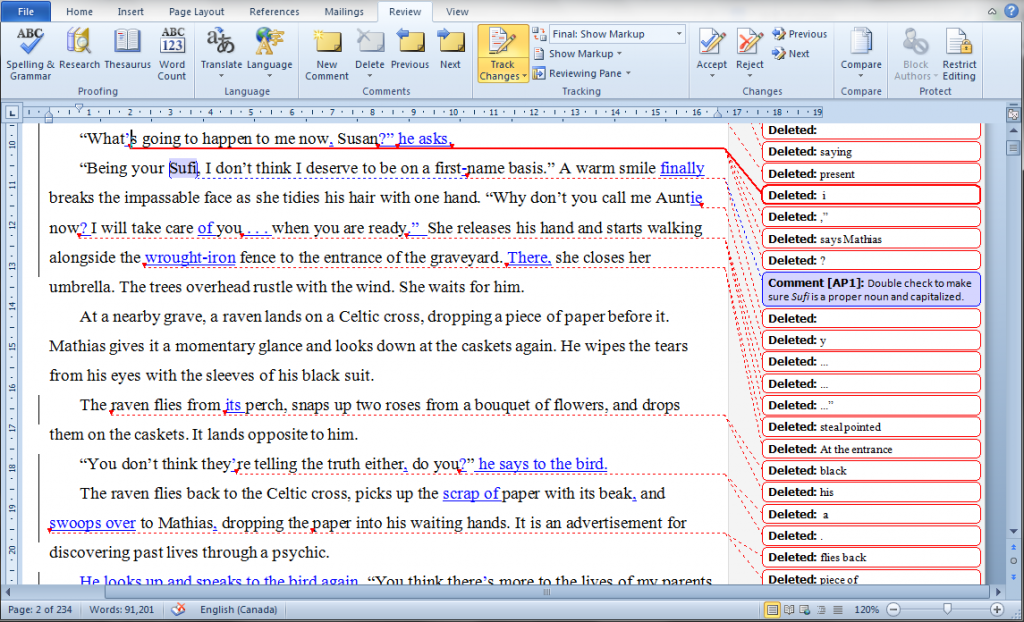
This is what a line edit looks like in a word processor using "Track Changes." It provides a clear record of every deletion, addition, and rephrasing.
Conclusion
In this lesson, you moved from theory to practice by performing a line edit on a nonfiction passage. You applied a systematic approach to improve a piece of writing, focusing on the core goals of clarity, precision, and flow.
Key Takeaways:
- Line editing nonfiction prioritizes making information and arguments clear, precise, and easy to follow.
- A practical toolkit for nonfiction line editing includes breaking down complex sentences, strengthening word choice, eliminating redundancy, and varying sentence structure.
- The goal is not to erase the author's voice, but to remove the clutter that obscures it, allowing their expertise to be communicated effectively.
Next Up:
Now that you have practiced these skills on a nonfiction text, our next lesson will challenge you to adapt them to a different context. We will move on to the next learning outcome: Perform a line edit on a fiction passage to enhance style while preserving authorial voice. This will require a greater focus on elements like rhythm, subtext, and characterization.