Hello and welcome back to our module, Advanced Copyediting and Style Management.
In our previous lessons, we built the foundational tools for this stage of editing. We learned how to create a style sheet to ensure a manuscript's internal consistency and how to approach fact-checking to guarantee its external accuracy. Your background in journalism gives you a distinct advantage in verification, and we've been honing that skill for the specific demands of book publishing.
Today, we will synthesize these skills. Our learning outcome is to copyedit a nonfiction excerpt, focusing on logical consistency and accuracy. This is where the meticulous work of copyediting meets the big-picture thinking of a critical reader. We'll move beyond correcting grammar and punctuation to ensuring that the author's argument is not only factually sound but also logically coherent from one sentence to the next.
1. The Copyeditor's Role in Logic and Accuracy
While a developmental editor assesses the overall structure and argument of a book, a copyeditor scrutinizes the logic at a more granular level. They are the first reader to test if the author's reasoning holds up under close inspection. Logical gaps, contradictions, and unsupported claims can erode a reader's trust just as surely as a factual error.
Often, these gaps arise from what cognitive scientist Steven Pinker calls the "curse of knowledge"—the difficulty of imagining what it's like for someone not to know something you know. An author, deeply immersed in their subject, might make logical leaps that seem obvious to them but are confusing to a reader. Your job is to spot these leaps.
Harvard Professor Explains The Rules of Writing — Steven Pinker
To understand why these logical gaps occur, let's watch a segment from an interview with Harvard Professor Steven Pinker. He explains the 'curse of knowledge' and its impact on writing.
Please watch from 00:31 to 04:30. As you watch, focus on Pinker's explanation of why even brilliant experts can be poor communicators. Consider how an editor acts as a proxy for the reader, identifying where the author's expertise might create confusion.
As Pinker points out, the solution is to put yourself in the reader's shoes. This involves not only checking for clarity but also ensuring accuracy, which is a particularly demanding task in nonfiction.
Editing Nonfiction: Why is it MORE Expensive?
The following video, 'Editing Nonfiction: Why is it MORE Expensive?', explains the expanded duties of a nonfiction editor, which go far beyond simple grammar correction.
Watch from 02:45 to 08:38. The speaker, Kristin, details the work involved in verifying claims, checking citations, and structuring information for engagement. This highlights the intersection of fact-checking and ensuring logical flow.
2. A Framework for Editing Nonfiction
To effectively copyedit for logic and accuracy, you need a systematic approach. We can think of this as a multi-layered check, moving from high-level coherence down to sentence-level correctness.
Editing Checklist for Nonfiction Writers
This 'Editing Checklist for Nonfiction Writers' from She Writes provides an excellent overview of the key areas to check. While some points touch on developmental editing, they are crucial for a copyeditor to keep in mind.
Please read the sections titled 'Make Sure You Have a Clear Message or Thesis,' 'Fact-Check and Verify All Sources,' 'Assess Your Book’s Structure and Flow,' 'Cut Out Redundant or Unnecessary Information,' and 'Address Gaps or Missing Information.' Notice how these concerns are all interconnected: a factual error can undermine the thesis, and poor flow can create the impression of missing information.
As you can see, the copyeditor's role involves wearing several hats: fact-checker, logician, and style enforcer. You must decide what to fix directly, what to add to the style sheet for consistency, and what requires a query to the author.
This "Copyediting Decision Guide" provides a clear visual map for making these choices.
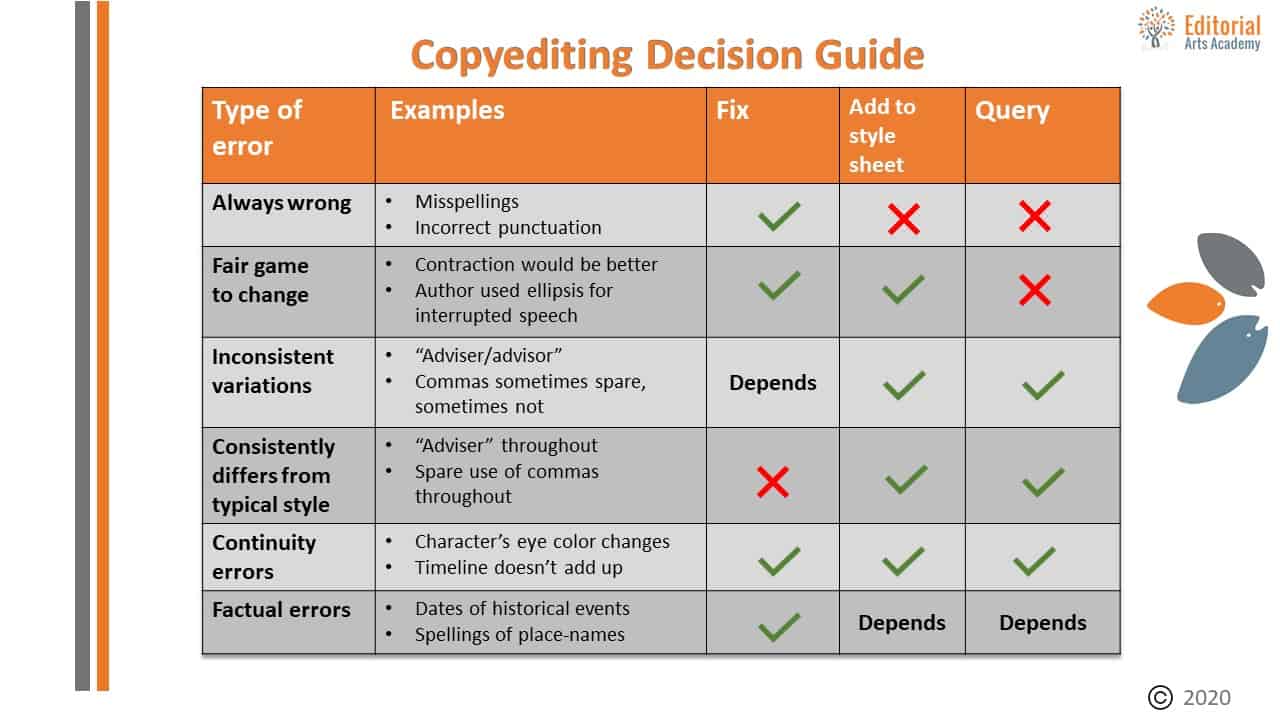
Let's break down the key actions based on this guide:
- Fix: Correct objective errors like typos, misspellings, and clear grammatical mistakes.
- Add to Style Sheet: Document any stylistic choice you make (e.g., spelling "adviser" instead of "advisor," using the serial comma) to ensure it's applied consistently throughout the manuscript. We covered this in detail two lessons ago.
- Query: Ask the author for clarification or a decision on issues you can't resolve yourself. This is essential for factual errors, logical contradictions, continuity problems, and ambiguous phrasing.
The art of the query is central to this process. A good query is:
- Clear: State the problem precisely.
- Concise: Get to the point quickly.
- Neutral: Present the issue without judgment.
- Constructive: If possible, suggest a solution or offer options.
For example:
- Weak Query: "This doesn't make sense."
- Strong Query: "Author, the text states here that manuscripts were 'cheap and plentiful,' but the previous paragraph suggests they were rare and expensive. Should we revise to clarify that they were scarce and valuable before the printing press?"
3. Practical Application: Copyediting an Excerpt
Now it's time to put this theory into practice. Below is an excerpt from a popular history manuscript about the printing press. It contains several intentional errors related to factual accuracy, logical consistency, and internal style.
Your task is to act as the copyeditor.
Excerpt:
The invention of mechanical movable type printing in Europe is widely credited to Johannes Gutenberg around 1440 in Strasbourg, Germany. His masterpiece, the Gutenberg Bible, was printed between 1452 and 1455. Each copy required the painstaking setting of over 300 distinct characters. Therefore, its publication immediately democratized knowledge, making books accessible to the masses overnight. Before Gutenberg, all books in Europe were hand-copied by scribes, a process that could take over a year for a single bible. These manuscripts were cheap and plentiful.
The new technology spread rapidly. By 1500, less than 30 years after the first Bible was printed, printing presses were operating throughout Europe, from Italy to England. The city of Venice, under the leadership of printers like Aldus Manutius, became a major hub. Manutius is famous for inventing italics and the concept of the paperback (which he called the enchiridion). His press, the Aldine Press, founded in 1495, was also the first to use the semi-colon.
The impact on science was equally profound. For example, Nicholas Copernicus's groundbreaking work, On the Revolutions of the Heavenly Spheres, was published in 1543, just before his death. This text, which argued for a heliocentric model of the universe, was printed, not handwritten. Because it was printed, its ideas couldn't be suppressed by the Church. It was widely read and accepted almost immediately, thanks to the hundreds of identical copies distributed across the continent. This is why Galileo was able to build on his work so easily a century later.
Exercise (20 minutes):
Please take the next 20 minutes to work through the following tasks.
- Identify Errors: Read the text carefully and identify at least five distinct errors. These could be factual inaccuracies, logical contradictions, or flawed reasoning.
- Draft Queries: Write two professional queries to the author to address the most significant issues you found.
- Build a Style Sheet: List three items you would add to a style sheet for this book, based on the excerpt.
After you've finished, continue to the next section for a detailed breakdown.
4. Debrief and Analysis
Let's review the excerpt and discuss the issues a copyeditor would flag.
Annotated Excerpt with Identified Issues:
The invention of mechanical movable type printing in Europe is widely credited to Johannes Gutenberg around 1440 in Strasbourg, Germany [1]. His masterpiece, the Gutenberg Bible, was printed between 1452 and 1455. Each copy required the painstaking setting of over 300 distinct characters [2]. Therefore, its publication immediately democratized knowledge, making books accessible to the masses overnight [3]. Before Gutenberg, all books in Europe were hand-copied by scribes, a process that could take over a year for a single bible [4]. These manuscripts were cheap and plentiful [5].
The new technology spread rapidly. By 1500, less than 30 years after the first Bible was printed [6], printing presses were operating throughout Europe, from Italy to England. The city of Venice, under the leadership of printers like Aldus Manutius, became a major hub. Manutius is famous for inventing italics and the concept of the paperback (which he called the enchiridion). His press, the Aldine Press, founded in 1495, was also the first to use the semi-colon [7].
The impact on science was equally profound. For example, Nicholas Copernicus's [8] groundbreaking work, On the Revolutions of the Heavenly Spheres, was published in 1543, just before his death. This text, which argued for a heliocentric model of the universe, was printed, not handwritten. Because it was printed, its ideas couldn't be suppressed by the Church. It was widely read and accepted almost immediately [9], thanks to the hundreds of identical copies distributed across the continent. This is why Galileo was able to build on his work so easily a century later.
Error Breakdown:
- Factual Error (Place): While Gutenberg did early work in Strasbourg, his press was perfected and the Bible was printed in Mainz.
- Factual Error (Number): The number of sorts (characters, punctuation, ligatures) was around 290, not over 300. This is a subtle but checkable fact.
- Logical Error (Flawed Reasoning/Exaggeration): The word "Therefore" implies a direct, immediate consequence. The impact was profound but gradual, not "overnight."
- Style Inconsistency: "Gutenberg Bible" is capitalized, but "bible" is not. A style guide (like The Chicago Manual of Style) and a style sheet would dictate consistent treatment.
- Logical Contradiction: Scribed manuscripts were extremely expensive and rare, not "cheap and plentiful." This statement directly contradicts the entire premise of the printing press's importance.
- Factual Error (Math/Timeline): 1500 is 45 years after 1455, not "less than 30 years."
- Style/Factual Nuance: Manutius popularized the semicolon, but he didn't invent it. The term is also "semicolon" (one word) in modern usage. This is a perfect style sheet item.
- Factual Error (Name): The standard spelling is "Nicolaus Copernicus."
- Logical & Factual Error: This is a major oversimplification. The Church did suppress the work (it was placed on the Index of Forbidden Books), and its acceptance was slow and highly contentious. Galileo's trial is prime evidence of this suppression, making the final sentence logically inconsistent with historical reality.
Sample Queries:
- Query for issue #5: "Author, this sentence claims scribed manuscripts were 'cheap and plentiful.' My understanding is that they were quite expensive and rare, which is why the printing press was so revolutionary. Should we revise to something like '...were painstakingly produced, making them rare and valuable'?"
- Query for issue #9: "Author, the claim that Copernicus's ideas 'couldn't be suppressed' and were 'accepted almost immediately' seems to conflict with the historical record, including the Church's placement of the book on the Index and Galileo's later trial. Could we nuance this to reflect the slower, more contentious adoption of the heliocentric model?"
Sample Style Sheet Entries:
The article 'Manuscript Editing' from BubbleCow provides excellent examples of how to build and use a style sheet. Compare your list to the examples in this resource.
Review the sections 'Copyediting, correctness and consistency,' 'House decisions upfront,' and 'Set standards before you touch a comma.' Note the specific examples provided for style sheet entries, like hyphenation, numbers, and common terms.
Based on our excerpt, a style sheet might include:
- Bible: Capitalize when referring to the holy book (e.g., the Bible, a Gutenberg Bible); lowercase when used generically (a process that could take a year for a single bible). Decision needed here based on style guide. CMOS 8.103 suggests lowercasing
bibleunless referring to a specific edition. Let's make that the house style. Sobibleis correct, but the copyeditor should note this decision. - semicolon: Use one word, not hyphenated "semi-colon."
- Numbers: Spell out numbers one through ninety-nine in narrative text; use numerals for 100 and above. (This would make "a century later" consistent with a style rule, though it's fine as is).
- Names: Nicolaus Copernicus (note spelling). Aldus Manutius.
Conclusion
Today we put our copyediting skills to the test, moving from isolated rules to a holistic analysis of a nonfiction text. You've seen how a single sentence can contain layers of issues—from factual accuracy to logical consistency—and you've practiced the essential editorial skills of identifying problems, drafting queries, and building a style sheet.
Key Takeaways:
- Copyediting nonfiction is an active process of interrogation, not a passive hunt for typos.
- Logical consistency ensures that the argument flows and that the text doesn't contradict itself at the sentence and paragraph level.
- Accuracy is paramount; a copyeditor serves as a crucial line of defense against factual errors, using the verification principles we've previously covered.
- The style sheet is your primary tool for ensuring internal consistency, which supports logical coherence.
- Professional, well-crafted queries are the primary mechanism for collaborating with an author to resolve complex issues of fact and logic.
Next Up:
We've now thoroughly examined the demands of nonfiction. In our next lesson, we will copyedit a fiction excerpt, balancing stylistic rules with authorial voice. This presents a different but equally fascinating challenge: how do you apply the rules of grammar and style while honoring the artistic intent and unique voice of a novelist?