Hello! Welcome to the fourth lesson in our module on the foundational principles of Raman scattering.
In our last lesson, we explored the classical model of the Raman effect. We saw how the interaction between the laser's electric field and a molecule's oscillating polarizability gives rise to Rayleigh, Stokes, and anti-Stokes scattering. The key takeaway was that Raman activity is dependent on the change in polarizability during a vibration, .
Today, we'll formalize this concept by comparing the selection rules for Raman and IR spectroscopy. We will see how molecular symmetry is the ultimate arbiter of whether a vibration is active in IR, Raman, both, or neither. This will culminate in understanding a powerful diagnostic tool: the Principle of Mutual Exclusion.
Your learning outcome for this lesson is to: Compare the selection rules for IR and Raman spectroscopy, explaining the principle of mutual exclusion.
By the end of this lesson, you will be able to use symmetry concepts to predict the spectroscopic activity of vibrational modes and understand why IR and Raman spectroscopy provide complementary information.
1. A Tale of Two Selection Rules
Your extensive experience with IR spectroscopy has made you very familiar with its fundamental selection rule. Let's place it side-by-side with the selection rule for Raman to highlight their distinct physical origins.
- Infrared (IR) Activity: A vibrational mode is IR active if it causes a change in the molecule's net dipole moment.
- Raman Activity: A vibrational mode is Raman active if it causes a change in the molecule's polarizability.
This fundamental difference is why the two techniques are often described as complementary. IR spectroscopy is most sensitive to vibrations of polar functional groups and asymmetric motions that create a transient dipole. Raman spectroscopy, on the other hand, excels at detecting vibrations of symmetric, non-polar bonds and molecular backbones, which involve significant changes in the electron cloud's shape and volume.
To deepen this understanding, let's review a concise explanation of these rules.
Introduction, Basic Theory and Principles
The following text from the book Modern Raman Spectroscopy clearly states the selection rules for both techniques and emphasizes their complementary nature.
Please read the short section titled 'The basic selection rule for Raman scattering' (which starts with 'The cyclohexane spectrum in Figure 1.3...'). This section directly contrasts the requirements for Raman and IR activity.
This complementarity is not just a theoretical curiosity; it has profound practical implications. For instance:
- The highly polar carbonyl group (C=O) produces a very strong absorption in the IR spectrum but is often weak in the Raman spectrum.
- Conversely, symmetric bonds like carbon-carbon double bonds (C=C) or the disulfide bond (-S-S-) in proteins produce strong Raman signals but are weak or silent in IR.
The spectra of the amino acid L-cysteine, shown below, provides an excellent real-world example of this principle.
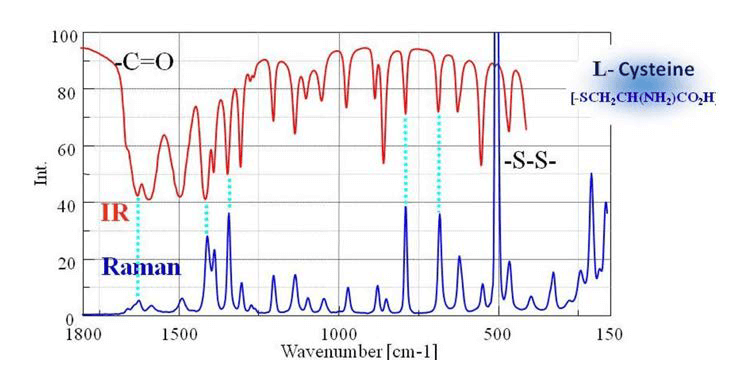
This complementary nature is a key advantage you will leverage when analyzing complex biological samples like fungi, where different techniques can highlight different components of the same system.
2. The Role of Symmetry
How can we predict whether a specific molecular vibration will be IR or Raman active? The answer lies in molecular symmetry. While we can intuitively use the polarizability ellipsoid as we did in the last lesson, a more rigorous and powerful method is to use group theory and character tables.
Given your background in physical chemistry, you have likely encountered character tables before. They provide a concise summary of a molecule's symmetry properties and are the key to predicting spectroscopic activity. The main idea is that each vibrational mode of a molecule transforms according to one of the symmetry species (or irreducible representations) of the molecule's point group.
The following video provides a practical guide on how to read a character table and use it to determine spectroscopic activity.
Symmetry: IR and Raman Spectroscopy
This video, "Symmetry: IR and Raman Spectroscopy" by Melissa Garrett, offers a clear walkthrough of a character table and explains the rules for determining IR and Raman activity.
Please watch the video from the beginning to 6:07 to understand the components of a character table. Then, skip to the section from 24:46 to 28:33, which explains how to use the functions in the last columns of the table to assign IR and Raman activity. The example used is water (C₂v point group).
As the video explained, the rules are straightforward:
- IR Activity: A vibrational mode is IR active if its symmetry species transforms in the same way as one of the Cartesian coordinates (x, y, or z). These appear in the last column of the character table. This is because the dipole moment is a vector, and its components lie along these axes.
- Raman Activity: A vibrational mode is Raman active if its symmetry species transforms in the same way as one of the quadratic functions (x², y², z², xy, xz, yz). These also appear in the last column. This is because polarizability is a second-rank tensor, which is described by these quadratic products.
If a mode's symmetry species has neither of these, it is "silent"—inactive in both IR and Raman. If it has both, as is the case for all vibrations of water, it is active in both. This brings us to a very important special case.
3. The Principle of Mutual Exclusion
What happens in highly symmetric molecules? Consider carbon dioxide (CO₂), a linear molecule with a center of symmetry. Water (C₂v symmetry) lacks a center of symmetry, whereas CO₂ (D∞h symmetry) has one. This single difference has a dramatic effect on their spectra.
This leads to the Principle of Mutual Exclusion:
For any molecule that has a center of inversion (i) as one of its symmetry elements, no vibrational mode can be active in both IR and Raman spectroscopy.
A mode will be either IR active or Raman active, but never both. Let's first read a clear definition of this rule.
Introduction, Basic Theory and Principles
The following text from Modern Raman Spectroscopy defines the mutual exclusion rule and its basis in centrosymmetry.
Please read the section titled 'The mutual exclusion rule', which starts with 'One specific class of molecule...'.
To understand why this rule holds, we need to consider how vibrations behave with respect to the inversion operation. In a centrosymmetric point group, every irreducible representation is classified based on its behavior under inversion:
- Gerade (g): Symmetric with respect to inversion (from the German for "even").
- Ungerade (u): Antisymmetric with respect to inversion (from the German for "odd").
The selection rules can now be stated with more precision:
- The dipole moment operator is ungerade. Therefore, only u vibrations can be IR active.
- The polarizability tensor is gerade. Therefore, only g vibrations can be Raman active.
Since a vibration cannot be both gerade and ungerade simultaneously, it cannot be both IR and Raman active in a centrosymmetric molecule. This is the origin of the mutual exclusion rule.
The text below provides a more formal explanation of this concept, which should align well with your physical chemistry background.
This article on the 'Rule of mutual exclusion' provides a rigorous but clear explanation based on the concepts of gerade and ungerade symmetry.
Please read the section 'Definition and theoretical basis' (the first paragraph) and the section 'Comparison of selection rules in IR and Raman spectroscopy'. These sections formalize the concepts of g/u symmetry and how they lead directly to the exclusion principle.
Example: Carbon Dioxide (CO₂)
CO₂ is the archetypal example of the mutual exclusion principle. It has a center of inversion and belongs to the D∞h point group. Let's analyze its vibrations.
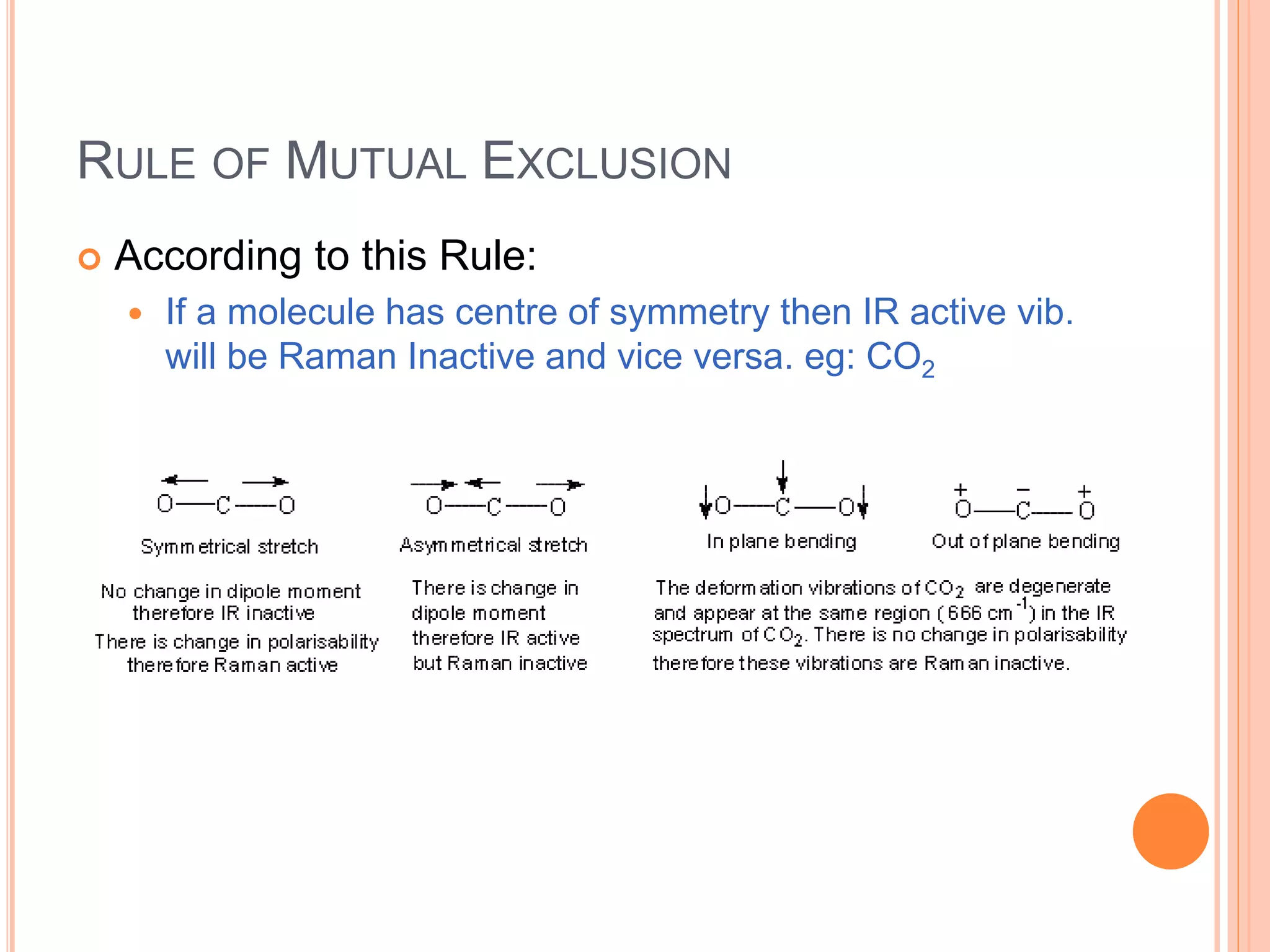
Let's break down the modes shown in the diagram using their symmetry labels:
-
Symmetric Stretch (ν₁): The two oxygen atoms move away from and toward the carbon atom in-phase. The molecule expands and contracts, changing its polarizability. This is a gerade motion. It causes no change in the dipole moment (which remains zero).
- Result: Raman active, IR inactive.
-
Asymmetric Stretch (ν₃): One oxygen moves in while the other moves out. This creates a large oscillating dipole moment along the molecular axis. This is an ungerade motion.
- Result: IR active, Raman inactive.
-
Bending (ν₂): The two oxygen atoms move perpendicular to the molecular axis. This also creates an oscillating dipole moment perpendicular to the bond axis. This is an ungerade motion. (There are two degenerate bending modes, in and out of the plane).
- Result: IR active, Raman inactive.
Thus, if you measure the IR and Raman spectra of CO₂, you will see completely different peaks, providing a perfect illustration of this powerful rule.
Conclusion
In this lesson, we have formalized the selection rules that govern vibrational spectroscopy and uncovered the crucial role of molecular symmetry.
Here are your key takeaways:
- The selection rules for IR and Raman are fundamentally different: IR requires a change in dipole moment, while Raman requires a change in polarizability.
- This difference makes the two techniques complementary, with each being sensitive to different types of molecular vibrations.
- Character tables are a practical tool to predict spectroscopic activity by checking if a mode's symmetry species corresponds to (x, y, z) for IR activity or (x², xy, etc.) for Raman activity.
- For molecules with a center of inversion, the Principle of Mutual Exclusion states that no vibration can be both IR and Raman active. This is because IR-active modes must have ungerade (u) symmetry, while Raman-active modes must have gerade (g) symmetry.
Looking Ahead
In our last two lessons, we described Raman scattering first through a classical model and now through symmetry rules. We've seen that the classical model predicts both Stokes and anti-Stokes scattering. In our next lesson, we will revisit these phenomena from a quantum mechanical perspective. We will use energy level diagrams to distinguish between Stokes, anti-Stokes, and Rayleigh scattering, providing a more complete physical picture. This will set the stage for the final lesson of this module, where we will explain why Stokes and anti-Stokes bands have such different intensities.