Hello! Welcome to your next lesson in our module on the UK's energy regulatory framework.
In the last lesson, we looked at the retail side of the electricity market—the rules that govern the companies that send you your bills. We saw that the price you pay is heavily influenced by the wholesale cost of electricity. Today, we're going to dive into one of the most important policies affecting that wholesale cost for renewable energy: Contracts for Difference (CfDs).
Our goal is to explain how Contracts for Difference (CfDs) support renewable energy deployment. By the end of this lesson, you'll understand what a CfD is, how the mechanism works, and why it has become the UK government's primary tool for building new wind farms, solar farms, and other low-carbon power sources.
1. The Challenge: Investing in Renewable Energy
Imagine you want to build a new offshore wind farm. It's a huge undertaking that can cost billions of pounds and take years to build. The main challenge for investors is uncertainty. Once the wind farm is built, its revenue will depend entirely on the wholesale price of electricity, which can fluctuate wildly from one hour to the next.
This price volatility creates significant financial risk, making it difficult to secure funding for such large, long-term projects. To overcome this hurdle and encourage investment in clean energy, the UK government introduced a policy as part of its Electricity Market Reform (EMR). The centrepiece of this reform is the Contract for Difference.
2. The Solution: How a Contract for Difference Works
A Contract for Difference is a long-term contract (typically 15-20 years) between an electricity generator and a government-owned company called the Low Carbon Contracts Company (LCCC). The purpose of the contract is to provide the generator with a stable, predictable price for the electricity it produces, removing the risk of market volatility.
To understand the basic principle, let's watch a short explanation.
Case Example on Energy Markets: the UK Power Market by Steve Thomas
This clip from a lecture by Steve Thomas for the Florence School of Regulation provides a concise, foundational explanation of the CfD mechanism.
Watch the segment from 16:56 to 18:20. Focus on the core idea: the generator sells its power at the market price, and the contract settles the difference based on an agreed contract price.
As the video explains, the CfD is a private financial contract that works alongside the physical electricity market. It operates based on three key elements.
Contracts for Difference: what are they and how do they work?
The article 'Contracts for Difference: what are they and how do they work?' from Empire Engineering clearly defines the key components of a CfD. We'll use it to break down the mechanism.
Please read the section 'How does the Contract for Difference scheme work?'. Focus on the definitions of the 'Strike price', 'Market reference price', and 'Difference payment'.
Let's summarise those key terms:
- Strike Price (£/MWh): This is the fixed price for electricity that is guaranteed to the generator for the duration of the contract. It's the most important number in the CfD.
- Market Reference Price (£/MWh): This is a measure of the average wholesale market price for electricity.
- Difference Payment: This is the payment made to settle the difference between the strike price and the market reference price.
The Two-Way Payment Mechanism
The genius of the CfD is that the payment can flow in two directions. This is what makes it a "two-way" contract:
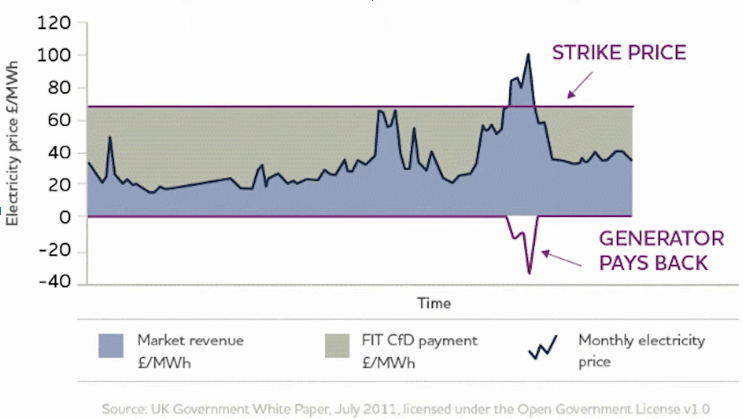
- When the Market Reference Price is below the Strike Price: The generator sells its electricity for a low price. To ensure they receive their guaranteed revenue, the LCCC pays the generator a top-up equal to the difference.
- When the Market Reference Price is above the Strike Price: The generator is making more money than expected from the market. In this case, the generator pays the difference back to the LCCC.
This payback mechanism is crucial because it protects consumers from high electricity prices. During the energy crisis of 2022-2023, generators on CfD contracts paid back billions of pounds, which was used to reduce customer bills.
The diagram below perfectly illustrates this process.
Test your understanding!
A solar farm has a CfD with a strike price of £50 per MWh. In a particular hour, the market reference price is £35 per MWh.
- Does money flow from the LCCC to the generator, or from the generator to the LCCC?
- How much is the difference payment per MWh?
Show answer
- Since the market price (£35) is below the strike price (£50), money flows from the LCCC to the generator.
- The payment is the difference between the two: £50 - £35 = £15 per MWh. This top-up ensures the solar farm effectively receives its guaranteed price of £50.
3. How CfDs Are Awarded: The Competitive Auction
CfD contracts are not simply handed out. They are awarded through competitive auctions known as Allocation Rounds (AR). This process is key to ensuring the scheme delivers value for money.
How do Allocation Rounds work, and what are CfDs?
This blog post from RenewableUK, an industry trade association, gives an excellent overview of the auction process.
Read the section titled 'How does a CfD auction work?'. Focus on understanding the role of sealed bids, the Administrative Strike Price (ASP), and how the winners are chosen.
Here is a summary of the auction process:
- Government sets the parameters: The government decides on a total budget for each auction and sets a maximum strike price it is willing to offer, known as the Administrative Strike Price (ASP).
- Developers submit sealed bids: Developers who want to build a new project (e.g., a wind farm) submit a sealed bid stating the lowest strike price they are willing to accept.
- Contracts are awarded to the cheapest bids: The bids are ranked from lowest to highest. Contracts are awarded to the cheapest projects first, continuing until the auction budget has been fully allocated.
This competitive pressure forces developers to be as efficient and innovative as possible to lower their costs and submit a winning bid. This process has been spectacularly successful, leading to a dramatic reduction in the costs of renewable energy, particularly offshore wind.
4. How CfDs Support Renewable Deployment
Now we can pull everything together to answer our main question. Contracts for Difference support the deployment of renewable energy in two primary ways:
-
Providing Investment Certainty: By guaranteeing a fixed revenue stream for 15-20 years, CfDs remove the biggest risk for investors: price volatility. This makes projects "bankable," meaning banks and other financial institutions are much more willing to provide the large, low-cost loans needed to fund construction. Without this certainty, most large-scale renewable projects would not be built.
-
Driving Down Costs through Competition: The auction-based system creates a highly competitive environment that has driven down the strike prices for renewables to record lows. Offshore wind, for example, is now one of the cheapest forms of new electricity generation in the UK, thanks largely to the cost reductions spurred by the CfD auctions.
Contracts for Difference: what are they and how do they work?
To reinforce these points, let's look at a final summary of the benefits.
Read the section 'What are the benefits of winning a Contract for Difference at auction?'. It succinctly summarises why this scheme is so attractive to developers.
Conclusion
Today we've unpacked the Contract for Difference scheme, the engine behind the UK's renewable energy boom. By providing long-term revenue stability and using competition to drive down costs, it has successfully unlocked billions of pounds of investment into clean energy infrastructure.
Key Takeaways:
- CfDs solve the problem of price volatility, which is a major barrier to investing in capital-intensive renewable energy projects.
- They are a two-way financial contract that guarantees a generator a fixed 'strike price'. The generator receives a top-up when market prices are low and pays back the difference when market prices are high.
- Contracts are awarded through competitive auctions (Allocation Rounds), which ensures value for money and has driven down the cost of renewables.
- The main benefit is de-risking investment, which allows developers to finance and build new renewable energy projects at scale.
Preview of the next lesson:
While CfDs support generation built within Great Britain, our electricity system is not an island. We are physically connected to neighbouring countries in Europe. In the next lesson, we will explore the role and physical operation of interconnectors and learn how electricity is traded across borders.