Hello! Welcome back to your course on the UK electrical grid.
In our last lesson, we saw how governor systems on generators provide Primary Control. After a fault, this is the grid's second line of defence. It's an automatic, local, and very fast active response that stops the grid frequency from falling into a dangerous zone. However, we ended with a stabilised grid running at a frequency slightly below the 50.0 Hz target—for example, at 49.85 Hz.
Today, we'll explore the crucial next step: how the system is brought back to normal. This lesson focuses on Secondary Control, a slower and centrally managed process. By the end of this session, you will be able to describe how Automatic Generation Control (AGC) is used by the System Operator to restore frequency to its target.
We will cover:
- Why the frequency must be returned to exactly 50.0 Hz.
- The role of the System Operator and the Automatic Generation Control (AGC) system.
- How AGC works in harmony with the primary control from governors to reset the grid.
- What happens when this secondary control is unavailable.
The Lingering Problem: A Stable but "Off-Target" Grid
Primary control has done its job: the immediate danger is over, and the grid is stable. But running continuously at 49.85 Hz is not acceptable for several reasons:
- Equipment Health: Many grid components and connected industrial machines are designed to run optimally at 50.0 Hz.
- Timekeeping: The grid's frequency is used as a reference for some electric clocks. A persistent low frequency would cause them to run slow.
- Reduced Headroom: The primary response has used up some of the generators' short-term capacity. If another fault happened now, there would be less ability to respond, making a blackout more likely.
Think back to our car analogy from the last lesson. The governors, using droop control, are like multiple engines all agreeing to slow down slightly to handle a steep hill. The convoy of cars is now stable, but moving at 58 mph instead of the 60 mph speed limit. The immediate crisis of stalling is averted, but the system isn't back to its desired state. Someone needs to coordinate a return to 60 mph.
In the power grid, this "someone" is the Electricity System Operator (ESO).
The Solution: Secondary Control and AGC
To correct this lingering frequency error, the ESO uses a slower, centralised system. This is called Secondary Control or Secondary Frequency Response. It is implemented using a computer system known as Automatic Generation Control (AGC).
While primary control is an automatic reflex built into every generator, secondary control is a deliberate, coordinated action managed by the ESO from its national control room.
The following graph shows where AGC fits into the timeline of an event. After the instantaneous inertial response and the fast primary (governor) response arrest the frequency drop, the slower AGC takes over to restore it.

How Automatic Generation Control Works
The AGC system works in a continuous loop to bring the frequency back to 50.0 Hz. Here's how:
- Measure: The ESO's control systems continuously measure the live grid frequency with high precision.
- Calculate Error: The AGC system calculates the deviation from the 50.0 Hz target. This deviation is a key part of what is known as the Area Control Error (ACE). A negative frequency deviation means there is not enough generation to meet demand.
- Send Instructions: Based on the ACE, the AGC system automatically sends electronic instructions to a select group of generators (or other service providers) across the country. These providers have contracts with the ESO to be on standby for this purpose.
- Adjust Power Output: The AGC instruction tells the generator's own control system to change its power output target. For a low-frequency event, it sends a "raise" signal, telling the generator to slowly ramp up its power production.
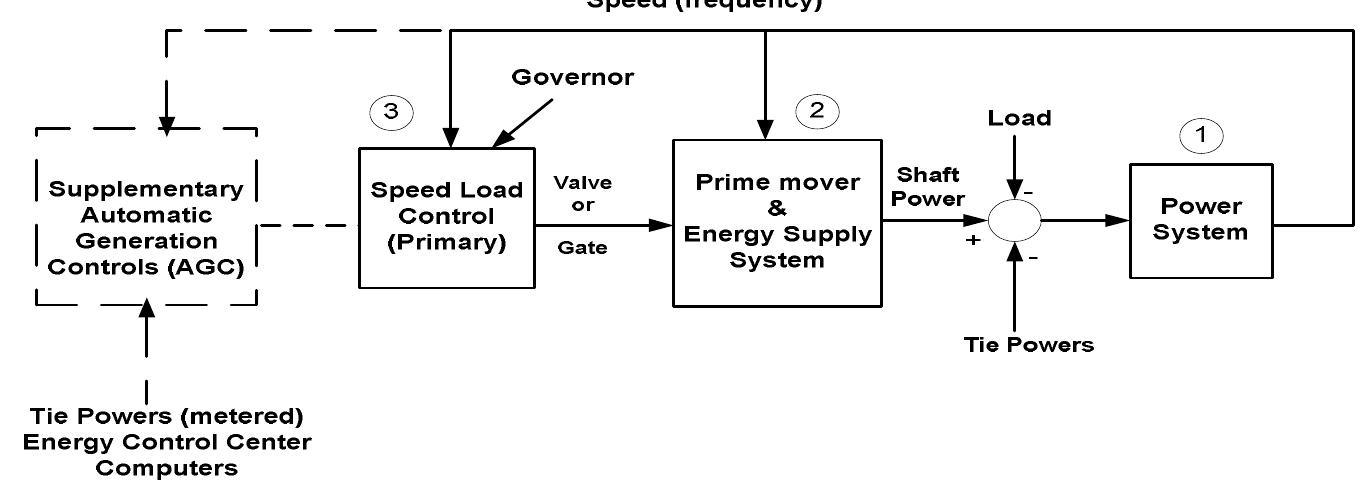
This process is fundamentally different from the governor's primary response. The governor reacts to a frequency it sees. The AGC gives the generator a new power level to target.
The block diagram below helps to visualise this. The "Primary Speed Load Control" is the governor's fast, local loop. The "Supplementary AGC" is the slower, external loop from the System Operator that provides a new setpoint to the primary controller.
This excellent resource from the Australian Energy Market Operator (AEMO) summarises the key differences between the frequency control stages.
Enduring primary frequency response requirements for the ...
The document 'Enduring primary frequency response requirements for the NEM' contains a table that clearly lays out the different stages of frequency control.
Please read the table titled 'Table 2 Stages within the frequency control chain'. Focus on the rows for 'Primary control' and 'Secondary control'. Note the differences in their roles, control actions, and typical response times. Then, read section 2.2.2, 'Secondary control loop', which explains that secondary control complements primary control over a slower timeframe.
As you read, you'll see that secondary control is described as a "remotely co-ordinated" system that acts over "tens of seconds to minutes" to correct errors, perfectly matching the process we've discussed.
Bringing the System Back to Normal
So, how does this AGC instruction restore order?
When the selected generators receive the "raise" signal from the AGC, they begin to ramp up their power output. This extra power flows into the grid, causing the frequency to slowly rise back towards 50.0 Hz.
What happens to all the other generators that provided the initial primary response? As the frequency recovers, their governors sense this. In line with their droop settings, they automatically begin to reduce their power output, returning to their original scheduled levels.
The process is complete when:
- The grid frequency is restored to exactly 50.0 Hz.
- The generators instructed by AGC are now providing the extra power needed to meet the system's demand.
- The generators that provided the initial primary response are back at their normal output, with their "shock absorbers" reset and ready for the next event.
Test your understanding!
A large power station unexpectedly trips offline, causing grid frequency to fall. Primary response from many generators stabilises the frequency at 49.85 Hz. The ESO's AGC system then sends "raise" signals to several other power stations.
What will happen to:
- The overall grid frequency?
- The power output of a generator that received the AGC "raise" signal?
- The power output of a generator that did not receive an AGC signal but did provide a primary response?
Show answer
- Grid Frequency: It will slowly rise from 49.85 Hz back towards the 50.0 Hz target.
- Generator with AGC signal: Its power output will increase as it follows the instruction from the System Operator.
- Generator without AGC signal: Its power output will automatically decrease back towards its original scheduled level as it sees the frequency recovering.
What Happens Without Secondary Control?
The seamless interaction between primary and secondary control is essential for a stable grid. A real-world event in Australia in January 2021 provides a perfect case study of what happens when secondary control is lost. The control system (SCADA) needed to send AGC signals failed for about an hour.
Enduring primary frequency response requirements for the ...
The appendix of the AEMO paper contains simulations and a real-world example showing the importance of secondary control.
First, look at Figure 18. Panel (b) shows ideal performance with both primary and secondary control. Panel (a) shows a simulation with primary control but no secondary control – notice how the frequency drifts away from 50 Hz. Then, read section A2.4, 'SCADA loss event'. This describes what happened in reality when AGC was unavailable. Look at Figure 25 to see how the frequency drifted upwards and stayed there until the system was restored.
This case study powerfully illustrates a key point made in the document: primary and secondary controls are not substitutes for each other. Primary control provides fast, local stability, but it cannot restore the frequency to its target. Only the slower, centralised secondary control can do that.
Conclusion: Key Takeaways
We have now covered the grid's third layer of defence, which completes the frequency restoration process.
- Primary control arrests a frequency fall but leaves a steady-state error, meaning the frequency is stable but not at the 50.0 Hz target.
- Secondary Control is a slower, centralised process managed by the Electricity System Operator (ESO) to restore the frequency to exactly 50.0 Hz.
- The ESO uses an Automatic Generation Control (AGC) system to send instructions to specific generators, telling them to change their power output.
- As these generators adjust their power, the frequency returns to normal, and the primary response from other generators is automatically withdrawn.
- This coordinated action ensures the grid is reset and ready to handle the next disturbance.
We now understand the mechanism the ESO uses to restore frequency. In the next lesson, we will look at the commercial arrangements behind this. We will explore the different frequency response services that the ESO procures from power stations and other providers to ensure it always has enough primary and secondary response capability on standby.