Hello! Welcome to the final lesson in our module on opportunities for improving the UK electricity system.
In our last two lessons, we've seen how digitalization is transforming key parts of the energy industry, from making wholesale markets more efficient to revolutionizing the accuracy of financial settlement with smart meters. Today, we turn our attention to one of the most significant hurdles in the UK's transition to clean energy: getting new projects physically connected to the grid.
Our learning outcome is to analyze how digitalization of the grid connection process can streamline applications, reduce delays, and increase transparency for new projects. We'll investigate why the old system created a massive bottleneck and how a combination of digital tools and new rules is designed to clear the logjam.
Part 1: The Grid Connection Bottleneck
To meet its climate targets, the UK needs to build and connect a huge number of new renewable energy projects, like solar farms, wind turbines, and large-scale batteries. The ambition is there, and so is the investment. However, for years, a major roadblock has been the process of getting a connection to the electricity grid.
Let's start by understanding the scale of this problem.
Fixing the UK’s grid connection backlog with Charles Deacon (Eclipse Power Solutions)
This clip from a discussion with Charles Deacon of Eclipse Power Solutions, a company that helps developers secure grid connections, perfectly sets the scene. It highlights the contradiction between the UK's clean energy goals and the bureaucratic crisis of the connection queue.
Please watch the first 2 minutes and 22 seconds of this video. Focus on how the narrator and guest describe the grid connection 'bottleneck' and its impact on the energy transition.
As the video explains, the grid connection queue became enormous. By some estimates, there was over 700 GW of projects waiting for a connection—far more capacity than the country could ever need, and multiples of what's required to run the grid today (peak demand is around 60 GW). This resulted in absurdly long waiting times, with some projects being given connection dates 10-15 years in the future, effectively making them unviable.
Part 2: The Old System: 'First Come, First Served'
Why did the queue get so long? The primary reason was the "first come, first served" model.
Under this system, any project could apply for a connection and, by paying a relatively small fee, secure a place in the queue. This place was held regardless of how viable the project was. The result was a queue clogged with speculative projects—some were little more than an idea on a map. These projects might never get planning permission or funding, but their spot in the queue could block other "shovel-ready" projects for years.
The network operators (like National Grid and the DNOs) were forced to study projects in the order they arrived, spending time and resources on projects that would likely never be built. This created a huge inefficiency and a major barrier to progress. It became clear that the system needed a radical overhaul.
Part 3: A New, Digital-First Approach to Connections
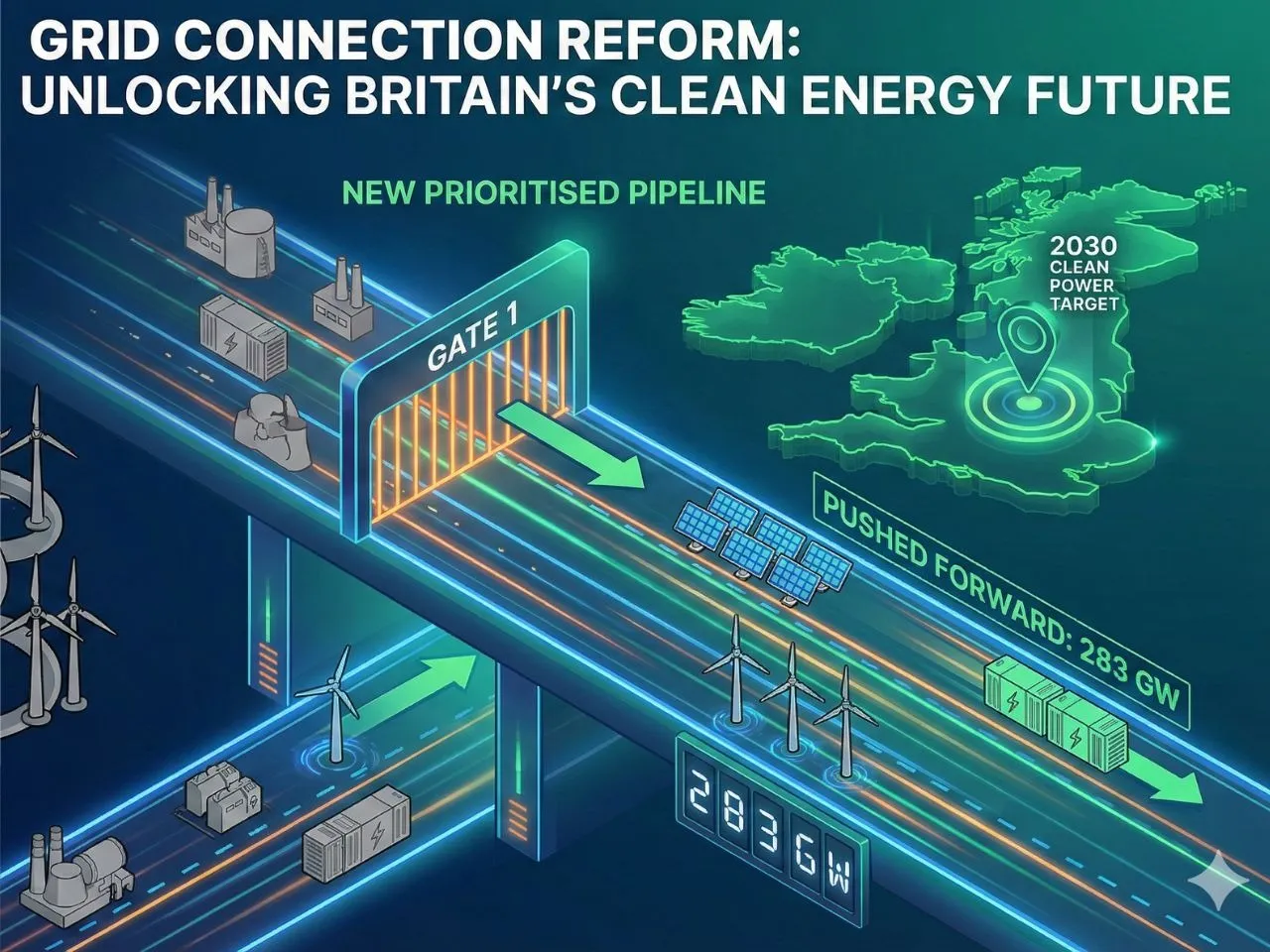
In response to this crisis, the National Energy System Operator (NESO), in collaboration with the regulator Ofgem, has implemented a major reform of the connections process. The new system moves away from "first come, first served" to a new mantra: "first ready, first connected."
This is achieved through a combination of a new gatekeeping system and digital tools to manage the process.
A. The Two-Gate System: Proving You're Ready
Instead of a single queue, the new process works like a two-stage filter to ensure only the most credible projects proceed.

Gate 1: The Entry Point
This is for projects that are still in the early stages of development. They can apply for a connection offer, but it will only be indicative. It gives them an idea of connection location and costs but does not give them a firm place in the queue. This allows developers to get initial information without blocking others.
Gate 2: Joining the Queue
This is the main entry point to the connection queue. To pass through Gate 2 and secure a firm connection date, a project must prove it is both ready and strategically aligned.
To understand what this means, let's look at a summary of the key criteria.
An ordered queue: reform of the GB grid connections process
This article from law firm Ashurst provides a detailed breakdown of the new rules. We won't read the whole thing, but we'll use its excellent summary tables to understand the Gate 2 criteria.
You don't need to read the full article. Instead, carefully study the tables in 'Figure 1: Gate 2 Readiness Criteria' and 'Figure 3: Routes to satisfying the Strategic Alignment Criteria'. For Readiness, note the two routes: the 'land route' and the 'planning route'. For Strategic Alignment, focus on the 'CP30 Action Plan' route. This shows that projects are prioritised if they help meet national targets for specific technologies (like solar, wind, or batteries).
By requiring projects to have secured land rights or submitted a formal planning application (Readiness) and to fit within national energy targets (Strategic Alignment), the system filters out speculative applications and prioritizes those that are most likely to be built and are most needed for the energy transition.
B. Digitalization: The NESO Connections Portal
A cornerstone of this reform is the move to a single, centralized digital platform: the NESO Connections Portal.
Previously, the application process was fragmented, with different network operators having their own procedures. The new portal digitalizes and standardizes the entire journey.
UK Grid Reform 2025: GW Renewables to Connect by 2030
This article from Kind Energy gives a great summary of the portal's function.
Please read the section 'The NESO Connections Portal Explained' to understand its key features and purpose.
The portal acts as a single front door for all transmission-level connection applications, creating a more efficient and transparent process for developers and network operators alike.
C. Backed by Long-Term Strategic Planning
This new connections process doesn't operate in a vacuum. It is informed by a much more strategic, long-term approach to planning the entire energy system, led by NESO.
Inside NESO: Designing the grid for net zero in the UK with Julian Leslie
To understand this bigger picture, let's hear from Julian Leslie, the Head of Strategic Planning at NESO. He explains how they are developing a 'Strategic Spatial Energy Plan' (SSEP) to map out where future energy assets should be located.
Watch this clip from 01:29 to 06:54. Focus on: What the Strategic Spatial Energy Plan (SSEP) is. How it's different from old planning methods (it looks at optimal locations for different technologies). The ultimate goal: to accelerate the delivery of infrastructure by planning it more intelligently upfront.
The SSEP provides the strategic blueprint that informs the "Strategic Alignment" criteria in the connections process. By planning where network infrastructure is needed decades in advance, NESO can ensure that the connections process prioritizes projects in the right places, further improving efficiency.
Part 4: Analysis of the Improvements
Now, let's tie this all together and analyze how these changes address the learning outcome.
1. Streamlining Applications
- Centralized Digital Platform: The NESO Connections Portal replaces a fragmented system of paper or email-based applications spread across multiple operators. It creates a single, standardized process for everyone, reducing administrative complexity and the potential for errors.
- Clear, Standardized Criteria: The Gate 2 criteria are publicly defined. Developers know exactly what they need to provide (land rights, planning status, etc.), making the application process more of a clear checklist and less of a subjective negotiation.
2. Reducing Delays
- Removing Speculative Projects: The two-gate system is the most powerful tool for reducing delays. By filtering out non-viable projects, it clears the queue and allows network operators to focus their efforts on studying and connecting projects that are actually going to be built.
- Proactive Network Planning: The long-term planning (SSEP) allows network operators to build grid reinforcements ahead of need. Instead of waiting for a connection application to trigger an upgrade, they can build the capacity in areas where they know future generation or demand will be located, speeding up final connection times.
3. Increasing Transparency
- Visible Queue: The centralized portal provides a single source of truth for the connections queue. Developers can see where they are and have more confidence in the process.
- Open Data: As mentioned in the first video by Charles Deacon, there is a major push towards making more grid data public. This allows developers to make better decisions about where to site their projects and enables third parties to propose innovative solutions, like shared connections.
- Clear Rules of the Game: The published criteria for Gate 2 and strategic alignment make the decision-making process transparent. It's clear why one project might be prioritized over another, based on its readiness and contribution to national targets.
Test your understanding!
You are a developer with a new, well-funded solar farm project. You have already secured the land rights for the site. Under the old 'first come, first served' system, you might have been stuck in the queue for 10 years behind a speculative project that only existed on paper.
How does the new 'Gate 2' system give your 'shovel-ready' project a better chance of connecting sooner? What two key things would you need to prove to pass through Gate 2?
Show answer
The new Gate 2 system gives my project a much better chance because it prioritizes 'ready' projects over speculative ones. I wouldn't be stuck behind a paper project anymore; if that project can't prove its viability, it gets removed from the queue, allowing me to move up.
To pass through Gate 2, I would need to prove:
- Readiness: I could do this via the 'land route' by showing evidence of my secured land rights for the project.
- Strategic Alignment: I would need to show that my solar project fits within the regional and national capacity targets for solar power set out in the government's clean power plan.
Conclusion
Today we've examined the critical bottleneck of grid connections and the sweeping reforms designed to fix it. We have moved from a simple but dysfunctional "first come, first served" system to a sophisticated, data-driven process.
Key Takeaways:
- The old grid connection process was a major barrier to the UK's energy transition, creating a massive queue of projects and decade-long delays.
- The system failed because it allowed speculative projects to block viable ones.
- The reform introduces a two-gate system that prioritizes projects that are proven to be ready (with land or planning) and strategically aligned with national energy goals.
- Digitalization is at the heart of the solution, with the NESO Connections Portal creating a streamlined, transparent, and centralized application process.
- This new approach is designed to reduce delays by clearing the queue, streamline applications through standardization, and increase transparency with clear rules and better data.
This lesson concludes our module on "Opportunities for System Improvement." We have seen how digitalization is not just a buzzword but a powerful force for change, unlocking efficiencies in wholesale markets, financial settlement, and now, the fundamental process of connecting the clean energy projects of the future.