Hello! Welcome to your next lesson in the UK electrical grids course.
In our last session, we focused on transformers and learned how to calculate changes in voltage and current. This is key to understanding how electricity is moved around the grid. Now, we'll take a step back and look at how a large portion of that electricity is generated in the first place.
This lesson addresses the learning outcome: Describe the shared energy conversion process in thermal power stations using the Rankine cycle (boiler, turbine, condenser).
We will explore the fundamental process that converts heat energy (from sources like coal, gas, or nuclear reactions) into the electrical energy that powers our homes and businesses. By the end of this 60-minute lesson, you will understand the four key stages of this process and the role of each major component.
1. From Heat to Electricity: The Thermal Power Station
A thermal power station is essentially a large-scale factory that converts heat into electricity. While the source of the heat can vary—burning fossil fuels, nuclear fission—the method for turning that heat into rotational energy to spin a generator is remarkably similar across all of them.
This shared process is a thermodynamic cycle known as the Rankine cycle. It uses a working fluid, almost always water, in a continuous closed loop to transfer energy.
To get a complete visual overview of how these components work together, let's watch a video that animates the entire process.
How does a Thermal power plant work?
This video from Sabin Civil Engineering provides a clear, step-by-step animation of a coal-based thermal power plant, which is a perfect example of the Rankine cycle in action.
Watch the video from 00:30 to 04:01. As you watch, focus on the journey of the water/steam through the four main components: the turbine, the condenser, the pump, and the boiler.
2. The Four Stages of the Rankine Cycle
As you saw in the video, the Rankine cycle consists of four main processes, each happening in a specific piece of equipment. Let's break them down one by one.
The diagram below shows these four components in a simplified loop. We will refer to it as we go through each stage.
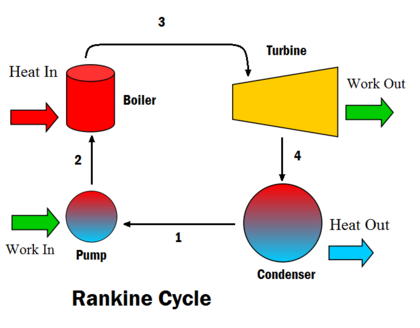
To solidify your understanding, the following reading provides a concise summary of these four steps.
This article from Energy Education clearly lists the four main steps of the Rankine Cycle. It's a great text-based summary to complement the video you just watched.
Please read the short section titled 'Steps in the Rankine Cycle'. Notice how it lists the pump, boiler, turbine, and condenser in order.
Now, let's detail what happens at each stage.
Stage 1: Pumping the Water (Pump)
- Process: The cycle begins with liquid water. A powerful pump takes this water and significantly increases its pressure.
- Purpose: The water needs to be at a very high pressure before it enters the boiler. This allows it to be heated to a very high temperature without boiling immediately, storing a huge amount of energy.
- Energy Conversion: The pump consumes a small amount of electrical energy to do the mechanical work of pressurizing the water.
Stage 2: Creating High-Pressure Steam (Boiler)
- Process: The high-pressure liquid water flows into a boiler. Here, a massive amount of heat is added (from burning coal, gas, etc.). This heat turns the water into high-pressure, high-temperature steam.
- Purpose: This is the main energy input for the cycle. The steam now holds the thermal energy from the fuel in a form that can be used to do work.
- Energy Conversion: Chemical energy (in fuel) is converted into thermal energy (heat), which is then transferred to the water to create steam.
Stage 3: Spinning the Turbine (Turbine)
- Process: The high-pressure steam is directed at the blades of a turbine, causing it to spin at high speed. As the steam expands and pushes past the turbine blades, it rapidly loses pressure and temperature.
- Purpose: This is where the useful work is done. The turbine is connected by a shaft to a generator. As the turbine spins, so does the generator, producing electricity.
- Energy Conversion: The thermal energy stored in the steam is converted into mechanical (rotational) energy in the turbine. The generator then converts this mechanical energy into electrical energy.
Stage 4: Turning Steam Back to Water (Condenser)
- Process: After leaving the turbine, the low-pressure steam enters a condenser. Inside the condenser are thousands of tubes with cool water flowing through them (often from a nearby river or cooling towers). The steam comes into contact with the outside of these cold tubes, which causes it to rapidly cool and condense back into liquid water.
- Purpose: This step is crucial for efficiency. It is far easier and requires much less energy to pump a liquid (water) than to compress a gas (steam). By turning the steam back into water, the cycle can start again with the pump.
- Energy Conversion: The remaining thermal energy in the steam (waste heat) is transferred to the cooling water. This is the heat you see leaving a power station's cooling towers as steam clouds.
This entire process forms a closed loop, with the same water being circulated, boiled, expanded, and condensed over and over again to produce a continuous supply of electricity.
3. Check Your Understanding
To ensure you've grasped the sequence and function of each component, try this matching exercise.
Match the component with its primary function in the Rankine cycle:
| Component | Function |
|---|---|
| 1. Boiler | A. Converts the thermal energy of steam into mechanical rotational energy. |
| 2. Turbine | B. Uses heat from a fuel source to turn high-pressure water into steam. |
| 3. Condenser | C. Increases the pressure of the liquid water. |
| 4. Pump | D. Cools low-pressure steam, turning it back into liquid water. |
Click here to see the correct matches
- 1. Boiler -> B. Uses heat from a fuel source to turn high-pressure water into steam.
- 2. Turbine -> A. Converts the thermal energy of steam into mechanical rotational energy.
- 3. Condenser -> D. Cools low-pressure steam, turning it back into liquid water.
- 4. Pump -> C. Increases the pressure of the liquid water.
Conclusion
In this lesson, we've unpacked the fundamental process that powers a vast portion of the world's electricity generation.
Key Takeaways:
- Thermal power stations (like coal, gas, and nuclear) share a common energy conversion process called the Rankine Cycle.
- The cycle uses water in a closed loop and has four main stages:
- Pump: Pressurizes liquid water.
- Boiler: Adds heat to create high-pressure steam.
- Turbine: Steam expands to spin the turbine, which drives a generator.
- Condenser: Cools the steam back into liquid water to repeat the cycle.
- The core energy conversion is from heat -> mechanical rotation -> electricity.
Preview of the next lesson:
Now that you understand the shared process of the Rankine cycle, our next lesson will focus on the differences. We will compare the heat source, efficiency, and operational characteristics of coal, gas (CCGT), and nuclear power stations.