Hello! Welcome back to our course on the UK electrical grids.
In our last lesson, we explored the historical divide between Half-Hourly (HH) and Non-Half-Hourly (NHH) metering. We saw that while large consumers provided detailed 30-minute usage data essential for market settlement, smaller consumers relied on estimated readings, leading to a complex and lengthy reconciliation process.
This lesson focuses on the technology that is revolutionizing this landscape. Our goal is to describe the role of smart metering infrastructure (SMETS meters, DCC) in modernizing energy data collection. We will uncover what a "smart meter" actually is, examine the components both in your home and across the national network, and understand how they work together to provide near-real-time data for everyone.
1. From Manual Readings to Smart Data
For decades, getting data from most meters meant sending a person to read a dial. This evolved into Automatic Meter Reading (AMR) for some businesses, but it was largely a one-way street. Smart meters represent a fundamental leap forward.
To understand what makes them different, let's look at their core capabilities.
The UK Smart Meter Data Ecosystem - Lost Boy
The article 'The UK Smart Meter Data Ecosystem' by Leigh Dodds provides an excellent introduction to what a smart meter is and how it improves upon older technologies.
Please read the sections 'Smart meters and meter readings' and 'The smart meter network infrastructure'. Focus on the differences between AMR and smart meters, the concept of two-way communication, and the distinction between SMETS-1 and SMETS-2 meters.
As the reading highlights, the key advancements of smart meters are:
- Two-Way Communication: Unlike older meters, the energy supplier can send information to the meter as well as receive data from it. This allows for remote tariff updates, prepayment top-ups, and diagnostics.
- Frequent, Automatic Data: Smart meters are designed to record and transmit data automatically at regular intervals, with half-hourly readings being the standard. This eliminates the need for manual readings and provides a detailed picture of energy use, just like the HH meters used by large businesses.
- A Shared Network (SMETS-2): The first generation of meters (SMETS-1) were often tied to a specific supplier's communication network. This meant if you switched suppliers, your meter might go "dumb" and lose its smart functionality. The second generation, SMETS-2 (Smart Metering Equipment Technical Specifications 2), solves this by requiring all meters to use a single, shared national communications network. This ensures interoperability and is crucial for a truly modern system.
2. The Smart Metering System in Your Home
A smart metering installation isn't just one device; it's a small network of connected components within your home. This is often called the Home Area Network (HAN).

The main components are:
- Smart Electricity Meter: Measures your electricity usage.
- Smart Gas Meter: Measures your gas usage (if you have a gas supply). It's typically battery-powered.
- Communications Hub (Comms Hub): This is the brain of the system. It's often physically integrated into the electricity meter. It gathers data from the gas and electricity meters and communicates with both the In-Home Display and the external national network.
- In-Home Display (IHD): A small screen that shows you your energy consumption in near-real-time, often translated into pounds and pence. It receives data from the Comms Hub every few seconds for electricity, helping you understand your usage patterns.
These devices in the HAN typically communicate wirelessly using a low-power protocol called Zigbee.
3. The National Infrastructure: The Data Communications Company (DCC)
Getting the data out of millions of homes and securely to the correct energy suppliers requires a massive, reliable, and secure national infrastructure. This is the role of the Data Communications Company (DCC).
The DCC is a licensed company that operates the UK's national smart meter network. It acts as a central, secure hub for all smart meter messages. It doesn't belong to any single energy supplier; instead, it provides a service to all of them, as well as to network operators and other authorised parties.
This diagram illustrates the full end-to-end data flow.
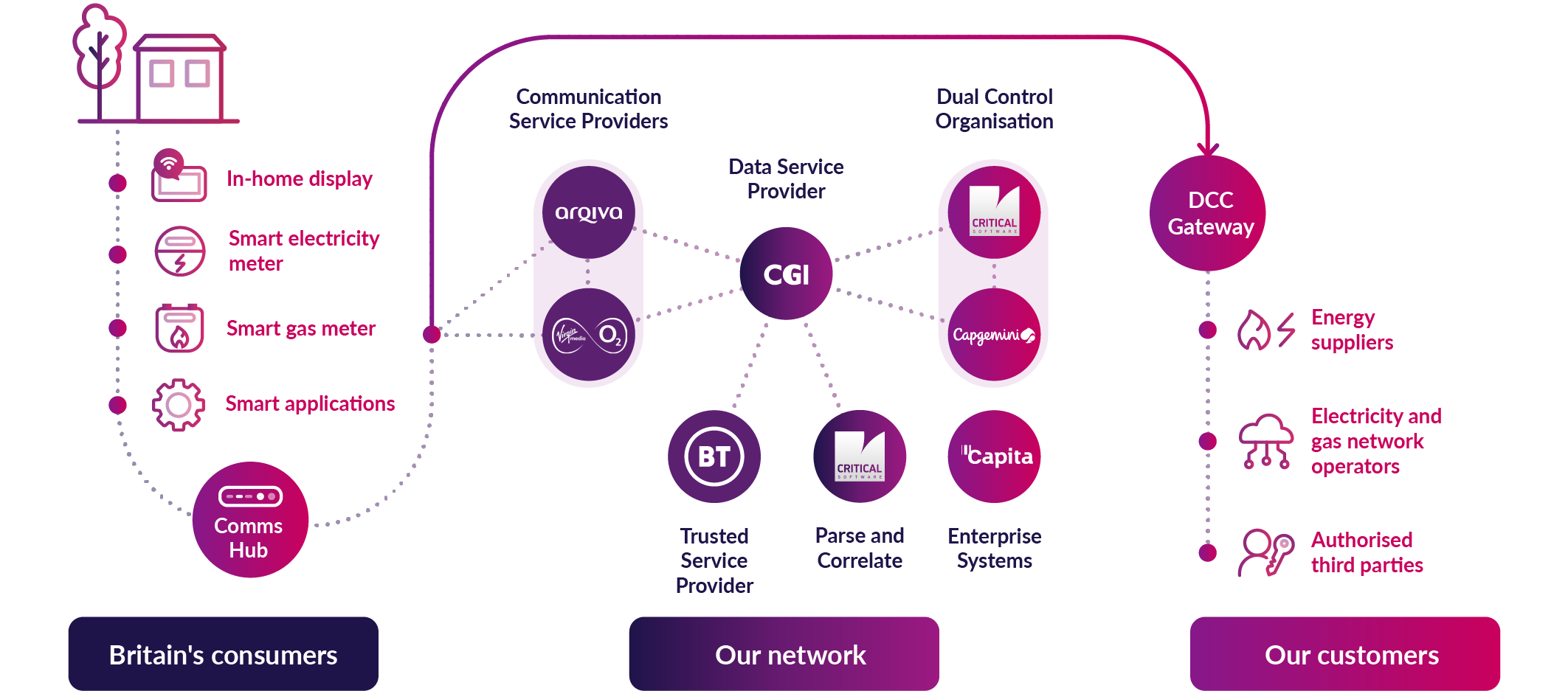
To understand the key players in this system, let's consult a guide on how it all fits together.
How do UK Smart Meters work and who runs them?
The article 'How do UK Smart Meters work and who runs them?' from Smartme.co.uk provides a clear breakdown of the DCC and the companies it works with to run the network.
Please read the sections 'End to End Process', 'Data Communications Company', and 'DCC Service Users'. Focus on what the DCC is and which companies it subcontracts to provide the communication services.
Here's a summary of the data journey from your meter to your supplier:
- Measurement: Your smart meters record your energy usage every half hour.
- Home Area Network (HAN): The meter sends this data to the Comms Hub.
- Wide Area Network (WAN): The Comms Hub sends the data over a long-range wireless network (the WAN) to the DCC. This network is operated by DCC's subcontractors: Arqiva in the north of Great Britain and Virgin Media O2 (Telefónica) in the central and southern regions.
- DCC Processing: The DCC receives the message, processes it via its Data Service Provider (CGI), and ensures it is secure.
- Delivery: The DCC securely forwards the message to the intended recipient, known as a DCC Service User. This is most often your energy supplier, who uses the data for billing. It could also be your local Distribution Network Operator (DNO), who might use the data to help manage the local grid.
The key takeaway is that the DCC provides a single, secure, and standardized pipeline for data, solving the interoperability problems of the SMETS-1 era and creating a platform for a modern, data-driven energy system.
Test your understanding!
A customer with a SMETS-2 meter lives in Scotland and decides to switch their energy supplier from Supplier A to Supplier B.
- Does the customer need a new smart meter? Why or why not?
- Which company is responsible for physically transmitting the meter's data over the Wide Area Network in their region?
- What is the name of the central organization that ensures the data is routed securely from the meter to the new supplier (Supplier B)?
Show answer
- No, the customer does not need a new meter. Because it's a SMETS-2 meter, it uses the shared national communications network, so it will continue to work seamlessly after switching suppliers.
- In Scotland (the 'north' region), Arqiva is the Communication Service Provider responsible for the WAN.
- The Data Communications Company (DCC) is the central organization that manages the network and ensures data is routed securely to the correct service user (in this case, the new supplier).
Conclusion
In this lesson, we have seen how smart metering infrastructure is fundamentally modernizing energy data collection in the UK. By moving away from manual readings and proprietary systems, it creates a unified, digital foundation for the entire energy market.
Key Takeaways:
- Smart Meters (SMETS-2) provide automatic, frequent (half-hourly) data and two-way communication over a shared national network, ensuring they work even when customers switch suppliers.
- The in-home system consists of the meters, a Communications Hub, and an In-Home Display, connected via a Home Area Network (HAN).
- The Data Communications Company (DCC) is the licensed central body that operates the national smart meter network, acting as a secure gateway between meters and authorised data users like suppliers and network operators.
- This entire infrastructure effectively gives every home and small business the same data capabilities previously reserved for large industrial consumers, paving the way for a more efficient and flexible grid.
Preview of the next lesson:
Now that we understand the technology that enables half-hourly data collection for everyone, our next lesson will examine the profound impact this has on the market itself. We will "Analyze how digitalization of the electricity settlement process can reduce inefficiencies and improve data accuracy," exploring the industry-wide shift known as Market-Wide Half-Hourly Settlement.