Hello! Welcome to the first lesson in Module 4: Transmission System Infrastructure.
In the previous modules, we've covered the fundamentals of AC power and how electricity is generated. Now, we'll begin to explore how that power gets from the power stations to our communities.
This lesson focuses on the first step of that journey: the high-voltage transmission network. Our goal is to address the following learning outcome:
"Describe the structure of the UK transmission network and voltage levels used (400kV, 275kV, 132kV)."
We will look at the transmission network as the 'motorway system' for electricity, designed to move huge amounts of power efficiently across the country. We'll identify its key components, its geographical layout, and the different voltage levels that form its backbone.
Let's begin by looking at the big picture.
1. The Grid: From Power Station to Plug
The electricity system that powers our country can be broken down into four main stages:
- Generation: Power stations create electricity.
- Transmission: High-voltage lines carry large amounts of power over long distances.
- Distribution: Lower-voltage local networks deliver power to specific areas.
- Consumption: Homes and businesses use the electricity.
This lesson focuses on the second stage: transmission.
Take a look at the diagram below. It provides a great overview of this entire process and highlights where the different voltage levels fit in.
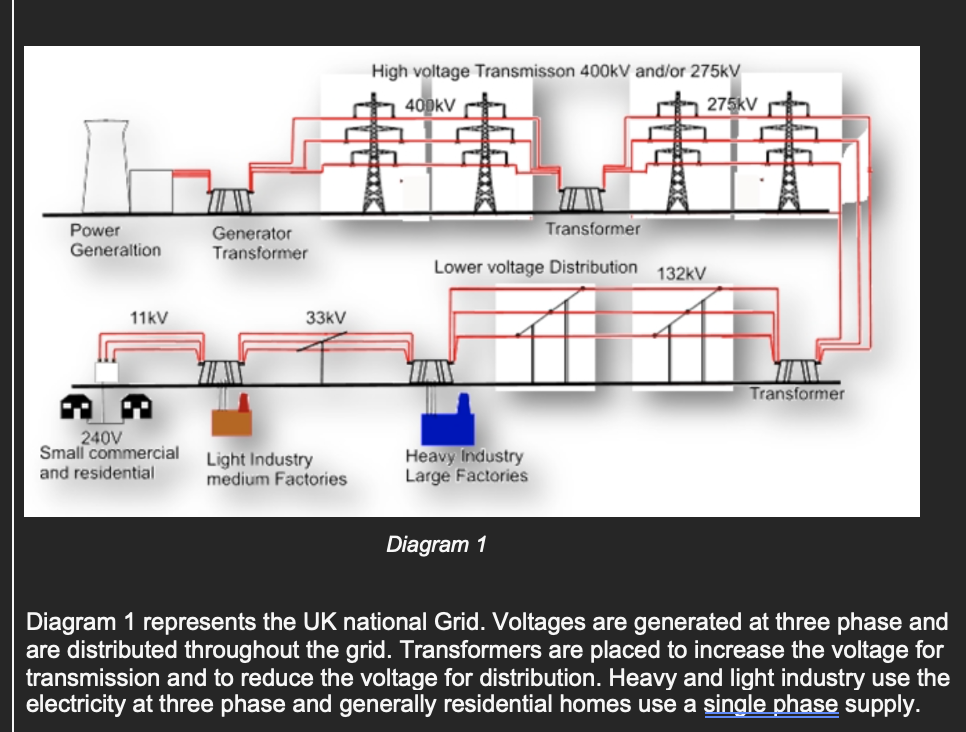
As you can see, the transmission network uses the highest voltages. Let's explore why.
2. What is the Transmission Network?
The term "National Grid" can be a bit confusing. It can refer to the entire electricity system, or to a specific company. For our purposes, we'll define the transmission network as the high-voltage backbone of Great Britain's electricity system.
To get a clear definition and understand its geographical scope, please read the short introductory sections of the following article.
The National Grid - What is it really, and who owns it?
This article from Business Energy Deals clearly defines the National Grid and explains what geographical areas it covers.
Please read the sections 'What is the National Grid?' and the FAQ 'Is Northern Ireland part of the National Grid?'. Focus on understanding the difference between the transmission and distribution networks and which countries make up the GB grid.
As you've just read, the transmission network covers England, Wales, and Scotland. Northern Ireland has its own separate system, which is integrated with the grid in the Republic of Ireland.
The transmission network's job is to take the power generated at large power stations and transport it efficiently across the country to major substations, where it is then passed on to the local distribution networks.
3. The Structure and Voltage Levels of the Transmission Network
The structure of the transmission network is defined by its physical components and, most importantly, by its operating voltages.
To get a good overview of these elements, let's watch a video that walks through how the grid works.
This video from 'The Electric Brit' provides an excellent introduction to the physical components of the grid and the different voltage levels used.
Please watch the following three segments: 'Introduction to the National Grid and its Components' (00:34 - 02:37) 'Voltage Levels in the UK Grid' (05:34 - 06:00) 'Structure of the UK Electrical Grid' (20:11 - 21:33) Pay close attention to the names of the key components (towers, conductors, substations) and the specific transmission voltages mentioned (400kV, 275kV, 132kV).
Key Components and Voltages
From the video, we can summarise the key points:
- Physical Components: The most visible parts of the transmission network are the large steel lattice towers (often called pylons) that support the high-voltage wires (called conductors). These lines connect at substations, which are crucial for changing voltage levels and directing the flow of power.
- Voltage Levels: The transmission network in Great Britain primarily operates at three main voltage levels:
- 400,000 volts (400 kV)
- 275,000 volts (275 kV)
- 132,000 volts (132 kV)
The "k" in kV stands for "kilo," meaning thousand. So, 400 kV is 400,000 volts—over 1,700 times the 230V supply in our homes!
The "Supergrid": A Brief History
These voltage levels weren't chosen at random; they evolved over time as the country's demand for electricity grew.
- The Original Grid (132 kV): The first nationwide grid, built in the 1930s, operated at 132 kV. This was a monumental achievement that connected the country's most efficient power stations.
- The Supergrid (275 kV and 400 kV): By the 1950s and 60s, demand had grown so much that a more powerful network was needed. This led to the creation of the "Supergrid", which involved building new lines at 275 kV and later upgrading and adding lines at 400 kV.
The 400 kV and 275 kV systems form the main arteries of today's transmission network, responsible for bulk power transfer across the country. The 132 kV network is still a crucial part of the system, particularly in Scotland, though in England and Wales it is now mostly considered part of the distribution network.
To learn more about this historical development, please read the following section from Wikipedia.
This Wikipedia article provides a concise history of how the National Grid developed and why the voltage levels were increased over time.
Read the 'History' section. Focus on the reasons for the creation of the first 132 kV grid and the subsequent upgrades to the 275 kV and 400 kV 'Supergrid'.
Why Use Such High Voltages?
You might be wondering why we go to the trouble of increasing the voltage to such high levels, only to reduce it again later. The reason is efficiency.
Electricity loses energy as heat when it flows through a conductor. This energy loss is proportional to the square of the current ($P_{loss} = I^2R$).
For a given amount of power, if you increase the voltage, you can decrease the current. A lower current means significantly lower energy losses during transmission. We will explore the physics and calculations behind this in our next lesson, but the key principle is:
High Voltage = Low Current = Low Losses
This makes it much more efficient to transmit power over the long distances from power stations to towns and cities.
4. Scale of the Transmission Network
The transmission network is vast. To give you an idea of its scale, let's look at the length of the lines that make up the network.
The table below, based on data from several sources including National Grid, shows the approximate length of high-voltage cables operated by the different Transmission Network Operators (TNOs) in Great Britain.
| Asset | England & Wales (National Grid) | Southern Scotland (SP Energy Networks) | Northern Scotland (SSE) |
|---|---|---|---|
| 400 kV Overhead Line | ~7,200 km | ~600 km | ~1,700 km |
| 275 kV Overhead Line | ~2,200 km | ~600 km | ~200 km |
| 132 kV Overhead Line | (Part of Distribution) | ~3,100 km | ~4,700 km |
Note: These figures are approximate and change as the network is updated. They clearly show that 400kV is the dominant voltage in England and Wales, while 132kV lines form a large part of the transmission network in Scotland.
Conclusion
In this lesson, we've established a foundational understanding of the UK's high-voltage electricity transmission network.
Here are the key takeaways:
- The transmission network is the high-voltage "motorway" that transports electricity in bulk from generators to local distribution systems.
- It covers Great Britain (England, Scotland, and Wales), but not Northern Ireland.
- Its main physical components are towers (pylons), conductors, and substations.
- The primary transmission voltages are 400 kV and 275 kV (the "Supergrid"), with 132 kV also forming a key part of the transmission system, especially in Scotland.
- High voltages are used to minimise energy losses by allowing power to be transmitted with a lower electrical current.
Preview of the Next Lesson
Now that we have a high-level view of the network's structure, our next lesson will zoom in on the lines themselves. We will explore the fundamental electrical properties of transmission lines—resistance, inductance, and capacitance—and see how they affect the flow of power.