Welcome to your first lesson. Your goal is to prepare for the Loksewa examinations for the Nayab Subba and Section Officer positions. This journey can seem daunting at first, given the breadth of the syllabus. This initial lesson is designed to give you a clear and structured map of the entire examination process. By the end of our session, you will be able to identify the exam pattern, marking scheme, and time allocation for both positions. Understanding this framework is the crucial first step, as it will shape your entire study strategy, helping you allocate your time effectively and know precisely what is expected of you at each stage.
Let's begin by deconstructing the structure of the Nayab Subba (Non-gazetted First Class) examination.
The Nayab Subba (NaSu) Examination Structure
The Nayab Subba exam is conducted in three distinct stages. Think of it as a multi-layered filter designed to select the most suitable candidates.
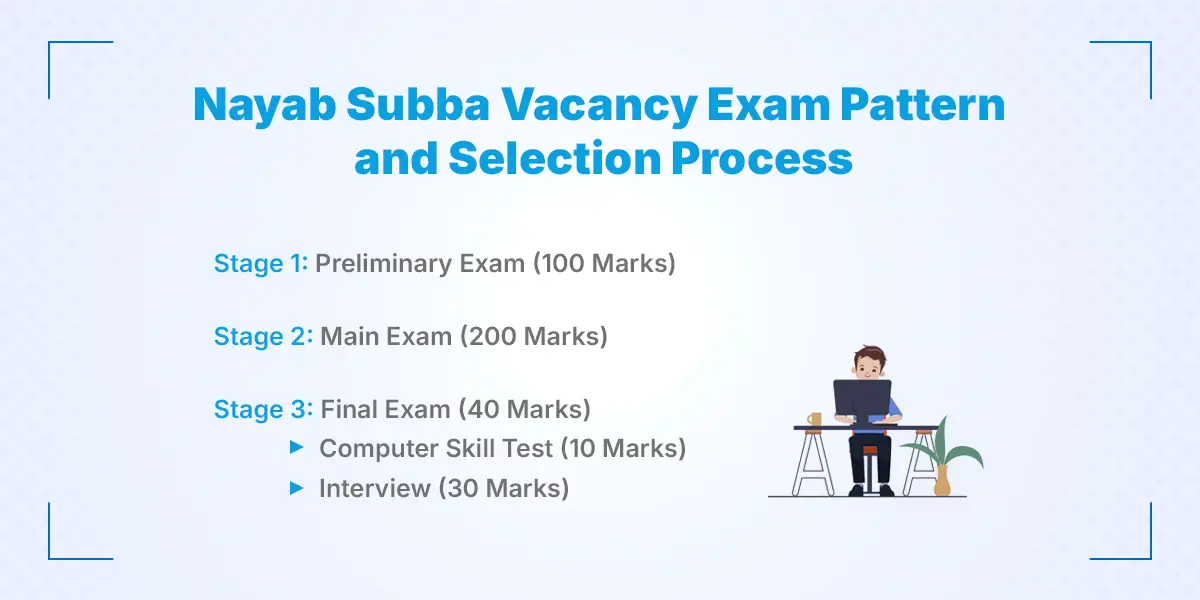
As you can see, the process involves a Preliminary Exam, a Main Exam, and a Final Exam. Now, let's explore the specific details of each stage. For this, we will refer to the official syllabus outline provided by the Public Service Commission (PSC).
Lok Sewa Aayog Nayab Subba Syllabus 2081
Please read the "Examination Scheme" section of this document. It details the structure of all three stages of the exam.
Start by reviewing the overall outline. Then, focus on the details provided in Table (1) for the preliminary exam. Next, examine Table (2) which describes the main exam papers. Finally, look at the breakdown of the final stage.
Based on the syllabus, let's summarize the key details for each stage of the Nayab Subba exam.
Stage 1: Preliminary Examination (First Paper)
This is the initial screening test. Its sole purpose is to select a smaller pool of candidates for the main examination. The marks obtained here are not added to your final score; you simply need to pass to qualify for the next stage.
- Subject: General Knowledge & General Mental Ability Test
- Format: Objective (Multiple Choice Questions - MCQ)
- Total Marks: 100
- Question Structure: 50 questions × 2 marks each
- Pass Marks: 45
- Time: 45 minutes
Stage 2: Main (Written) Examination
Candidates who pass the preliminary exam move on to this stage. The main exam consists of two subjective papers that test your depth of knowledge and writing skills. The marks from these papers are crucial for your final ranking.
-
Paper II: Contemporary Studies & Public Service Management
- Format: Subjective (Short & Long Answers)
- Total Marks: 100
- Question Structure: 14 questions × 5 marks & 3 questions × 10 marks
- Time: 2 hours 30 minutes
-
Paper III: Service-Group Related Subject
- Format: Subjective (Short & Long Answers)
- Total Marks: 100
- Time: 2 hours 30 minutes
- Note: The specific subject and question structure for this paper depend on the service group you choose (e.g., Administration, Audit).
Stage 3: Final Stage
This is the last stage for candidates who have successfully cleared the main written exam. It assesses your practical skills and personality.
- Computer Skill Test:
- Format: Practical
- Total Marks: 10
- Time: 15 minutes
- Interview:
- Format: Oral
- Total Marks: 30
Your Bachelor in Information Management (BIM) provides a strong foundation for the computer skill test. Your preparation will focus on adapting your existing knowledge to the specific tasks and time constraints of the exam, such as Nepali typing (Devanagari) and standard office software tasks.
The Section Officer (SO) Examination Structure
Now, let's turn our attention to the Section Officer (Gazetted Third Class) exam. While it also follows a multi-stage process, it is more extensive than the NaSu exam, reflecting the greater responsibilities of the position. We will focus on the structure for the Administrative Service, which is your target.
Lok Sewa Aayog Section Officer (Sakha Adhikrit) Syllabus 2081
Please review the "Examination Scheme" in this syllabus. It outlines the complete structure for the Section Officer exam.
Begin with the overall Syllabus Outline. Then, in Table (1), examine the details of the preliminary exam, paying attention to the breakdown of the Administrative Aptitude Test. Next, review Table (2) for the structure of the main exam papers for services other than Foreign Service. Finally, read the section on the final stage examination and the details in Table (4).
Let's break down the Section Officer exam structure based on this information.
Stage 1: Preliminary Examination (First Paper)
Similar to the NaSu exam, this is a qualifying test. However, its scope is broader.
- Subject: Administrative Aptitude Test (AAT)
- Format: Objective (MCQ)
- Total Marks: 100
- Question Structure: 100 questions × 1 mark each
- Pass Marks: 45
- Time: 1 hour 30 minutes
The AAT is composed of three distinct parts:
- General Awareness: 50 marks
- Aptitude Test: 30 marks
- English Language Competence Test: 20 marks
Stage 2: Main (Written) Examination
This stage is significantly more comprehensive, involving three separate subjective papers.
-
Paper II: Governance Systems
- Format: Subjective
- Total Marks: 100 (10 questions × 10 marks)
- Time: 3 hours
-
Paper III: Contemporary Issues
- Format: Subjective
- Total Marks: 100 (10 questions × 10 marks)
- Time: 3 hours
-
Paper IV: Service Related Subject
- Format: Subjective
- Total Marks: 100 (10 questions × 10 marks)
- Time: 3 hours
Stage 3: Final Stage
The final stage for the Section Officer exam includes an additional component not present in the NaSu exam: the Group Test.
- Information Technology Skill Test:
- Format: Practical
- Total Marks: 10
- Time: 20 minutes
- This test includes Devanagari & English typing, Word Processing, Spreadsheet, Presentation, and basic OS/internet tasks.
- Group Test:
- Format: Individual Presentation in a Group
- Total Marks: 10
- Interview:
- Format: Oral
- Total Marks: 40
Summary and Key Comparisons
To consolidate your understanding, here is a side-by-side comparison of the two examination structures for the Administrative Service.
| Stage | Nayab Subba (Non-Gazetted First Class) | Section Officer (Gazetted Third Class) |
|---|---|---|
| Stage 1: Preliminary | 1 Paper (GK & Mental Ability), 100 marks, 45 mins | 1 Paper (AAT), 100 marks, 1 hr 30 mins |
| Stage 2: Main (Written) | 2 Papers, 200 total marks (100 each), 2h 30m each | 3 Papers, 300 total marks (100 each), 3h each |
| Stage 3: Final | Computer Test (10 marks) + Interview (30 marks) = 40 total marks | IT Test (10) + Group Test (10) + Interview (40) = 60 total marks |
| Total Marks (Main + Final) | 200 + 40 = 240 marks | 300 + 60 = 360 marks |
This comparison highlights that while both exams follow a similar three-stage philosophy, the Section Officer exam is more rigorous in terms of the number of papers, duration, and the total marks that determine your final ranking.
Conclusion
In this lesson, we have mapped out the complete examination process for both the Nayab Subba and Section Officer positions. You now have a clear blueprint of what each exam entails.
Here are the key takeaways:
- Both exams use a multi-stage structure: a preliminary objective test for screening, a main subjective exam for deep assessment, and a final stage for practical and interpersonal skills.
- The preliminary exam is a crucial first hurdle; you must pass it to proceed, but its marks do not count towards your final score.
- The main written exams are the core of the competition, requiring strong analytical and long-form writing abilities.
- The Section Officer exam is more extensive than the Nayab Subba exam, with more papers, longer durations, and an additional "Group Test" component in the final stage.
With this structural understanding in place, you are ready to begin exploring the actual content of the syllabus. In our next lesson, we will dive into the first major topic area: the Constitution of Nepal. We will start by examining its preamble and the core principles that form the foundation of Nepal's governance system.