Hello! Welcome to your sixth lesson.
In our last lesson, we explored how venture capital fuels the "explosive growth" model of tech startups. We saw that building a massive company requires immense capital, especially in the early, unprofitable years. Today, we'll look at the ultimate capital-intensive segment of the tech world: cloud computing. This is the foundational layer upon which nearly every modern tech company is built.
This lesson addresses the learning outcome: Identify major players and competitive dynamics in the cloud computing sector. We will identify the handful of giants that dominate this market, analyze their market share, and dissect the competitive strategies they use to win and retain customers in this multi-hundred-billion-dollar industry. Understanding this landscape is critical, as the decisions made by these few players impact the cost, architecture, and strategy of almost every other company in the tech ecosystem.
1. The Giants of the Cloud: Meet the "Hyperscalers"
The cloud computing market is an oligopoly, dominated by three colossal players often called "hyperscalers" due to the sheer scale of their operations. These are:
- Amazon Web Services (AWS): The pioneer and current market leader.
- Microsoft Azure: The fast-growing challenger.
- Google Cloud Platform (GCP): The third major player, competing fiercely on data and AI.
These companies rent out their vast infrastructure—servers, storage, networking, databases, and more—as a utility, much like an electric company sells power. This business, known as Infrastructure-as-a-Service (IaaS), is incredibly profitable and forms the bedrock of the modern internet.
Cloud Providers Compared: A Comprehensive Guide to AWS, Azure, and GCP
To start, let's get a high-level overview of these three providers. This video from Win The Cloud gives a concise introduction to each platform's origins and core focus areas.
Watch the introductory section from the beginning until 01:50. Pay attention to: When each service was launched. Their initial strategic focus (e.g., Azure's focus on hybrid cloud, GCP's on big data).
As the video points out, AWS had a significant head start, launching in 2006. Azure and GCP followed a few years later, but they came to the fight with the immense resources and existing customer bases of their parent companies, Microsoft and Google.
2. Market Share and Financial Clout
From your finance background, you know that market share is a clear indicator of competitive strength. In the cloud market, the numbers tell a compelling story. The total market for cloud infrastructure services reached over $330 billion in 2024, with the Big Three accounting for about two-thirds of it.
Let's look at the data.
AWS, Microsoft, Google Fight For $90B Q4 2024 Cloud Market Share
This article from CRN provides recent market share data for the end of 2024. It gives a clear, quantitative picture of the competitive landscape.
Read the following sections to understand the market breakdown: Start with '2024 Cloud Market Hits $330 Billion' to grasp the overall market size. Then, read the sections for 'No. 3: Google Cloud', 'No. 2: Microsoft', and 'No. 1: Amazon Web Services' to see their specific market share percentages and revenues. Notice the mention of Generative AI being a major growth driver.
Based on the article, as of Q4 2024, the approximate market shares were:
- AWS: ~30%
- Microsoft Azure: ~21%
- Google Cloud: ~12%
The following chart visualizes this trend over several years, clearly showing AWS's sustained lead, Azure's steady climb, and GCP's slower but consistent growth.
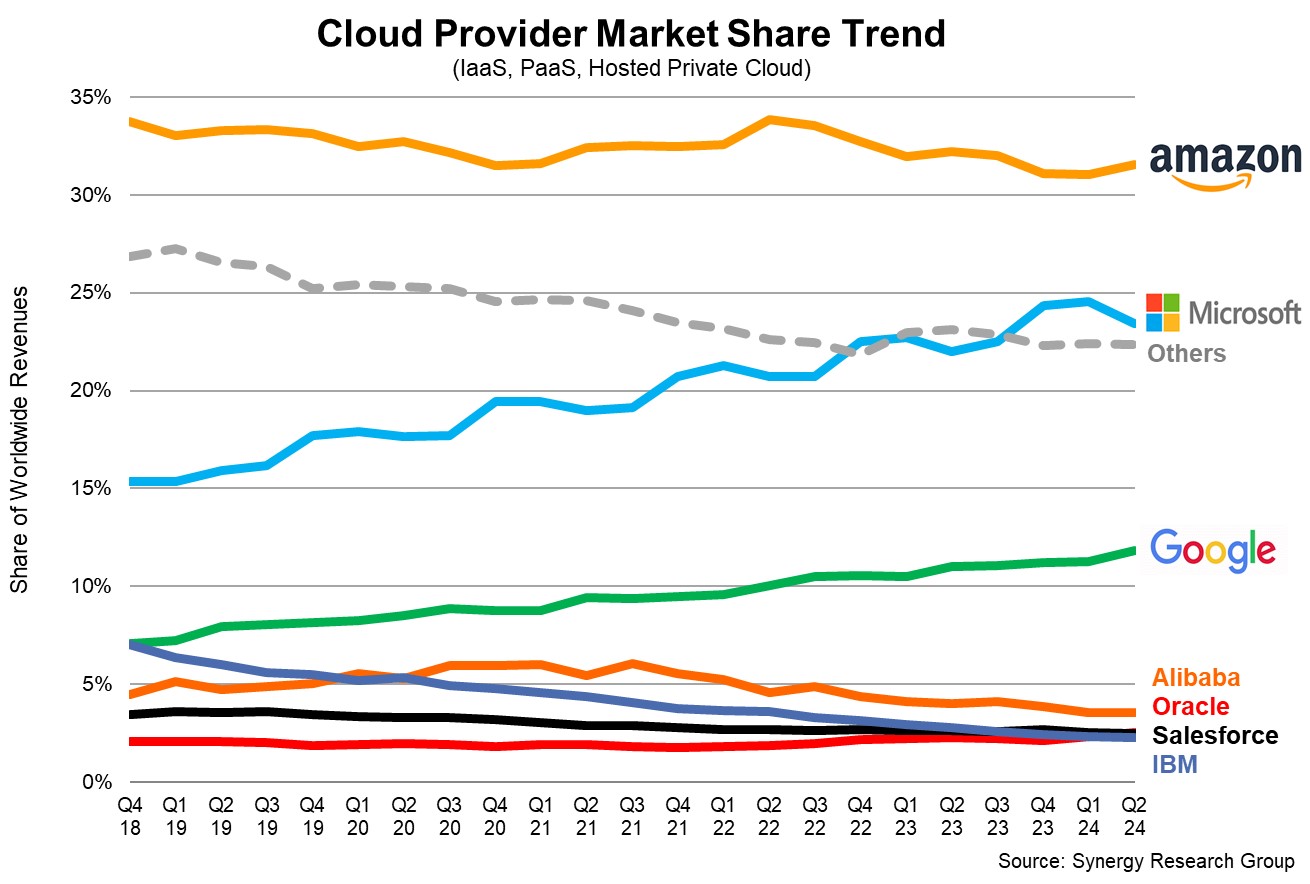
While the "Big Three" dominate, the CRN article also notes other players like Alibaba, which is a major force in China, and Oracle, which is growing in niche enterprise segments.
3. The Battle for the Cloud: Competitive Strategies
Market share is a result of strategy. Each hyperscaler leverages its unique strengths to compete. While they all offer similar core services (compute, storage, databases), their approaches and target customers differ.
Market Dynamics of the Big Three Cloud Providers
The blog post 'Market Dynamics of the Big Three Cloud Providers' provides an excellent strategic analysis of each player's competitive advantages.
Please read the section titled 'Competitive Advantages'. It's a short but dense summary of each company's core strategy. Focus on understanding the key differentiators for AWS, Azure, and GCP.
Let's synthesize those points:
AWS: The Incumbent's Scale and Breadth
- Strategy: Maintain leadership through an unmatched variety of services (over 200) and a massive, mature ecosystem.
- Advantage: First-mover advantage means many companies, from startups to large enterprises, are already deeply integrated with AWS. It is the de facto standard for many.
- Challenge: Its growth rate is slower than its competitors, as it's harder to grow quickly from such a large base.
Microsoft Azure: The Enterprise Powerhouse
- Strategy: Win large corporate customers by leveraging Microsoft's existing enterprise relationships.
- Advantage: Seamless integration with products that businesses already use and trust (Office 365, Windows Server, Dynamics 365). Azure is often the natural choice for large companies already in the Microsoft ecosystem. They are also a leader in hybrid cloud, which allows companies to mix their own private data centers with the public cloud.
- Strength: A major strategic push into AI through its partnership with OpenAI (the creator of ChatGPT).
Google Cloud (GCP): The Data and AI Specialist
- Strategy: Differentiate through superior technology in data analytics, machine learning (ML), and AI.
- Advantage: Leverages Google's decade-plus experience in running global-scale services like Search and YouTube. Tools like BigQuery (for data warehousing) and Vertex AI (for machine learning) are considered best-in-class by many developers.
- Approach: Often competes on price and by targeting data-intensive, developer-focused companies and startups.
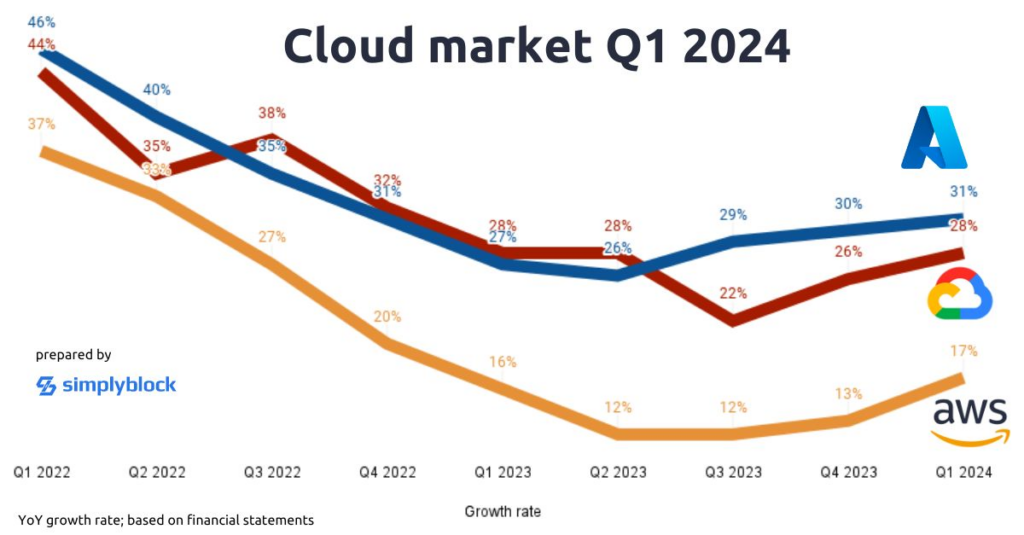
This chart of year-over-year growth rates vividly illustrates the competitive pressure. While AWS is the biggest, Azure and GCP have been consistently growing at a faster pace, eating into the market.
4. The Competitive Moat: How Cloud Providers "Lock You In"
The cloud business is incredibly "sticky." Once a company builds its products on a specific cloud provider, it is very difficult and expensive to leave. This is a powerful competitive advantage known as vendor lock-in.
Cloud providers engineer this stickiness in several ways.
Why you're addicted to cloud computing
The Fireship channel is known for its fast-paced, insightful tech explanations. This video explains the business model behind vendor lock-in with a focus on the financial incentives.
Watch the segment from 01:07 to 04:24. Focus on these three key lock-in mechanisms: Free Credits: How they get startups "addicted" early on. Egress Fees: The concept of charging high fees to move data out of the cloud. Proprietary Technology: How using managed services and custom APIs makes infrastructure difficult to migrate.
To summarize the key tactics that create lock-in:
- High Switching Costs: The most significant barrier is egress fees. It's generally free to move data into the cloud, but providers charge significant fees to move it out. For a company with petabytes of data, this cost alone can make switching prohibitive.
- Proprietary Services: While you can rent a basic virtual server (which is fairly standard), providers offer powerful, managed services (like specialized databases or AI tools) that are unique to their platform. The more a company uses these proprietary services, the more its technology becomes tied to that specific provider.
- Ecosystem Integration: The services within a single cloud platform are designed to work together seamlessly. Mixing and matching services from different clouds is often complex and less efficient.
- Human Knowledge: Engineers and developers become experts on one platform's tools and APIs. Switching providers requires retraining the entire team, which represents a significant cost and productivity loss.
Test your understanding!
Imagine you are the Head of Operations for a successful startup that provides video hosting and streaming services. Your entire platform was built on AWS.
A competitor, built on Google Cloud, is able to offer lower prices because GCP has just released a new, highly efficient video-transcoding service that is 30% cheaper than the equivalent service on AWS.
Your CEO asks you to evaluate switching to Google Cloud to stay competitive. What are the major business and financial obstacles you would immediately point out, based on the concept of vendor lock-in?
Show answer
The primary obstacles would be:
- Egress Fees: The biggest and most immediate financial barrier. Moving terabytes or petabytes of customer videos from AWS S3 (storage) to Google Cloud Storage would incur massive data transfer fees from AWS. This one-time cost could easily wipe out any potential savings for years.
- Proprietary Service Migration: Your streaming platform is likely built using AWS-specific services (e.g., AWS Elemental MediaConvert for transcoding, Amazon CloudFront for content delivery). Migrating to GCP would require re-architecting and rebuilding large parts of your application to use Google's equivalent services, which is a major engineering project.
- Team Expertise: Your engineering team is skilled in AWS. They would need significant time for training and ramp-up to become proficient with Google Cloud's tools, slowing down product development.
- Operational Disruption: A large-scale cloud migration is a high-risk project that could lead to downtime or performance issues, potentially damaging customer trust and your brand's reputation.
In short, even if GCP's service is cheaper on paper, the switching costs could make the move financially and operationally unfeasible.
Conclusion
You now have a strategic overview of one of the most important sectors in technology. The cloud computing market is a battle of titans, where scale, strategy, and "stickiness" define the winners.
Key Takeaways:
- The cloud market is dominated by three hyperscalers: AWS (the leader), Microsoft Azure (the enterprise challenger), and Google Cloud (the data/AI specialist).
- AWS competes on its vast service catalog and first-mover advantage. Azure leverages its enterprise customer base and hybrid cloud strengths. GCP differentiates with best-in-class data, analytics, and AI services.
- Competition is fierce, with Azure and GCP growing faster than AWS, but the market leader's position is protected by strong vendor lock-in.
- High switching costs, primarily driven by data egress fees and reliance on proprietary services, create a powerful moat that makes it difficult for customers to change providers.
In our next lesson, we'll shift from the foundational infrastructure layer to the application layer. We will identify the major players and competitive dynamics in the e-commerce and marketplace sector, a landscape with very different business models and success drivers.