Hello! Let's continue our journey across the Atlantic to see how the Christmas controversies we discussed in our last lesson played out in the New World.
In our previous session, we examined the Puritan-led ban on Christmas in England, exploring its theological roots and the political turmoil of the English Civil War that made it possible. We saw that this was not just a whim, but a concerted effort to purify the nation of what they considered an unholy, rowdy, and "Popish" festival.
Today, we will follow these ideas to colonial America. The English settlers did not leave their cultural and religious baggage behind; they brought it with them, creating a patchwork of attitudes toward Christmas that varied dramatically from one colony to another. This lesson focuses on how Christmas was observed—or pointedly ignored—in early colonial America. By the end, you'll be able to identify the distinct regional differences in Christmas observance across the thirteen colonies.
A Tale of Three Regions
The story of Christmas in colonial America is not a single narrative but three distinct ones, corresponding to the major regions of settlement:
- Puritan New England: Where celebrating Christmas could get you fined.
- Anglican Southern Colonies: Where the English gentry's traditions of feasting and revelry continued.
- The Diverse Middle Colonies: A cultural mosaic where various traditions coexisted.
To begin, let's get a general overview of this divided landscape.
How Christmas Was Celebrated in the 13 Colonies
The article "How Christmas Was Celebrated in the 13 Colonies" from History.com provides a great introduction to the differing views on Christmas that settlers brought from Europe.
Please read the first two sections of the article, from the beginning down to the heading 'Christmas in Jamestown and Plymouth'. This will set the stage by explaining how the Puritan-Anglican conflict in England directly shaped the debate over Christmas in the colonies.
New England: The War on Christmas Continues
The Puritans who founded the Plymouth and Massachusetts Bay colonies were the very same people whose ideological brethren were fighting to ban Christmas back in England. It's no surprise, then, that they established a society where the holiday was officially suppressed.
The Plymouth Pilgrims: A Day for Work
As the History.com article mentions, the Pilgrims treated their first Christmas in 1620 as just another workday, getting on with the business of building their settlement. Governor William Bradford's diary records that when a few newcomers refused to work on Christmas Day 1621, he excused them but later found them "in the street at play." He reprimanded them, stating that if they made Christmas a matter of "devotion, let them keep their houses," but there would be "no gaming or reveling in the streets."
Massachusetts Bay Colony: Christmas Outlawed
The Puritans of the larger and more influential Massachusetts Bay Colony went even further. Echoing the actions of Parliament in England, they made celebrating Christmas illegal.
The 22-Year Ban on Christmas in Massachusetts
To understand the specifics of this ban, let's watch a short video from History Dose. It details the 1659 law and the reasons behind it.
Please watch the video from the beginning to 03:53. Pay attention to the details of the law, the fine imposed, and the three main reasons for the Puritan opposition: lack of biblical command, pagan origins, and its association with debauchery.
As the video and historical records show, a 1659 Massachusetts law imposed a five-shilling fine on anyone found "observing any such day as Christmas or the like, either by forbearing of labor, feasting, or any other way."
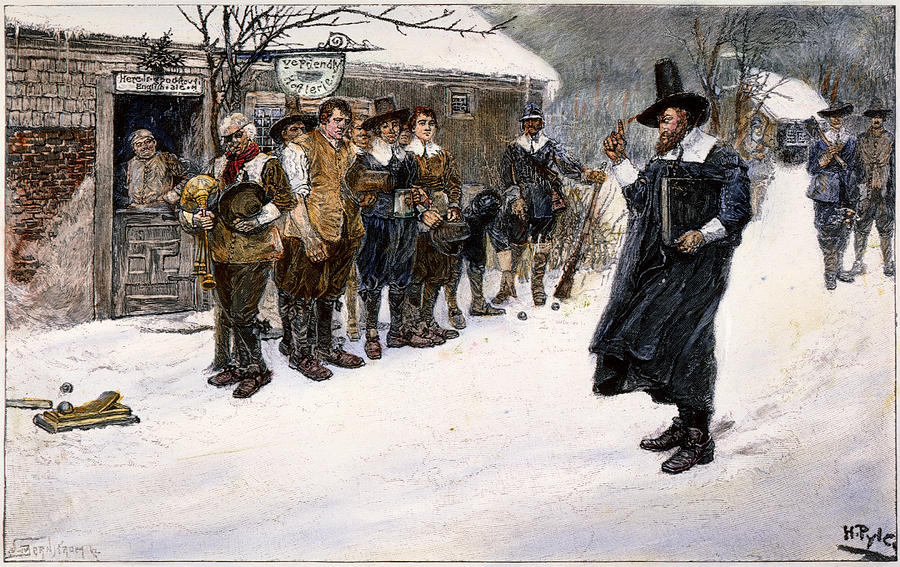
Even after the ban was officially repealed in 1681 due to pressure from the English Crown, the deep-seated cultural opposition remained for over a century. Diaries from the period show that for many New Englanders, December 25th was business as usual.
What's Christmas Like In The 18th Century? And Corriander Cookies From 1796
The video from the Townsends YouTube channel provides fascinating evidence of this from primary sources.
Please watch from 00:58 to 02:25. Notice how Matthew Patton's diary from New Hampshire treats December 25th as an ordinary day for court proceedings and daily chores.
The Southern Colonies: Feasting and Festivities
The situation in the Southern colonies, such as Virginia and the Carolinas, was a world away from New England. Settled primarily by Anglicans who remained loyal to the Church of England and the Crown, these colonies imported English traditions of Christmas celebration.
Christmas in Colonial and Revolutionary America
To explore these southern traditions, let's turn to the article "Christmas in Colonial and Revolutionary America" from the Fraunces Tavern Museum.
Please read the section titled 'To find the greatest regional embracement...' and the following short section on the enslaved population. Note the types of activities mentioned and how the experience differed for enslaved people.
In the South, Christmas was a time for adult-centric social gatherings, religious services, and revelry. For the wealthy plantation-owning class, the season was marked by:
- Feasting and Parties: Grand balls and feasts were common.
- Outdoor Activities: Fox hunts, a popular pastime for the gentry, were part of the festivities.
- Decorations: Homes and churches were adorned with evergreen plants like holly, ivy, and mistletoe.
- Rowdy Traditions: Customs like "mumming" (dressing in costumes and visiting neighbors) and firing muskets in celebration were widespread.
For the enslaved population, the experience varied. As the article notes, house servants often faced an increased workload to support the holiday feasts, while many field hands were given a period of rest between Christmas and New Year's Day.
The Middle Colonies: A Cultural Mosaic
Between the two extremes of New England and the South lay the Middle Colonies (New York, Pennsylvania, New Jersey, Delaware). This region was the most ethnically and religiously diverse, and its approach to Christmas reflected that.
Here, Anglicans, German Lutherans, Dutch Calvinists, and English Quakers lived side-by-side, each with their own views.
- Quakers: Like the Puritans, the Quakers who founded Pennsylvania were strongly against Christmas celebrations, viewing them as ostentatious and without biblical basis.
- Dutch and Germans: These groups brought their own rich Christmas traditions. As the Townsends video notes, Dutch immigrants were among the most enthusiastic celebrants, a tradition that would eventually give rise to the figure of Sinterklaas, a precursor to Santa Claus.
- Anglicans and others: They followed their English Christmas customs.
This diversity meant that while Christmas was celebrated, it was often in localized, community-specific ways rather than as a large-scale public holiday. Peter Kalm, a Swedish visitor to the colonies in the mid-18th century, observed that Quakers worked on Christmas Day, while members of the English church wished one another a "happy Christmas holiday" but made few other special preparations.
Test your understanding!
An immigrant arriving in colonial America in the 1760s wants to continue their family tradition of celebrating Christmas with a special church service and a festive meal. Based on what you've learned, rank the three colonial regions (New England, Middle Colonies, Southern Colonies) from most to least welcoming of this practice, and briefly explain your reasoning.
Show answer
- Most Welcoming: Southern Colonies. This region, dominated by Anglicans, had a strong, established tradition of celebrating Christmas with both religious services and festive meals. The immigrant's practices would fit in well with the prevailing culture of the gentry.
- Moderately Welcoming: Middle Colonies. The welcome here would depend on the specific community. An Anglican or Lutheran community would be receptive, but a Quaker-dominated area would be disapproving. The overall diversity, however, meant that such celebrations were not uncommon, even if they weren't universally practiced.
- Least Welcoming: New England. Despite the official ban being lifted, the Puritan cultural opposition to Christmas remained powerful. Public celebrations were strongly discouraged, and the day was still widely treated as a normal workday. The immigrant would find their traditions viewed with suspicion and disapproval.
Conclusion
As we've seen, there was no single "colonial American Christmas." The holiday's observance was deeply fractured along regional and religious lines, a direct inheritance of the conflicts that had defined Christmas in England.
Key Takeaways:
- Christmas in colonial America was highly regionalized, not a nationally recognized holiday.
- In New England, Puritan influence led to the legal suppression of Christmas for a time, and a lasting cultural disapproval that treated it as a regular workday.
- In the Southern Colonies, the Anglican elite celebrated Christmas with the feasting, parties, and revelry characteristic of English gentry traditions.
- The Middle Colonies were a diverse mix, where groups like the Dutch and Germans celebrated, while others like the Quakers abstained, resulting in localized but not widespread observations.
- Even where it was celebrated, the colonial Christmas was primarily an adult-focused season of revelry and religious observance, bearing little resemblance to the family-centric holiday we know today.
After the American Revolution, Christmas remained a divisive and relatively minor holiday for many decades. In fact, Congress held its first session on December 25, 1789, a clear sign that it was not yet a federal holiday. It would take a profound cultural shift in the 19th century to reshape Christmas into a national celebration.
In our next lesson, we will jump forward to that era and begin our next module, "The Victorian Reinvention of Christmas." We will start by exploring the immense influence of a single book that did more than almost any other to define the spirit of the modern holiday: Charles Dickens's A Christmas Carol.