Hello! Welcome back to our course on the history of Christmas.
In our last lesson, we saw how the figure of St. Nicholas became a central part of medieval Christmas, a beloved gift-bringer whose feast day kicked off the season of giving. We concluded by noting that the very traditions he embodied—the veneration of saints, festive celebrations, and church-sanctioned holidays—would soon come under intense scrutiny.
Today, we step into that period of upheaval. This lesson opens our fourth module, "Reformation and Revolution," by exploring the profound and varied impact of the Protestant Reformation on Christmas celebrations across Europe. You will learn that there was no single "Protestant" approach to Christmas; instead, the Reformation created deep divisions, turning the holiday into a theological and cultural battleground.
By the end of this lesson, you will be able to explain how the Protestant Reformation affected Christmas celebrations across Europe, from outright abolition in some regions to a significant rebranding in others.
A Fork in the Road: The Core Theological Disagreement
The Protestant Reformation, which began in the early 16th century, was a movement to reform the beliefs and practices of the Catholic Church. Reformers sought to return to what they saw as the core principles of Christianity, with a strict emphasis on the authority of the Bible. This put any tradition not explicitly mentioned in scripture—including Christmas—in a precarious position.
The split in how to handle Christmas can be traced to two opposing principles of worship that emerged among the leading Reformers.
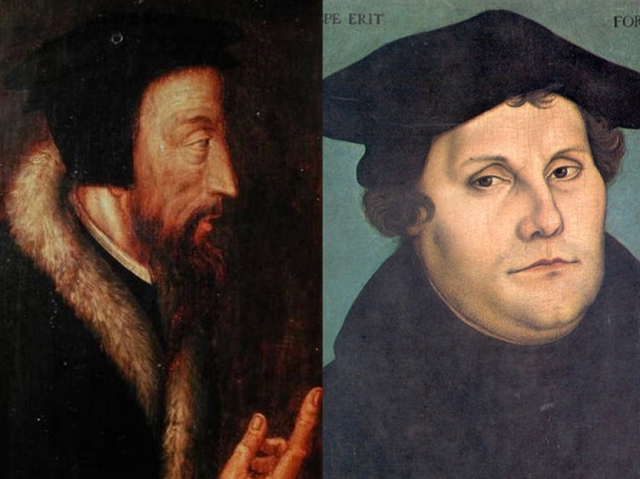
To understand this crucial divergence, let's examine the views of the Reformation's most influential figures.
Luther, Calvin and Zwingli on Christmas
The article 'Luther, Calvin and Zwingli on Christmas' provides a concise explanation of the theological divide. It outlines the three main perspectives that shaped the holiday's future in Protestant Europe.
Please read the first three sections, titled '1.- Luther, Pro-Christmas', '2.-Zwingli, Anti-Christmas', and '3.- Calvin, Neither For Nor Against'. As you read, focus on understanding the two key principles that guided their thinking: The Normative Principle (Luther): What does this principle state about church practices? The Regulative Principle (Zwingli & Calvin): How does this principle differ from the normative one?
As you've just read, the debate boiled down to this:
-
Martin Luther and the Lutherans followed the Normative Principle: If the Bible does not explicitly forbid a practice, it may be permitted, as long as it helps promote the Gospel. For Luther, Christmas was a valuable opportunity to preach about the incarnation of Christ. It didn't need to be abolished, but rather reformed and refocused on its theological meaning.
-
Ulrich Zwingli and John Calvin, leaders of the more radical "Reformed" wing, adhered to the Regulative Principle: The church should only engage in practices that are explicitly commanded in the Bible. Since the Bible does not command a celebration of Christ's birth on December 25th, they saw Christmas as a human invention at best, and a "popish" (a derogatory term for Catholic) superstition at worst.
This fundamental disagreement ensured that the Reformation's impact on Christmas would vary dramatically depending on which theological tradition held sway in a given region.
Test your understanding!
Imagine two Protestant communities are debating whether to use a pipe organ in their church service. One community is Lutheran, and the other is Calvinist (Reformed). Based on the normative and regulative principles, how would each community likely argue its case?
Show answer
- The Lutheran community (normative principle) would likely argue that since the Bible doesn't forbid using musical instruments, and if the organ's music helps elevate worship and praise God, then it is permissible.
- The Calvinist community (regulative principle) would argue that since the Bible does not explicitly command the use of pipe organs in New Testament worship, they should not be used. The focus should be purely on what is prescribed in scripture, such as prayer, preaching, and singing psalms.
The Reformation's Impact Across Europe
This theological split created a patchwork of Christmas practices across the continent. A map of the religious landscape in the 16th century helps visualize where these different attitudes would have taken root.

The Lutheran Reformation: Rebranding Christmas
In Lutheran territories like northern Germany and Scandinavia, Christmas was not cancelled but rather transformed. The focus shifted away from saints and elaborate Catholic rituals towards a more personal, Christ-centered celebration.
One of the most significant changes was the deliberate attempt to replace the figure of St. Nicholas. As we saw in the last lesson, his feast day and gift-giving traditions were deeply tied to the Catholic cult of saints, which Luther sought to abolish.
History-Makers: Saint Nicholas to Santa Claus
This short clip from 'History-Makers: Saint Nicholas to Santa Claus' explains the new gift-bringer introduced to replace St. Nicholas in Lutheran Germany.
Watch from 04:37 to 05:32. Pay close attention to who Martin Luther suggested should be the new gift-bringer and why.
This introduction of the Christkind or "Christ Child"—an angelic figure representing the infant Jesus—was a brilliant move. It shifted the act of gift-giving from a saint's day (Dec. 6) to Christmas itself and placed Christ at the absolute center of the celebration. Traditions we now consider timeless, like the Christmas tree, also gained popularity in Lutheran Germany during this era.
The Calvinist Reformation: Abolishing Christmas
In areas influenced by Calvin and Zwingli—such as Geneva, Zurich, Scotland, and the Netherlands—the approach was far more severe.
How the Reformation (Almost) Killed Christmas
Let's look at the article 'How the Reformation (Almost) Killed Christmas' to see how this anti-Christmas sentiment played out.
Please read the first five paragraphs, starting from 'It was Christmas Day, 1550...' down to '...sought to ban Christmas celebrations outright.' Notice Calvin's personal feelings about the celebration and the core reasons for his opposition.
For Calvin, Zwingli, and their followers (including the Scottish Presbyterians and English Puritans), Christmas was illegitimate for several reasons:
- Lack of Biblical Mandate: It was not commanded by God.
- Pagan Roots: Its timing and many customs were seen as continuations of Roman pagan festivals.
- Catholic Superstition: It was filled with "popish" rites and the veneration of saints.
- Sinful Revelry: It was associated with the drunkenness, gluttony, and misrule we discussed in a previous module.
- Idolatry of a Day: It elevated a man-made holiday above the one true holy day commanded in the scripture: the weekly Lord's Day (Sunday).
In these regions, Christmas celebrations were often officially banned. Churches were kept shut, and people were expected to work as on any other day.
Case Study: The English Civil War and the Ban on Christmas
Nowhere was the conflict over Christmas more dramatic than in England. The Church of England had tried to steer a middle course, but a powerful and vocal Puritan movement, heavily influenced by Calvin, grew increasingly opposed to the holiday.
This theological conflict erupted into a political one during the English Civil War. When the Puritan-led Parliament defeated the king's forces, they seized the opportunity to remake England according to their religious principles.
Origins of Christmas History Channel Documentary
The documentary 'Origins of Christmas' provides an excellent account of how the Puritans in England banned Christmas and how the public reacted.
Please watch from 09:32 to 14:30. As you watch, focus on: The Puritan view of traditional English Christmas celebrations. The specific actions taken by Oliver Cromwell's government to suppress the holiday. The forms of popular resistance to the ban. The connection between the restoration of Christmas and the restoration of the monarchy.
This episode highlights the deep cultural attachment to Christmas. Despite the government's official ban, people continued to celebrate in secret, defiantly singing carols and eating "mince pies" instead of "Christmas pies." The popular backlash was so strong that the desire to bring back Christmas became intertwined with the movement to restore the monarchy. When King Charles II returned to the throne in 1660, the legal celebration of Christmas was restored along with him. The attempt to abolish Christmas had failed.
This struggle was carried over to the New World. In Puritan-dominated colonies like Massachusetts, Christmas was also outlawed, while in more Anglican colonies like Virginia, the celebrations continued.
Conclusion
Today, we have seen how the Protestant Reformation shattered the unified medieval Christmas, creating a deep and lasting divide. It forced communities across Europe to question the very basis of the holiday.
Key Takeaways:
- The Reformation's impact on Christmas was not uniform; it was split along theological lines defined by the normative principle (Lutheran) and the regulative principle (Calvinist).
- In Lutheran regions, Christmas was reformed and preserved. The focus was shifted to Christ, leading to new traditions like the Christkind as a gift-bringer.
- In Calvinist and Reformed regions, Christmas was often banned. It was seen as an unbiblical, Catholic invention tainted by paganism and sinful behavior.
- The battle over Christmas in England became a major political and cultural conflict, resulting in a 13-year ban under the Puritans that was overturned with the restoration of the monarchy.
While we have touched on the core Puritan objections today, their arguments were detailed and deeply felt. In our next lesson, we will delve more deeply into the specific theological reasoning behind the Puritan "war on Christmas" and explore why they considered the holiday to be so dangerous to a Christian society.