Hello! Welcome to your next lesson in our "Christmas in the Modern World" module.
In our previous lesson, we analyzed the broad forces that led to the secularization of Christmas in the 20th century. We identified state policies, globalization, and, most powerfully, the rise of consumer culture and mass media as key drivers. We saw how this shift sparked cultural debates, often called the "War on Christmas," over the holiday's public identity.
Today, we will build directly on that foundation by taking a deep dive into the most influential of those forces. Our learning outcome is to analyze the impact of consumer culture, advertising, and media on modern Christmas celebrations. We will explore how retailers, advertisers, and media outlets didn't just capitalize on Christmas but actively shaped and, in many ways, invented the holiday as we know it today.
The Marketplace as a Cathedral
In the 19th century, a fundamental shift occurred. The marketplace began to compete with, and for many, displace the church as the primary venue for Christmas celebrations. This was not a hostile takeover, but a gradual transformation driven by the burgeoning industrial economy and the rise of a new middle class.
The Commercialization of Christmas in American Society
To understand the roots of this change, let's start with a section from a detailed thesis on the topic by Melissa Leone. It defines the concepts and outlines how retailers began to see the commercial potential of the holiday.
Please read the first page (labeled page 1 in the PDF) and then the section on pages 5-7 that starts with 'By the end of the nineteenth century...'. Focus on how gift-giving evolved from a minor, one-way charitable act to a reciprocal, central feature of the holiday, fueled by industrialization and the rise of department stores.
As the reading describes, what was once a modest tradition of charity or small, handmade gifts exploded into a major economic event. This was driven by two key developments:
- The Rise of Department Stores: Establishments like Macy's and Wanamaker's became, as historian Leigh Eric Schmidt called them, "cathedrals of consumption." They were grand, magnificent public spaces that offered an unprecedented variety of manufactured goods.
- Elaborate Displays: To lure customers in, these stores created fantastical window displays, turning shopping into a form of festive entertainment. These displays were not just about showing products; they were about creating a magical Christmas atmosphere that became an attraction in its own right.

Forging the Icons of a Commercial Christmas
The influence of commerce went far beyond simply selling goods. Advertising and marketing campaigns played a crucial role in standardizing the very iconography of the holiday, creating a shared visual language for a commercial Christmas.
Let's watch a video that masterfully chronicles this process, showing how brands didn't just steal Christmas, but in many ways, created it.
The History of a Corporate Christmas | Christmas History | Extra History
The 'Extra History' channel has an excellent episode detailing how corporations shaped the modern holiday. This segment focuses on two key creations: the Christmas shopping season and the modern image of Santa Claus.
Please watch from 01:21 to 08:17. As you watch, pay attention to: How the Macy's Thanksgiving Day Parade was explicitly designed to kick off the shopping season. The evolution of Santa Claus's image from a 'right jolly old elf' to the life-sized, red-suited figure we know today, especially through the influence of Thomas Nast and, pivotally, Coca-Cola.
As the video explains, what we now consider timeless traditions were often deliberate commercial strategies:
- The Santa Claus "Brand": Before the mid-19th century, there was no single, agreed-upon image of Santa. It was the illustrations by Thomas Nast for Harper's Weekly and, most famously, the decades-long advertising campaign by Coca-Cola with art by Haddon Sundblom, that solidified the image of Santa as a large, jolly, white-bearded man in a red suit. This secularized and standardized figure was a perfect, friendly spokesman for all manner of products.
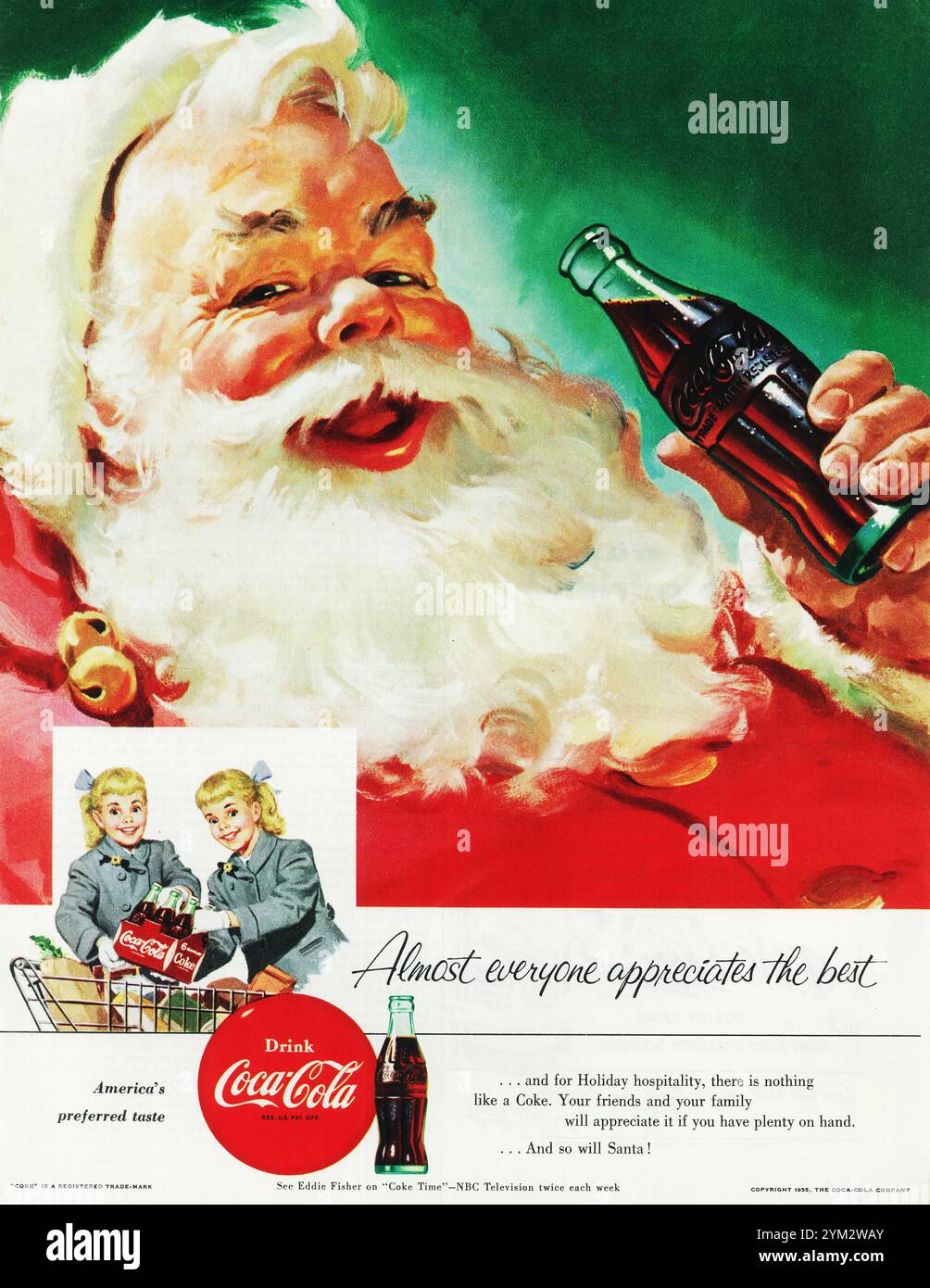
- The "Christmas Creep": The Macy's parade was designed to officially launch the Christmas shopping season. This season became so vital to the American economy that, as the video notes, President Franklin D. Roosevelt actually moved the date of Thanksgiving in 1939 to give retailers an extra week of sales. This is a stark illustration of the holiday's economic power. Today, this impulse continues with the "Christmas Creep" of holiday marketing starting ever earlier, and manufactured retail events like Black Friday and Cyber Monday.
Test your understanding!
Imagine you are a marketing executive in the 1920s. Your company sells a new brand of electric lights for Christmas trees. Drawing on the strategies discussed so far, what are two distinct actions you might take to promote your product and embed it into the holiday tradition?
Show answer
Based on the lesson, here are two effective strategies:
- Create an Association with Santa Claus: You could launch a print advertising campaign featuring Santa Claus himself admiring a tree decorated with your lights, or even using them to light his workshop. This leverages the trusted, magical figure of Santa to endorse your product, making it seem like a part of the authentic Christmas experience.
- Sponsor a Public Spectacle: You could partner with a major department store or city hall to create a massive, publicly televised "tree lighting ceremony" using your lights. This turns your product into a festive event, creating a new "tradition" that people look forward to and associate with the start of the holiday season, similar to the Macy's parade.
Media as the Modern Christmas Scripture
In the latter half of the 20th century and into the 21st, film and television became profoundly influential in defining what Christmas should feel like. They created a powerful, often nostalgic, cultural narrative that reinforces specific values and, indirectly, consumer behaviors.
A prime example is the Hallmark Christmas movie genre, which has become a cultural phenomenon.
Hallmark Movies and The Invention of Christmas
The channel Wisecrack offers a sharp analysis of how Hallmark movies, despite their often anti-materialistic plots, function as powerful vehicles for consumerism.
Please watch from 07:26 to 11:15 and from 12:03 to 12:34. Focus on the central paradox the video identifies: How do these movies sell a consumerist vision of Christmas while telling stories about leaving corporate life for small-town simplicity?
The Wisecrack video exposes a fascinating system at work. Hallmark movies, and much of Christmas media, operate on a few key principles:
- Selling Nostalgia: The movies evoke a yearning for a "mythical Christmas past"—a simpler, more authentic time. This nostalgic feeling is a core part of the modern holiday. It creates a sense that our own Christmas is incomplete, which can be remedied through consumption: buying the right decorations, the perfect gifts, the coziest sweaters.
- The Anti-Materialist Paradox: The narratives often feature a protagonist who discovers that corporate success is empty and that true happiness lies in community, family, and love. However, this "spirit" is expressed through visually rich, picturesque settings that are themselves products of consumption (beautifully decorated homes, artisanal bakeries, festive town squares). The solution to material problems in these movies is often not structural change, but the benevolence of a wealthy individual, reinforcing a capitalist fantasy.
- Codifying Tradition: The films present a very specific set of rituals—tree-decorating, cookie-baking, ugly sweater contests—as the definition of an "authentic" American Christmas. This creates a cultural script, suggesting that participation in these consumer-heavy activities is essential to properly celebrate the holiday and "be American," regardless of one's religious beliefs.
Conclusion
The story of the modern Christmas is inextricably linked with the story of modern consumer capitalism. Far from being a recent corruption of an ancient holiday, commercialism has been a driving force in defining and popularizing Christmas in the United States and, subsequently, the world for over 150 years.
Key Takeaways:
- Consumer culture is foundational, not just peripheral, to modern Christmas. From the 19th century onward, department stores, advertising, and a manufactured "shopping season" have been central to the holiday's celebration.
- Advertising and media created and standardized key holiday symbols. The modern image of Santa Claus is perhaps the most prominent example, having been codified by illustrators and advertisers like Coca-Cola to serve as a universal, secular pitchman.
- Modern media shapes our emotional expectations of Christmas. Films and television shows, like the Hallmark movies we analyzed, sell a powerful sense of nostalgia and codify specific consumer-centric activities as essential holiday traditions, often under the guise of anti-materialism.
In our previous lesson, we saw that Christmas spread globally. Now, having analyzed the powerful engine of American consumer culture, we are better equipped to understand how this particular version of Christmas was exported. In our next lesson, we will shift our focus to Europe and describe distinctive Christmas traditions in various cultures, including Germany and France, to see how they compare and contrast with the commercialized American model.