Hello! Welcome to your next lesson on Christmas in the Middle Ages.
In our last session, we discussed how the Twelve Days of Christmas were a period of intense social activity, marked by feasting, charity, and political gift-giving. We concluded by framing these celebrations as a "social release valve" for a rigid, hierarchical society. Today, we will explore the most dramatic and fascinating example of this phenomenon: the tradition of the 'Lord of Misrule' and other forms of festive role-reversal, where the world was temporarily turned upside down.
This lesson will focus on describing these traditions, understanding their origins, and appreciating the social function they performed.
The Logic of Chaos: A Social Safety Valve
Before we dive into the specific traditions, it's important to understand why a society built on strict order would not only tolerate, but actively encourage, periods of sanctioned chaos. Life in the Middle Ages was governed by a rigid feudal hierarchy. For a few days during Christmastide, this order was playfully inverted.
Let's begin with a short video clip that explains the fundamental purpose behind these seemingly bizarre customs.
12 Days of Medieval Christmas | What They Actually Did
The video '12 Days of Medieval Christmas | What They Actually Did' provides an excellent summary of why these traditions of inversion were so important for social stability.
Please watch the segment from 10:08 to 10:43. Focus on the explanation of Christmas as a 'pressure release' for a rigid social hierarchy.
As the video explains, by permitting controlled chaos, rulers could prevent uncontrolled chaos. These traditions provided a safe, ritualized outlet for social tensions and grievances. This concept of a regulated system that allows for temporary disorder to maintain long-term stability might resonate with your background in systems and information theory.
The roots of this practice stretch back to the pre-Christian Roman festival of Saturnalia, where social roles were famously reversed—masters would serve their slaves, and gambling was permitted. Many of the medieval traditions we'll explore are direct descendants of this ancient festival.
Role Reversal in the Church and Community
The inversion of social order found its way into both religious and secular celebrations, often blending the two.
The Feast of Fools
One of the most notorious traditions was the Feast of Fools, typically celebrated around New Year's Day. Within the Church itself, lower-ranking clergy would temporarily take on the roles and duties of bishops and senior priests.
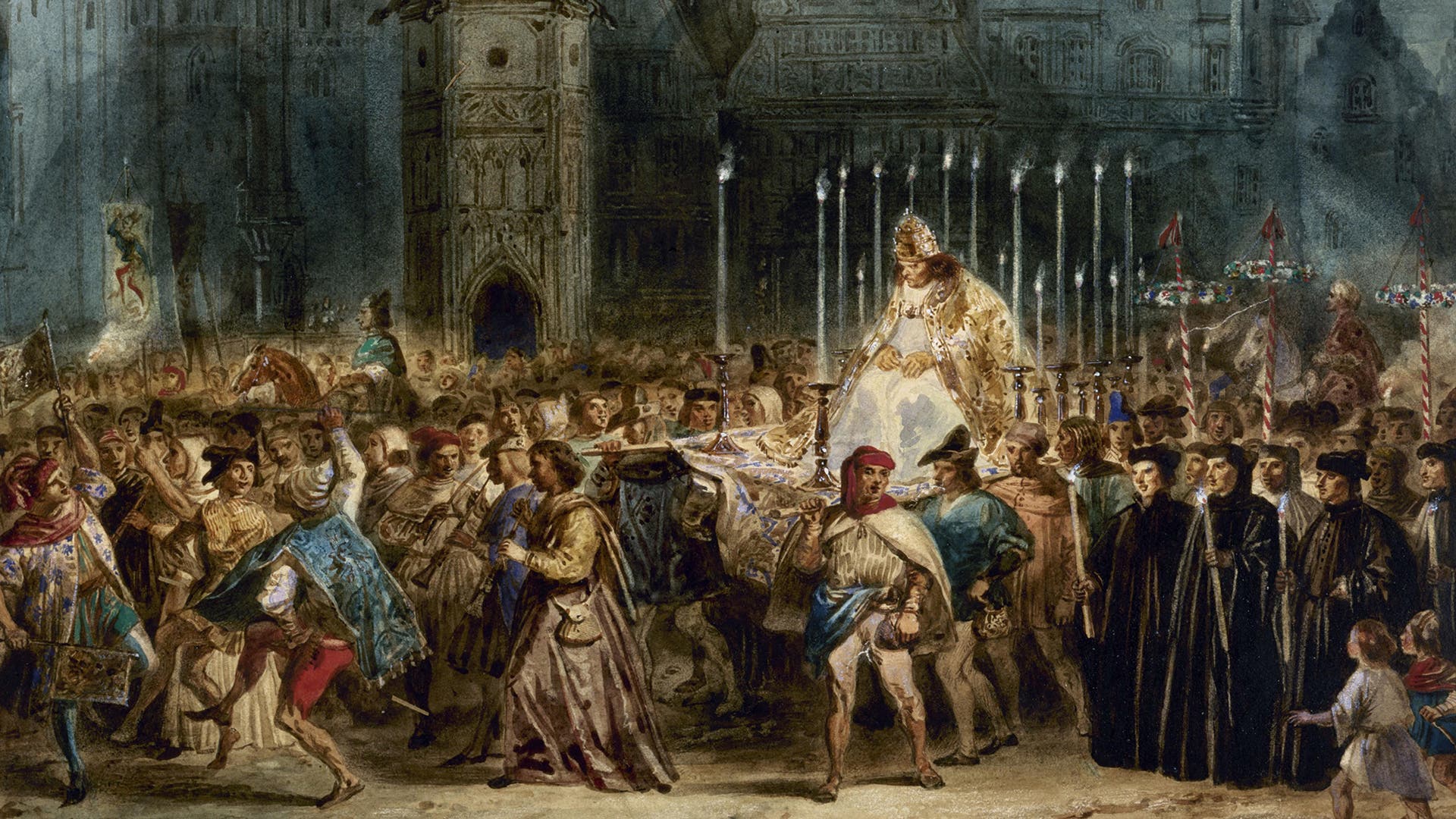
These ceremonies could become quite raucous, involving masks, satirical songs, and general revelry that inverted the solemnity of the church services.
12 Days of Medieval Christmas | What They Actually Did
Let's return to the '12 Days of Medieval Christmas' video for a description of what the Feast of Fools entailed, particularly in France.
Watch from 03:27 to 04:22. Note the activities described by theologians and the distinction made between behavior inside and outside the church.
Other, similar traditions existed across Europe. In Spain, the Día de los Santos Inocentes (Holy Innocents' Day) on December 28th became a day for pranks, with records of monks locking their abbots in their chambers and demanding a "ransom" of food and drink.
The Boy Bishop
A related, and slightly more restrained, tradition was that of the Boy Bishop. On certain feast days associated with children (like St. Nicholas's Day), a choirboy would be elected to assume the full ceremonial duties of the bishop. He would be dressed in miniature vestments, lead processions, and even deliver a sermon. This custom was widespread in cathedrals across England and Europe.
The Lord of Misrule and Secular Mayhem
While the church had its share of role-reversal, the most famous figure of festive anarchy presided over secular celebrations: the Lord of Misrule.
In noble households, university colleges, and even the royal court, a person of lower status—sometimes a peasant, servant, or student—was appointed to "reign" over the Christmas festivities, typically for the full Twelve Days. His job was to ensure the season was as chaotic and fun as possible.

This "mock king" had the authority to command everyone, including his actual masters and even the monarch, to participate in games, dances, pranks, and mock trials.
The WEIRDEST Christmas Traditions in History! | WHAT THE PAST?
The video 'The WEIRDEST Christmas Traditions in History!' gives a lively description of the Lord of Misrule, his appearance, and his duties.
Watch from 01:32 to 02:40. Pay attention to the description of the Lord of Misrule's reign, his colorful attire, and the types of activities he organized.
To gain a deeper understanding of this central figure, especially his prominence in Tudor England, please read the following article.
The article 'The Lord of Misrule' from Historic UK provides a detailed history of this tradition, from its origins to its enthusiastic adoption by Tudor monarchs.
Please read the text from the beginning down to the end of the section about George Ferrers (ending just before the 'Morris dancers' image). Focus on: The link to Saturnalia. The enthusiastic patronage by kings like Henry VII and Henry VIII. The description of the Lord of Misrule's role as an orchestrator of 'court-sanctioned madness'.
Other Forms of Secular Inversion
- The Bean King: A tradition popular in France and later England, where a bean was baked into a cake (the Galette des Rois). Whoever found the bean in their slice was crowned "king" for the day, their every command to be obeyed. This is a direct echo of a Saturnalia custom.
- Mumming: Groups of people would disguise themselves in masks and costumes, often dressing as the opposite gender or as animals. They would visit neighbors' houses, performing silent plays (mimes), dancing, and playing dice, all while their identities were concealed. This disguise gave them license to behave in ways that would normally be unacceptable.
Test your understanding!
Compare the Feast of Fools with the reign of the Lord of Misrule. What are the key similarities and differences in terms of who participated and where the events took place?
Show answer
Both were role-reversal traditions designed to invert the normal social order during Christmastide.
Similarities:
- Both involved a person or group of lower status being elevated to a position of temporary authority.
- Both were characterized by revelry, mischief, and a departure from normal rules of behavior.
- Both served as a "social safety valve."
Differences:
- Participants & Location: The Feast of Fools was primarily a clerical tradition, taking place within the church and its immediate community, with lower clergy taking the roles of higher clergy. The Lord of Misrule was a secular tradition, taking place in households, courts, and universities, with a commoner or servant presiding over nobles and even the king.
The Limits and Decline of Misrule
While these traditions celebrated disorder, the chaos was not limitless. It was "sanctioned" and "controlled." If the misrule went too far—for instance, leading to significant property damage or genuinely challenging authority—the participants could face severe punishment. The goal was to playfully mock the hierarchy, not to actually dismantle it.
These boisterous traditions reached their peak in the late Middle Ages and the Tudor period. Their decline began in the 16th century for several reasons:
- The Protestant Reformation: Reformers viewed these traditions as pagan, disorderly, and inappropriate for a Christian festival. Henry VIII, despite his personal enjoyment of the Lord of Misrule, banned the Boy Bishop tradition.
- The Rise of Puritanism: In the 17th century, Puritans in England condemned Christmas celebrations altogether as decadent and unbiblical, leading to an outright ban under Oliver Cromwell. The Lord of Misrule was a prime target of their criticism.
- Shift in Social Mores: Over time, the nature of celebration began to change. The wild, communal anarchy of medieval Christmas gave way to the more domestic, family-focused holiday that the Victorians would later champion.
Conclusion
In this lesson, we have explored the wild, upside-down world of medieval Christmas. We've seen how the strict social order was temporarily and playfully inverted through a variety of fascinating traditions.
Key Takeaways:
- Role-reversal traditions like the Lord of Misrule, the Feast of Fools, and the Boy Bishop were a central part of medieval Christmas celebrations.
- These customs had roots in the Roman festival of Saturnalia.
- Their primary social function was to act as a "pressure release valve," allowing for controlled chaos to reinforce long-term social stability.
- These inversions took place in both religious settings (the Church) and secular ones (royal courts, manors, universities).
- The traditions began to decline with the Protestant Reformation and were largely stamped out by Puritanism, paving the way for a different kind of Christmas celebration in the modern era.
In our next lesson, we will move from social rituals to artistic expressions of the holiday, tracing the origins and development of Christmas carols and nativity plays.