Good to see you again. In the previous lesson, you mapped the distinct roles of FIPS 140-3, ISO/IEC 19790, ISO/IEC 24759, the SP 800-140 series, Implementation Guidance (IG), and the CMVP Management Manual. That map tells you where to start. This lesson adds the essential control: determining whether the source you found is the correct version for the question, the time, and the validation situation at hand.
For CMVP consulting, a technically sound answer based on a superseded IG, an archived Management Manual, or an inapplicable transition rule is still an unreliable answer. The aim is to turn “I found the relevant document” into a defensible statement such as:
As of the stated decision date, this release is the currently listed CMVP source; it is in force for this type of FIPS 140-3 submission, and its scope covers the module feature in question.
Currency is a configuration-control problem
A CMVP policy answer has a configuration baseline, much like a satellite-system assurance argument has a defined hardware, software, and operational baseline. The relevant baseline is not merely “the latest PDF I downloaded.” It is a combination of:
- the precise policy question;
- the decision date for that question;
- the relevant submission or certificate lifecycle state;
- the governing document’s edition, revision, and release status;
- any effective-date or transition rule; and
- the source’s technical scope.
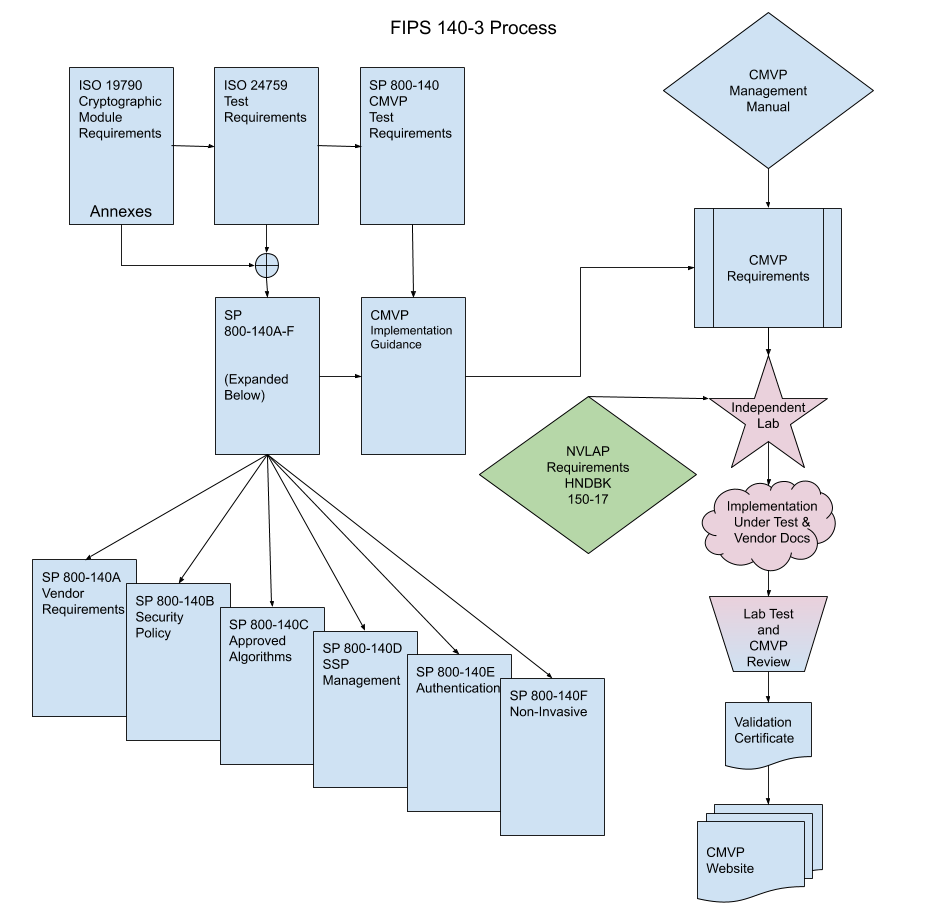
The process illustration from the previous lesson is useful here, but it should not be read as a timeline. It shows that requirements, testing, program guidance, laboratory assessment, and CMVP review interact. Each document entering that process can have its own revision history and applicability conditions.
A useful formalism is:
where:
- is a source or specific source revision;
- is the client’s question and module context; and
- is the decision date or other relevant temporal anchor.
This is deliberately stricter than asking whether a document is “current.” A source can be current but irrelevant to the module type. It can be historically correct but no longer controlling for a new submission. Or it can be generally controlling but subject to a transition rule that changes its effect on a specific case.
Five dates that should not be conflated
For every policy source, distinguish these dates explicitly:
| Date | Meaning | Why it matters |
|---|---|---|
| Publication or release date | When the artifact was issued | Identifies the revision in a document history |
| Effective date | When the policy is intended to govern | Determines whether it was in force at the decision point |
| Transition or sunset date | When an old rule ceases, or a new rule becomes mandatory | May distinguish permitted, recommended, and required treatment |
| Engagement decision date | When the client needs an answer | Anchors your advice |
| Retrieval date | When you checked the authoritative source | Makes the work reproducible and signals when re-checking is needed |
A page may label a document “latest” and show a date. That is strong evidence of present publication status, but do not automatically infer every other date from it. The document itself, its change notice, a transition announcement, or an explicitly referenced program rule may establish a different effective or mandatory date.
For example, a consultant should not write:
The current IG requires the following.
without stating at least the answer’s “as-of” date and the module situation. A more controlled statement is:
As of 9 April 2026, the CMVP IG announcements page lists this IG release as the latest. Its applicability to this prospective FIPS 140-3 submission must still be confirmed against the guidance’s scope and any stated transition treatment.
That wording separates an observed fact from an applicability conclusion.
A source has a lifecycle, not simply a title
A title such as “FIPS 140-3 Implementation Guidance” is not enough to identify a source. The actual object being relied upon is closer to:
For a high-consequence conclusion, add the document’s internal version identifier, its publication date, and a locally retained copy or file hash where your engagement’s document-control process requires it.
Practical source-status labels
Use disciplined labels in notes and deliverables:
| Status | Meaning for advice |
|---|---|
| Current / latest listed | The authoritative CMVP location identifies this as the most recent available release at retrieval time |
| In force | The release is effective at the relevant decision time; confirm this from the authoritative source or governing transition language |
| Superseded | A later revision replaces it for the relevant purpose |
| Withdrawn | The guidance item or document has been formally removed; do not treat it as a live rule |
| Archived | Retained as a historical artifact; useful for reconstructing past decisions, but not presumptively controlling for new work |
| Draft | Informative for planning, but not a basis for representing a CMVP requirement unless explicitly adopted |
| Pending applicability determination | You found the likely source, but still need to establish scope, timing, or a transition condition |
These labels prevent a common error: treating “archived” and “wrong” as synonyms. An archived document may be exactly the right source for answering a historical question:
- “What rule governed this test report when it was finalized in 2024?”
- “Why does an existing certificate contain this caveat?”
- “Was this implementation path permissible when the laboratory began testing?”
But that same archived document normally cannot be used without qualification to advise a client on a new 2026 submission.
Supersession is not retroactive technical magic
A newer policy release can supersede an older release for future decisions without automatically invalidating an existing validation certificate, rewriting a historical test result, or proving that the previous interpretation was erroneous at the time.
Keep the questions separate:
- What controlled when the historical action occurred?
- What controls the current submission, change, or deployment decision?
- Does a transition or maintenance rule explicitly connect the two?
This distinction matters especially in post-validation consulting. A client may be operating under a certificate issued using an earlier policy baseline while planning a security-relevant update that will be evaluated under a later baseline.
Use the official release history, not accumulated PDFs
The CMVP’s IG announcements page is a primary working source for identifying the currently listed IG release and reconstructing changes between releases. Read it not as a technical tutorial, but as a document-control record.
Cryptographic Module Validation Program | CSRC
Read the CMVP’s official IG announcements page to see how a consultant establishes the currently listed IG release and traces a specific guidance item through prior releases.
At the top of the page, locate the table entry for the FIPS 140-3 IG and record the release date identified as the latest version. Then, under the 04-09-2026 update heading, scan the latest change list. Notice that the page identifies individual guidance items and whether they were added, updated, or administratively revised. Next, use the chronological archive below it to trace one topic that matters to your work, such as self-tests, entropy, KEMs, or non-reconfigurable memory. Do not merely search for the topic name: identify the release immediately preceding and immediately following the relevant change. Finally, read the release-history context near the bottom, which explains why older FIPS 140-2-era guidance cannot be assumed to carry into the FIPS 140-3 scheme unchanged.
Several practical conclusions follow from this page:
- The supplied page identifies an IG release dated 9 April 2026 as the latest version.
- It provides archived releases, allowing you to identify what changed rather than merely observing that a new PDF exists.
- It records when individual guidance items are new, updated, or withdrawn.
- A withdrawal should be recorded as such. Do not silently replace it with a nearby or similarly named active guidance item unless the CMVP has explicitly made that connection.
There is also an important temporal discipline here. If you are answering a question dated before 9 April 2026, you cannot cite the 9 April 2026 release as though it had controlled at that earlier time. Conversely, if you are advising on a future submission after that release, an older local copy should not be used merely because it was the version available when the design began.
The “latest version” test
For an IG question, perform this sequence:
- Locate the official CMVP release page, rather than relying on a vendor repository, lab email attachment, presentation slide, or web-search result.
- Identify the latest listed release and record its date.
- Open the release itself and confirm the relevant IG identifier, title, resolution, notes, and scope.
- Review the change history for that IG identifier.
- Locate the prior relevant release if the issue has historical, transition, certificate-maintenance, or finding-response implications.
- Record whether the new text is substantive, editorial, newly introduced, or a withdrawal.
- Establish case applicability before claiming that the latest text governs the client’s exact module and validation situation.
The third and seventh steps are where many otherwise capable teams fail. A change labelled “admin update” may not alter the technical conclusion, but it can still change required terminology, evidence references, or security-policy representation. A new technical resolution may be clearly relevant in subject matter yet still require investigation of its scope, stated dates, or submission-status treatment.
Current does not mean applicable
A current source is only the beginning of the analysis. Test applicability along three dimensions.
1. Temporal applicability
Ask:
- What is the decision date?
- Is this an initial validation, an in-progress laboratory assessment, a CMVP review response, a revalidation, or a deployment assessment?
- Does the source specify an effective date, transition period, sunset, grandfathering condition, or mandatory date?
- Is the client asking for a historical explanation or prospective advice?
A release history alone tells you that the text changed. It does not necessarily tell you whether a particular in-flight submission is handled under the new text. That requires the applicable CMVP process rules, transition statements, and—where the public documents do not settle the issue—a question to the laboratory or CMVP through the established process.
2. Subject-matter applicability
Ask whether the source actually addresses the question. For example:
- An IG on key encapsulation mechanisms is not automatically relevant to a module that does not implement a KEM.
- An operational-environment guidance item may not apply to a fixed hardware module.
- A rule for a particular algorithm, mode, parameter set, or protocol profile may not cover a superficially similar implementation.
- A Management Manual revision may govern a submission-process issue but not answer a technical question about self-test behavior.
Do not use document recency to substitute for technical relevance.
3. Case-state applicability
The same technology can be treated differently depending on its validation state:
| Case state | Typical source question |
|---|---|
| Early design / feasibility | What will likely govern an intended new submission? |
| Laboratory testing in progress | What policy baseline and transition treatment govern this engagement? |
| CMVP review / finding response | What was controlling when the evidence package was finalized, and what current policy affects the response? |
| Existing validation | What did the certificate actually validate and under which historical context? |
| Proposed post-validation change | Which current maintenance, change-management, and technical policies govern the changed configuration? |
This is why a client question should never be accepted in shorthand form, such as “Is KEM allowed?” A consultant should restate it into an assessable question:
For a new FIPS 140-3 module submission planned after the stated date, using this KEM construction within the claimed approved mode, which current CMVP sources govern algorithm status, testing, evidence, and security-policy disclosure?
That restatement determines which source history you need to examine.
Management Manual currency: administration needs its own baseline
The same method applies to the CMVP Management Manual, but its role is administrative and programmatic rather than the primary technical source. The official Management Manual page distinguishes the latest document from its archived versions.
Cryptographic Module Validation Program CMVP
Use this official CMVP page to practice identifying the current Management Manual and separating a current administrative rule from historical versions used to explain prior program actions.
In the section titled “FIPS 140-3 Management Manual,” find the latest-version row and record its displayed date. Read the statement of purpose, then the following paragraph distinguishing administrative guidance from technical requirements. Next, use the “Archived” list to compare the currently listed manual with the explicit V2.6, V2.5, and earlier archived releases. Treat the list as evidence of revision history. For a real engagement, open both the current manual and the historically relevant archived version before asserting that a process rule changed or that it applies to an in-flight submission.
The supplied Management Manual page identifies a latest version dated 04-09-2026 and separately lists archived versions, including V2.6 dated 10-16-2025 and V2.5 dated 05-14-2025. This gives you a practical pattern:
- The official page supports identification of the currently listed document.
- The archive supports reconstruction of historical program conditions.
- The manual’s purpose statement cautions against using it as the primary technical requirements source.
A consultant should therefore avoid this category error:
Management Manual V2.5 says the module must perform a particular self-test.
Instead, separate the claims:
The technical self-test obligation derives from the applicable technical requirement, derived test requirement, and any relevant IG. The Management Manual governs the associated CMVP program process and responsibilities.
A worked policy-trace example
Consider a client who provides an older internal analysis from 2024 stating that there is no CMVP IG specifically addressing the client’s proposed KEM feature. The client plans a new FIPS 140-3 submission in May 2026 and asks whether the old conclusion still holds.
A weak answer would be:
The old analysis is outdated. Use the current IG.
That statement identifies a likely problem but is not yet an analysis.
A defensible approach is:
Step 1: Set the temporal anchor
State the decision context:
- Question: What guidance governs the proposed KEM feature for a prospective submission?
- Decision date: May 2026.
- Validation state: Pre-submission design and evidence planning.
- Relevant scheme: FIPS 140-3 CMVP validation, not a historical FIPS 140-2 assessment.
Step 2: Identify the source family and exact guidance item
The IG announcements history shows that D.S Key Encapsulation Mechanisms was introduced in a later release and subsequently updated. That immediately invalidates the older assertion as a statement about the May 2026 policy landscape.
But do not stop there. Open the current IG release and identify:
- the exact scope of D.S;
- its scenarios and conditions;
- referenced algorithm and test requirements;
- evidence or documentation consequences; and
- any transition wording or cross-references.
Step 3: Classify the old analysis correctly
The 2024 internal analysis is now a historical design artifact, not a controlling policy source for the May 2026 submission. Preserve it in the traceability record, but mark its conclusion as superseded for prospective planning.
Step 4: Test applicability
The current KEM guidance is relevant only if the module’s construction actually falls within its defined scope. Determine, for example:
- whether the module implements a KEM or merely invokes an external service;
- whether the feature is in the claimed approved mode;
- which algorithm profile and use case are implemented;
- what implementation is inside the cryptographic boundary; and
- which algorithm-validation and evidence conditions are implicated.
Step 5: State a bounded conclusion
A suitable preliminary conclusion could read:
The internal 2024 conclusion is not suitable as the policy baseline for a May 2026 FIPS 140-3 submission. The official IG release history shows later KEM-specific guidance. The current IG must be evaluated against the proposed module’s KEM construction, operational mode, boundary, and claimed validation configuration before determining design, testing, and documentation obligations.
Notice what this does not claim: it does not prematurely declare the KEM implementation compliant, non-compliant, Approved, or testable. Currency analysis establishes the correct source baseline; technical interpretation comes next.
A reusable source-decision record
For each non-trivial client question, create a short record before drafting advice. This is not yet the full course checklist; it is a focused work product that makes your analysis auditable.
| Field | Record |
|---|---|
| Question ID and decision sought | A precise, bounded policy question |
| Client and module context | Module type, configuration, feature, claimed mode, security level where relevant |
| Case state | Design, lab testing, CMVP review, existing certificate, or post-validation change |
| Decision date | The time against which applicability is being evaluated |
| Source identity | Issuer, title, document version or release date, official URL |
| Retrieved on | Date you checked the authoritative location |
| Current-status evidence | Latest-version listing, publication page, document front matter |
| Historical-status evidence | Archive entry, change summary, withdrawal notice, prior revision |
| Effective / transition evidence | Explicit effective date, sunset date, transition notice, or “not found” |
| Scope conditions | Technology, module type, level, use case, test area, program stage |
| Conclusion | Current and applicable; historical only; superseded; withdrawn; or unresolved |
| Open issue / owner | What must be confirmed, by whom, and before which decision gate |
Two fields deserve special attention: effective / transition evidence and open issue / owner. If you have not found an explicit transition rule, record that fact rather than silently assuming one. This turns uncertainty into a managed consulting action.
Recommended conclusion language
Use calibrated wording that distinguishes fact from inference:
- Current-status fact: “The official CMVP page lists the release dated [date] as the latest version when checked on [retrieval date].”
- Historical fact: “The archive identifies [older version] as a prior release dated [date].”
- Applicability conclusion: “For the stated prospective submission context, the current release is the appropriate starting baseline, subject to the source’s scope and any transition terms.”
- Unresolved condition: “No explicit public transition statement has yet been identified for this in-progress assessment; laboratory confirmation is required before committing to a schedule or design conclusion.”
Avoid these formulations:
- “The latest document always applies.”
- “The archived version is invalid.”
- “The lab told us this last year, so it remains policy.”
- “The CMVP website has changed, therefore the certificate is no longer valid.”
- “A later IG update proves the previous interpretation was wrong.”
Each collapses important differences between release status, applicability, historical evidence, and validation state.
Key takeaways
A reliable FIPS 140-3 or CMVP policy answer is controlled by more than a document title. You must identify the exact release, establish its current or historical status from an authoritative source, distinguish publication from effective and transition dates, and test whether the source applies to the module feature and case state at issue.
The official IG announcements page and Management Manual page provide two core evidence patterns: a latest-version indication and an archived revision history. Use both. A current release can be irrelevant; an archived release can be essential historical evidence; and neither status alone settles a transition or scope question.
Your working discipline is:
Next, you will use this currency discipline together with the source-role map to resolve an apparent conflict among a base requirement, a derived test requirement, and CMVP Implementation Guidance.