Welcome back. In our last lesson, we charted the divergent paths of French Realism by comparing Balzac's vast social panorama in Père Goriot with Flaubert's meticulously focused psychological study in Madame Bovary. This comparison highlighted that realism was not a single doctrine but a dynamic and varied artistic movement.
Today, we cross the English Channel to explore a different, though related, tradition. We turn our attention to Charles Dickens and his masterpiece, Great Expectations. This novel will be our entry point into the world of English Realism. Our goal is to identify its key features by examining three intertwined themes that are central to the novel and to Dickens's social vision: social mobility, the dawning of class consciousness, and the complex path of moral development. Through the journey of the protagonist, Pip, Dickens provides a profound commentary on the class structure, values, and anxieties of Victorian England.
The Spark of Ambition: Class Consciousness
Like many realist novels, Great Expectations is deeply concerned with how an individual's identity is shaped by their social environment. The novel begins with its young protagonist, Pip, seemingly content with his life and his destiny to become a blacksmith like his kind brother-in-law, Joe Gargery. This initial state of innocence, however, is not destined to last.
The story's inciting incident occurs in a lonely churchyard, a moment powerfully captured in early illustrations of the novel.
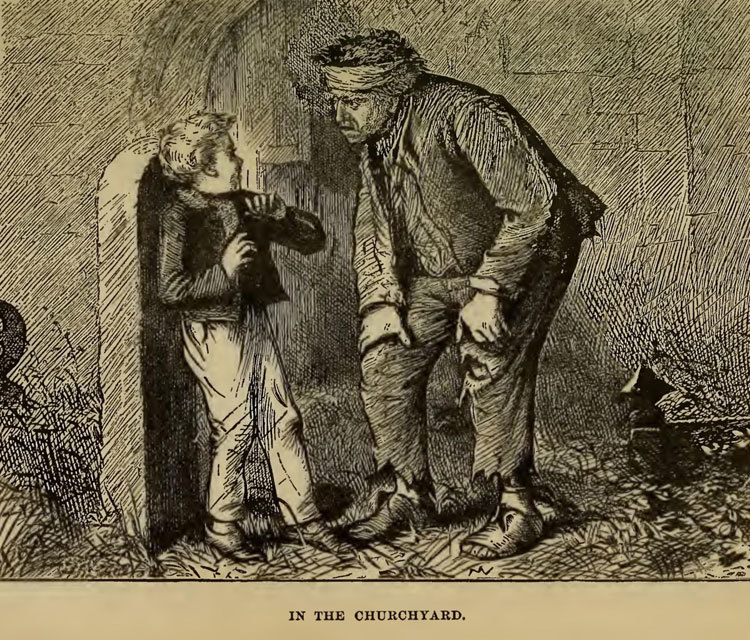
While this encounter with Magwitch introduces the themes of crime and hidden connections, it is Pip's introduction to the genteel, albeit decaying, world of Satis House that truly ignites his class consciousness. His interactions with the eccentric Miss Havisham and her beautiful, cruel ward Estella fundamentally alter his perception of himself and his world. For the first time, he is made to feel "common," and this newfound shame becomes the driving force of his ambition.
To understand this crucial turning point, let's examine a short analysis of Pip's psychological shift.
[PDF] The portrayal of class and social mobility in Charles Dickens' Great ...
This academic paper provides a clear analysis of how Pip's class awareness develops. It details his internal conflict after his visits to Satis House.
Please read the section titled "Pip's working-class background" (starting on p. 10). Pay close attention to how the author describes Pip's change in attitude towards Joe's trade and the life he once accepted without question.
As the reading makes clear, Estella’s scorn for his "coarse hands" and "thick boots" instills in Pip a deep sense of inadequacy. His world, once simple and secure, is now measured against a new, seemingly superior standard. The forge, once his future, becomes a symbol of the "commonness" he desperately wants to escape. This internal crisis—this awakening of class consciousness—is the essential first feature of realism we see at play. The novel isn't just telling a story; it's dissecting the psychological impact of a rigid social hierarchy on an individual's sense of self-worth.
The Journey Upward: Social Mobility
Pip's shame and his love for Estella fuel a powerful desire to become a "gentleman." This ambition is mysteriously fulfilled when he is informed by the lawyer, Mr. Jaggers, that he is the beneficiary of "great expectations" from an anonymous benefactor. This sudden fortune initiates his journey of social mobility, a theme that fascinated Victorian society and its novelists.
Dickens himself was acutely aware of the fluidity of class in his era. The Industrial Revolution had created new avenues for wealth and social advancement, but also new forms of poverty and instability. The following video from the British Library provides excellent context for this social dynamism and its portrayal in Great Expectations.
Class mobility in Great Expectations
This short video, "Class mobility in Great Expectations," features Professor John Mullan discussing the social context of the novel.
Please watch from the beginning to the end of the discussion on Magwitch. Note the distinction he draws between the triumphant story of social climbing in David Copperfield and the "darker and more haunted version" told in Great Expectations.
As the video explains, Pip's journey is no simple rags-to-riches tale. It is a story "haunted by guilt." His social ascent comes at a moral cost. He moves to London, acquires the superficial trappings of a gentleman—fashionable clothes, a servant, idle habits—but in the process becomes ashamed of his origins. He grows cold and condescending toward the very people who loved him most, particularly Joe.
This tension is a hallmark of Dickens's realism. Social mobility is not presented as an uncomplicated good. Instead, it is a complex process that tests an individual's character, severs old loyalties, and creates a profound sense of alienation. Pip's move from the forge to London is not just a change in location and wealth; it is a fundamental shift in his identity, and one that leaves him morally adrift.
The True Gentleman: Moral Development and the Bildungsroman
This brings us to the third and most philosophically rich feature of realism in the novel: moral development. Pip's journey forces him, and the reader, to question the very definition of a "gentleman." Is it a matter of wealth, manners, and social status, as the young Pip believes? Or is it a quality of the heart and character, exemplified by the illiterate but deeply good Joe Gargery?
Great Expectations belongs to a genre known as the Bildungsroman, or a "novel of education," which traces the protagonist's development from youth to maturity. However, as Professor Mullan noted in the video, Dickens subverts the genre's typical arc of triumphant fulfillment. Pip's expectations lead not to happiness, but to debt, disillusionment, and a profound identity crisis when the shocking source of his wealth is revealed.
The novel’s realism lies in this unflinching psychological portrait of a young man grappling with his own flawed character. A superb analysis on the website Literariness.org delves into this psychological complexity.
Analysis of Charles Dickens's Great Expectations
This detailed commentary explores the novel's psychological depth and its central moral questions. It offers a sophisticated perspective that aligns with your interest in philosophical and systemic analysis.
In the "COMMENTARY" section, please read the paragraphs from "Expectations is more realistic..." to understand the novel's specific brand of realism. Then, skip to the paragraph beginning "This division indicates Pip's fractured sense of self." This part offers a compelling psychological framework for Pip's character. Finally, in the "CHARACTERS" section, read the short entry on Joe Gargery. This will solidify your understanding of Joe's role as the novel's moral compass.
The concept of Pip's "fractured sense of self" is crucial. His attempt to suppress his "common" past in favor of a genteel future creates a deep internal division. He cannot reconcile the boy from the forge with the man he wants to become. The journey of the novel is largely about his painful process of integrating these disparate parts of himself.
His moral education culminates in his ability to reject the false values of his "expectations" and recognize the true worth of the people he abandoned. He learns to see Magwitch not as a terrifying criminal, but as a suffering human being to whom he is bound by a profound obligation. He learns to appreciate Joe's "gentle Christian" nature as the true mark of a gentleman. This development is not a straight line to success, but a circular journey back to the values he initially spurned, now understood with the wisdom of painful experience.
Conclusion
In Great Expectations, Charles Dickens masterfully employs the personal story of one individual to critique the class structure and moral landscape of Victorian England. We have identified three defining features of his realist approach in this novel:
- Class Consciousness: The detailed psychological exploration of how social status shapes self-perception, leading to shame and ambition.
- Social Mobility: A critical examination of the fantasy of social climbing, highlighting its moral costs and the alienation it can produce.
- Moral Development: The tracing of a protagonist's flawed journey toward a more profound understanding of value, contrasting superficial gentility with innate human goodness.
Unlike the broad sociological mapping of Balzac or the stylistic microscopy of Flaubert, Dickens's realism operates through a powerful blend of social commentary and deep psychological and moral investigation. He creates unforgettable, often eccentric characters and dramatic plots to explore the real-world pressures of money, class, and conscience on the human heart.
In our next lesson, we will examine the primary narrative technique Dickens uses to achieve this effect: first-person retrospective narration. We will analyze how having an older, wiser Pip tell the story of his younger self allows for the rich layers of irony, judgment, and reflection that make the novel's exploration of these themes so powerful.