Hello. In our previous lessons on Madame Bovary, we have focused on Gustave Flaubert's groundbreaking techniques. We began by establishing his principle of authorial impersonality and then dissected the primary tool he used to achieve it: free indirect discourse. We saw how this narrative mode allowed him to merge the narrator's voice with the character's consciousness, giving us unfiltered access to Emma's inner world.
Today, we will analyze why Flaubert gives us this access. His goal was not simply to create a psychologically realistic portrait. By immersing us in Emma's mind—a mind saturated with the clichés of popular romantic fiction—Flaubert constructs one of the most powerful critiques of the Romantic movement ever written. In this lesson, we will explore how Flaubert uses Emma's illusions, from her youthful fantasies to her tragic end, to expose what he saw as the dangerous falsehoods of romanticism. This analysis is central to understanding Flaubert's specific brand of realism.
The Romantic Ideal and the Ache of Sehnsucht
Before we can understand Flaubert's critique, we must first define what he is critiquing. The target is not the entire, complex Romantic movement, but rather its popular, sentimentalized form, which dominated the cheap novels and ladies' magazines of the era. This brand of romanticism peddled fantasies of absolute love, heroic passion, and exotic escape from the mundane.
This yearning for something beyond the grasp of everyday reality has a name in German philosophy and literary theory: Sehnsucht. It signifies a deep, often painful, longing for an unattainable ideal. It is, as the poet Shelley wrote, "The desire of the moth for the star." An excellent academic paper, "The Romantic Longing for Absolute Love," explores this very concept in the context of Madame Bovary.
[PDF] The Romantic Longing for Absolute Love in Flaubert's Madame Bovary
This paper by Shun-Liang Chao introduces the central argument that the novel is an ironic critique of romanticism, and provides a philosophical definition of the "Romantic longing" that drives Emma. Given your interest in philosophy, you will likely find its use of Kantian and Lacanian ideas to frame the concept particularly engaging.
First, read the introduction to grasp the paper's core thesis about irony and romantic longing. Then, read section I, beginning with "Let me begin", which defines Sehnsucht and connects it to philosophical concepts of the sublime and the unfillable gap between desire and reality.
As the paper explains, this longing creates a fundamental conflict: an infinite desire for transcendence trapped within a finite, dissatisfying reality. For Flaubert, this isn't just a philosophical problem; it's a psychological condition, and Emma Bovary is his primary case study. She is a character who contracts a romanticized worldview like a disease, and the novel charts its devastating progression.
The "Education" of Emma Bovary
Emma is not born with these illusions; she acquires them. Her education at the convent and her voracious reading of sentimental novels provide her with a complete, ready-made vocabulary and set of expectations for life. Love should be ecstatic, lovers should be dashing, and life should be a series of dramatic, passionate encounters. These readings form a "code" through which she interprets the world, a code that is entirely disconnected from her actual circumstances.
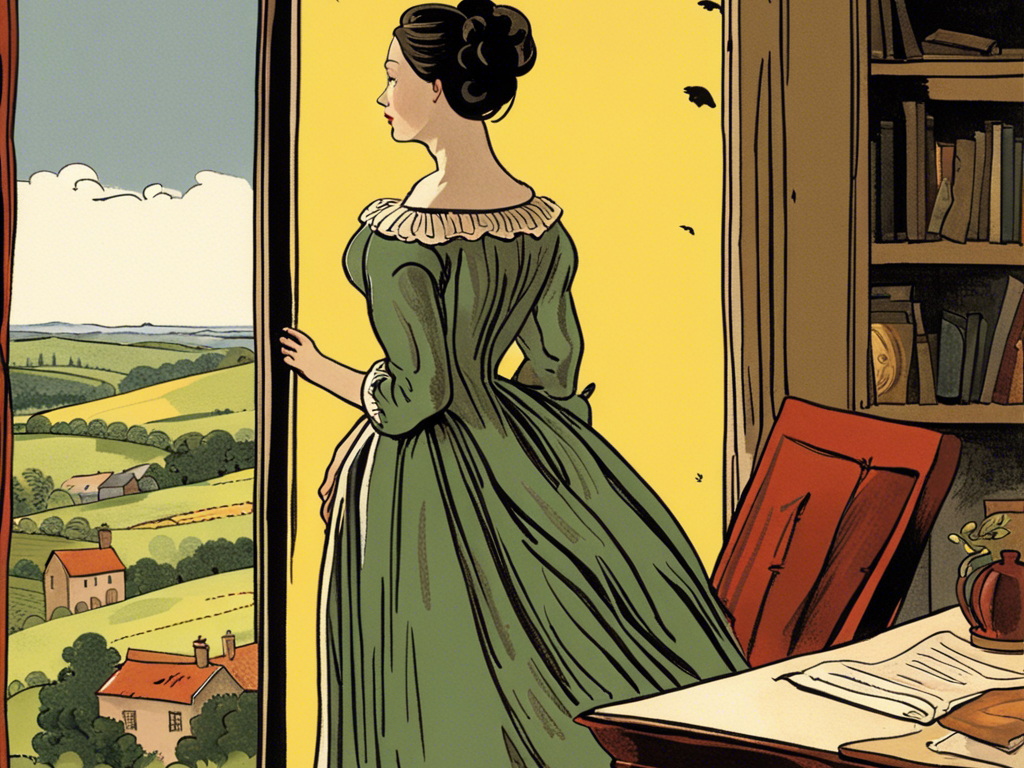
Flaubert uses his signature irony, powered by the free indirect discourse we studied, to expose the absurdity of this code.
[PDF] Birds eye view on Madame Bovary by Flaubert - IJIRT
This paper analyzes Flaubert's use of irony to deflate his characters' pretensions. It specifically details how the chapter on Emma's convent education establishes the "code" of romanticism that she will follow for the rest of her life.
In the section titled "Flaubertian Irony," please read from the paragraph that begins, "When Flaubert writes...". Focus on how Flaubert details the specific content of Emma's fantasies—the exotic locations, noble ladies, and sentimental clichés—to establish the system of values she will tragically try to apply to her own life.
By outlining this "code" so clearly, Flaubert provides us with the key to his critique. We are made aware of the lens through which Emma sees the world. When we later hear her thoughts of "bliss, passion, and ecstasy," we recognize them not as genuine feelings, but as echoes of the novels she has read. The tragedy of the book is watching a character desperately try to make reality conform to a fictional template.
The Illusions Collide with Reality
Emma's marriage to the kind but dull Charles Bovary is the first and most brutal collision between her romantic fantasies and reality. She expects the "rapture" described in her books, but instead finds the "dead calm" of a stable, unexciting provincial life.
The turning point comes with the ball at the Marquis d'Andervilliers' château, La Vaubyessard. For one night, Emma's fantasy world becomes real. She waltzes with aristocrats, sips champagne, and breathes the perfumed air of high society. This experience doesn't satisfy her; it ruins her. It gives her a tangible glimpse of the life she believes she is entitled to, making her return to Yonville unbearable. The paper on "Romantic Longing" describes this moment with striking clarity.
[PDF] The Romantic Longing for Absolute Love in Flaubert's Madame Bovary
This next section of the paper traces Emma's longing as it manifests in her life, starting with the convent and culminating in her disillusioning affairs.
Please read the beginning of section II, from "Critics often ascribe...". Pay close attention to the analysis of the ball at La Vaubyessard and the metaphor of it creating a "chasm [un trou] in her life."
This "chasm" is the gap between the ideal and the real. Emma spends the rest of the novel trying to fill it. Her affairs with the cynical womanizer Rodolphe and the sentimental clerk Léon are not merely acts of infidelity; they are desperate attempts to cast herself as the heroine in her own real-life romance. She tries to force these banal men and sordid encounters into the narrative framework of her books. But reality refuses to cooperate. Rodolphe finds her intensity tiresome and abandons her with a cliché-ridden letter. Léon, initially a kindred spirit, is ultimately frightened by her "excessive" personality and retreats into the safety of a conventional life. Each attempt to live the illusion only deepens her disillusionment.
The Final Critique: An Unromantic Death
The ultimate expression of Flaubert's critique comes in the novel's devastating conclusion. Having exhausted all avenues of escape and facing financial ruin, Emma decides to commit suicide. In her mind, shaped by romantic literature, this is the final, dramatic act of a tragic heroine. She imagines a swift, peaceful, almost beautiful death.
Flaubert denies her this last illusion. The reality of death by arsenic is grotesque, painful, and humiliating. In the following video, literary commentator Julian de Medeiros gives a vivid analysis of how Flaubert contrasts Emma's romantic expectation with the brutal reality.
Madame Bovary: The Vicissitudes of Realism
This video, "Madame Bovary: The Vicissitudes of Realism," analyzes the novel's anti-romantic core, focusing on the gap between imagination and reality.
Please watch the section describing Emma's death. Note the stark contrast between her fantasy of a "perfectly pretty death" and the agonizing, grotesque reality. Then, continue watching for the analysis of the blind man's song, which provides the scene's final, horrifying layer of irony.
The drawn-out, clinical description of Emma's physical suffering is a masterstroke of realist technique. Flaubert forces the reader to confront the brute fact of her death, stripping it of all romantic glamour. The appearance of the blind beggar singing his lewd song about a lusty maiden at the very moment of her death is the novel's cruel, final joke. The romantic ideal she chased her whole life is thrown back at her in its most degraded form as she dies. It is the ultimate statement that her dreams were not just unattainable, but a grotesque lie.
Conclusion
Throughout Madame Bovary, Flaubert conducts a systematic demolition of the romantic worldview. He shows that a consciousness shaped by sentimental fiction is tragically ill-equipped to navigate the complexities and disappointments of real life.
Here are the key points of his critique:
- Source of the Illusion: Emma's romantic ideals are not innate but acquired from her reading of popular, sentimental novels, which provide a false "code" for life.
- The Clash with Reality: These ideals inevitably shatter against the mundane reality of her provincial marriage and social station.
- Adultery as Failed Fantasy: Her affairs are not pursuits of love, but desperate attempts to live out a literary fantasy, leading to further disillusionment.
- The Unromantic Truth: Flaubert uses graphic, clinical realism, most notably in Emma's agonizing death, to expose the ugly truth that lies beneath romanticized notions of passion and suffering.
By using Emma Bovary as a vehicle for romantic illusions and then relentlessly demonstrating their failure, Flaubert makes a powerful case for his own realist aesthetic. For him, the purpose of the novel was not to provide escape, but to confront the world in all its unvarnished, and often disappointing, truth.
In our last lesson on Flaubert, we will take a step back and compare his approach to realism—focused, psychological, and stylistically meticulous—with the panoramic social realism of Honoré de Balzac that we studied earlier. This will help solidify your understanding of the different forms realism took in 19th-century France.