Welcome back. In our previous lessons on Balzac, we identified a fundamental tension in his work. We saw a realist, meticulously documenting the economic and social realities of the Maison Vauquer, who simultaneously deployed the romantic devices of monomania and melodrama through characters like Goriot and Vautrin. Balzac, the author, was a very visible presence—a showman, a historian, and a moralist all at once.
Today, we turn to Gustave Flaubert, who represents a crucial, almost dialectical, response to this style. Flaubert sought to purge the novel of this authorial presence, to take the next great leap in the development of realism. Our objective in this lesson is to understand his foundational principle: authorial impersonality. We will explore what this principle means, how Flaubert achieved it through an obsessive dedication to style, and why it was so revolutionary that it put him on trial.
The Author as God: A New Aesthetic Ideal
Reacting against the perceived sentimentality of Romanticism and the authorial intrusions common in writers like Balzac, Flaubert proposed a radical new role for the artist. He articulated this vision in a now-famous letter: the author in his work should be like God in the universe, "present everywhere and visible nowhere."
This is the philosophical cornerstone of Flaubertian realism. It is not an argument for a cold or inhuman art. Rather, it is a call for a different kind of artistic truth, one that does not depend on the author's declared opinions or moral signposting. The world of the novel should be a self-contained system, coherent and objective, where events unfold with an air of inevitability, unmediated by a narrator's explicit judgment.
The website for Yale's Modernism Lab provides a concise summary of this idea.
This article introduces Flaubert's concept of the "godlike artist" and connects it to his narrative strategy.
Please read the first paragraph, from the beginning of the article. Pay close attention to the explanation of the author being "present everywhere and visible nowhere" and what this implies: the avoidance of direct moral judgments and the use of an unobtrusive narrator.
This principle of impersonality marked a significant departure. Where Balzac acted as a social historian, Flaubert aspired to the objectivity of a scientist. His goal was not to tell the reader what to think about society, but to present it so precisely that its inner workings would be self-evident.
The Science of Style: Le Mot Juste
How does an author become "invisible"? For Flaubert, the path to impersonality was through an almost fanatical devotion to style. If the author's personality, biases, and opinions were to be erased, the language itself had to achieve a state of perfection and precision. He spent five years of grueling labor on Madame Bovary, sometimes spending a week on a single page, in a relentless search for le mot juste—the perfect word.
The logic is compelling: if each sentence is perfectly constructed, each word the only possible choice, the prose achieves a kind of objective truth. It no longer feels like one person's subjective account, but rather like an unmediated window onto reality itself. The style becomes, in Flaubert's own words, "an absolute manner of seeing things."
The following video discusses Flaubert's painstaking process and the technical innovations he developed to achieve this effect.
How to Read Madame Bovary by Gustave Flaubert
This segment from Benjamin McEvoy's lecture details Flaubert's obsessive writing habits and explains how his search for the perfect word and the "invisible narrator" are central to his realist technique.
Watch the section from the discussion of authorial tools. Focus on the three key ideas presented: Le Mot Juste: The concept of the "perfect word" and Flaubert's laborious process. Musicality and Precision: The attempt to create prose as rhythmic as verse and as precise as science. The Invisible Narrator: The explicit goal of being "present everywhere and visible nowhere," with a concrete example of Flaubert's objective-seeming prose.
As the video explains, this stylistic obsession creates a paradox. The novel, meant to depict the mundane and commonplace, becomes a "highly wrought, beautiful luxury item." The immense artifice of the author's labor is deployed to create an illusion of artlessness, of pure, unadorned reality.
Mapping Narrative Perspective
To better grasp this shift from Balzac to Flaubert, it can be useful to think in terms of a structured model of narrative perspective. The literary theorist Dorrit Cohn proposed such a model, which helps clarify the relationship between narrator and character.
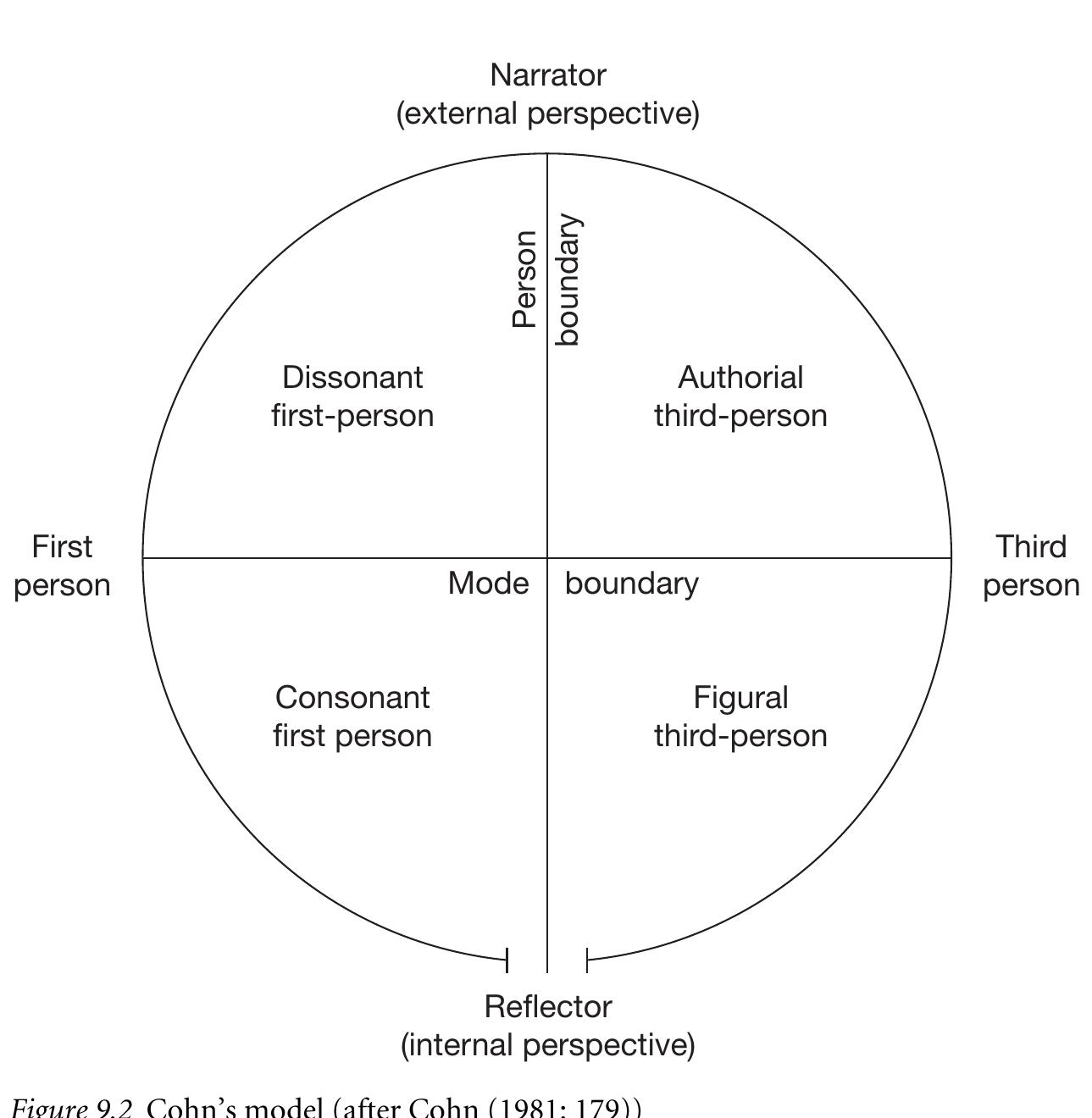
In this model, Balzac, especially when he offers sweeping social commentary, largely operates in the top-right quadrant: Authorial third-person. The narrator is a knowledgeable, external entity who stands above the story and its characters.
Flaubert's revolution was to abandon this authorial perch and commit fully to the bottom-right quadrant: Figural third-person. Here, the narrative, while still in the third person, is filtered through the consciousness of a character (a "reflector"). Flaubert's principle of impersonality is the aesthetic and philosophical engine that drives this technical shift. He seeks to erase the "Narrator (external perspective)" and fuse the narrative voice with the "Reflector (internal perspective)," so that the reader experiences the world through the character's senses and thoughts, without the author's overt guidance.
The Significance: A Revolution Put on Trial
Flaubert's commitment to impersonality was not merely a stylistic preference; it was a profound redefinition of the novel's purpose and the author's moral responsibility. And its impact was so immediate and unsettling that it led to one of the most famous literary trials in history.
In 1857, Flaubert was prosecuted for "offense to public and religious morality" for publishing Madame Bovary. Crucially, the prosecution's case rested not just on the novel's depiction of adultery, but on the way it was depicted. The prosecutor, Ernest Pinard, was confounded by the lack of a clear moral voice. As the Modernism Lab article notes, he asked in court: "Who can condemn this woman in the book? Nobody... There is not in the book a character who can condemn her."
This section explains how Flaubert's technical innovations created moral ambiguity, which became the central issue at his trial.
Read the second half of the article, beginning from the paragraph that starts here. Focus on the prosecutor's complaint about the author's refusal to render an explicit moral judgment and how this was seen as a violation of an author's duty.
The prosecutor's argument is remarkable because it confirms the success of Flaubert's project. The absence of an authorial voice condemning Emma's actions was interpreted as a tacit endorsement. Flaubert's refusal to judge was, in the eyes of the court, a moral crime. This demonstrates just how radical and unfamiliar the principle of impersonality was. It challenged the fundamental expectation that literature should provide clear moral instruction. By presenting events without explicit condemnation or praise, Flaubert forced the reader into a new, more active and ethically complex role.
Conclusion
In this lesson, we have defined and explored Flaubert's principle of authorial impersonality, a concept that fundamentally altered the course of literary realism.
Here are the key takeaways:
- A New Ideal: Flaubert's goal was for the author to be "present everywhere and visible nowhere," creating a self-contained, objective novelistic world without direct authorial commentary or moralizing.
- The Method of Style: This impersonality was achieved through a rigorous, scientific devotion to style, centered on the search for le mot juste (the perfect word). This precision aims to make the prose feel inevitable and objective.
- A Shift in Perspective: This principle marks a move from the "authorial" narration of Balzac to a "figural" narration, where the story is filtered through a character's consciousness.
- Revolutionary Significance: The technique was so new and unsettling that it led to Flaubert's obscenity trial. The lack of an explicit authorial judgment was itself seen as a moral transgression, proving how thoroughly Flaubert had subverted the traditional role of the narrator.
Flaubert's impersonality is not simply about what he leaves out, but what he masterfully puts in. In our next lesson, we will dissect the primary grammatical and stylistic tool he used to achieve this effect: free indirect discourse. Having established the "why" of his method, we will turn to the "how," analyzing specific passages from Madame Bovary to see this revolutionary technique in action.