Welcome to the first lesson of your course on effective teaching methods. We'll begin by exploring the cognitive foundations of learning, as understanding how the brain learns is the first step toward designing instruction that truly works. Your interest in psychology and cognitive science will be a great asset as we navigate these foundational concepts.
Today's lesson focuses on the two most critical components of our memory system: working memory and long-term memory. Our goal is for you to be able to describe how these two systems interact during the learning process. This understanding is the bedrock upon which many effective teaching strategies are built, from explaining complex technical topics to designing engaging practice activities.
The Information Processing Model: A Mental Blueprint
To understand how memory works, cognitive scientists often use the Information Processing Model. Given your background teaching computer courses, you might find this model's central analogy quite intuitive: the human mind is treated as an information processing system, much like a computer. It takes in input, processes it, and stores it for later use.
This model proposes that our memory is not a single entity, but a system of interconnected components. The three primary stages are:
- Sensory Memory: The very brief, initial recording of sensory information (what we see, hear, etc.).
- Working Memory: The "workbench" of the mind where we actively process information. It's conscious and has a very limited capacity. You can think of it as the brain's RAM.
- Long-Term Memory: The vast, seemingly permanent storage of knowledge and skills. This is analogous to a computer's hard drive.
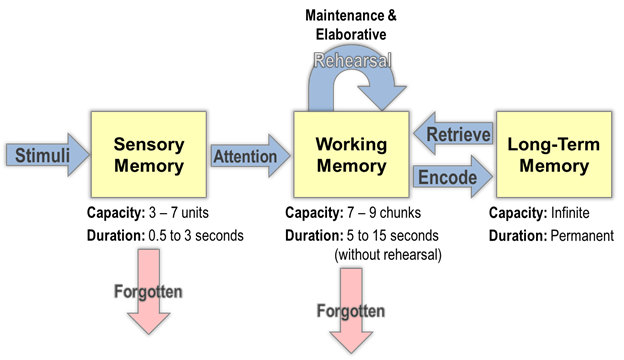
The diagram above provides a high-level map of this system. Learning, in essence, is the process of moving information from our working memory into our long-term memory in a durable and accessible way.
Getting Acquainted with the Components
Let's start with a clear overview of these memory stages. The following video from Khan Academy provides a concise explanation of the information processing model, detailing the role and characteristics of each component.
Information processing model: Sensory, working, and long term memory | MCAT | Khan Academy
This video provides a solid introduction to the three main stages of the information processing model. As you watch, focus on the distinct function and limitations of each memory store.
Please watch the following segments: First, the introduction to the model. Then, the explanation of sensory memory and the crucial role of attention. Next, focus on the description of working memory, particularly its limited capacity. Finally, get an overview of long-term memory as the final storage stage.
As the video explained, information flows from our senses into sensory memory. If we pay attention to it, it moves into our working memory. This is the first critical point of interaction: attention is the gatekeeper. As an instructor, simply presenting information doesn't guarantee it enters a student's working memory; you must first capture their attention.
Once in working memory, the information is actively manipulated, thought about, and processed. This is where the real "work" of learning happens. But as you heard, this workspace is incredibly small, able to hold only a handful of items at once.
The Two-Way Street: How Working and Long-Term Memory Interact
Now we arrive at the core of our lesson. The interaction between working memory (WM) and long-term memory (LTM) is not a simple one-way transfer. It's a dynamic, two-way street involving two key processes: encoding and retrieval.
1. Encoding: Moving Information into Long-Term Memory
Encoding is the process of converting information from working memory into a format that can be stored in long-term memory. However, not all processing is equal. The way we process information in working memory dramatically affects how well it's encoded. This is often referred to as "levels of processing."
The following reading explains this concept using a classic experiment.
Working memory and its role in teaching and learning
This article from The Education Hub discusses how the quality of processing in working memory is vital for building strong long-term memories.
Please read the section titled "How processing in the working memory can support better long-term memory." Focus on the experiment described and its conclusion: the key finding was that processing the meaning of information led to far better memory than processing its superficial features (like its shape or sound).
The key takeaway for you as a teacher is that learning isn't about rote repetition. For your students to truly learn a programming concept, they need to engage with its meaning. Asking them "What does this function do?" or "Why would we use a while loop instead of a for loop here?" encourages the kind of deep, meaningful processing that leads to durable long-term memories.
2. Retrieval & Integration: Using Long-Term Memory to Learn
Here is the other side of the interaction: working memory doesn't just process new, incoming information in a vacuum. It actively pulls relevant, existing knowledge from our long-term memory to make sense of the new material. This process of connecting new information to what we already know is called integration, and it's perhaps the most critical part of learning.
This is how we build what are called mental models or schemas—organized networks of knowledge in our long-term memory. When teaching, your goal is to help students build accurate and robust schemas for the concepts you're teaching.
The following video provides an excellent analogy and a concrete example of how working memory selects, organizes, and integrates new information with prior knowledge from long-term memory.
The Role of Working Memory for Learning
This video from Medmastery uses a great Lego analogy and a practical example to illustrate how working memory builds mental models and integrates them with existing knowledge.
Please watch the segment from organizing and integrating. Pay close attention to how the new information about cloud formation is connected to pre-existing knowledge (e.g., that warm air rises) to create a new, coherent mental model in long-term memory.
This process of integration is happening constantly in your classroom. When a student learns about object-oriented programming for the first time, they aren't starting from scratch. Their working memory pulls their existing schemas for "variables," "functions," and "data types" from their long-term memory. It then uses this prior knowledge as an anchor to understand the new concepts of "classes," "objects," and "methods," integrating them into a new, more complex schema. Your role as a teacher is to facilitate this integration by explicitly linking new concepts to what students already know.
From Effortful Processing to Effortless Expertise
What happens when we practice and repeatedly retrieve a piece of information? The connections become stronger, and the schema becomes more robust and easily accessible. Eventually, using this knowledge becomes automatic, requiring very little conscious effort from our working memory.
Think about driving a car. When you were a learner, every action—checking mirrors, pressing the clutch, steering—consumed your full attention. Now, these actions are likely automatic. Your working memory is free to focus on navigating traffic and planning your route. The same applies to technical skills.
Let's read a final excerpt that describes this journey from novice to expert.
Working memory and its role in teaching and learning
This final reading explains the stages of learning and how mastering a concept reduces the burden on our limited working memory.
Read the two short sections titled "Making meaning" and "How much of the working memory capacity does it take?" Focus on how a concept moves from simply being known to being understood, and finally, how mastery makes its use automatic and effortless.
This principle is fundamental to teaching complex subjects like computer science. By ensuring students master foundational concepts (like variables, data types, and control flow) to the point of automaticity, you free up their precious working memory resources. This allows them to tackle more complex problems, like designing algorithms or debugging complex programs, without becoming overwhelmed.
Conclusion
In this lesson, we have laid the groundwork for understanding how learning happens at a cognitive level. We've moved from a simple "computer" analogy to a more nuanced picture of a dynamic, interactive memory system.
Here are the key takeaways:
- Learning involves a flow of information from the environment through sensory memory, into the active workspace of working memory, and finally into the vast storage of long-term memory.
- Working memory is the bottleneck. It is where conscious thought occurs, but its capacity is severely limited.
- The interaction between working and long-term memory is a two-way process:
- Encoding: New information is processed meaningfully in working memory to be stored in long-term memory.
- Retrieval/Integration: Prior knowledge is pulled from long-term memory to help working memory make sense of new information.
- Practice and repeated retrieval lead to automation. Well-developed schemas in long-term memory can be used automatically, freeing up working memory to handle more complex tasks.
This brings us directly to our next topic. Given that working memory is so limited, one of the biggest challenges in teaching is to avoid overwhelming it. In the next lesson, we will explore Cognitive Load Theory, which provides a powerful framework for designing instruction that respects the limits of working memory and maximizes learning.