In our previous lesson, we demystified the classic loop-closure bug, solidifying your understanding of how a function's [[Environment]] slot creates a persistent link to its surrounding variables. You learned that this "backpack" is not a copy but a live reference, and you can now diagnose and fix related issues using let, IIFEs, or bind, explaining the mechanics of each solution.
Today, we'll leverage that deep understanding of closures for a constructive purpose: performance optimization. We will implement memoize, one of the most powerful and practical patterns in a senior developer's toolkit. This lesson will move you from simply understanding closures to actively using them to build higher-order functions that can dramatically speed up your applications. This is a topic that frequently appears in senior interviews, not just as a "gotcha," but as a live-coding challenge to assess your grasp of closures, higher-order functions, and performance trade-offs.
Why This Matters at a Senior Level
[Always asked]
Any mid-level developer can use a memoize function from a library like Lodash. A senior engineer is expected to be able to build it from scratch and articulate its inner workings and trade-offs. Implementing memoize demonstrates a command of several core JavaScript concepts at once: higher-order functions, closures, rest/spread syntax, and the nuances of creating cache keys. In a system design context, it shows you think about performance bottlenecks and the classic space-for-time trade-off. Failing to explain this pattern in an interview is a significant red flag; mastering it is a clear signal of seniority.
The Core Problem: Expensive, Repetitive Calculations
Imagine a function that performs a computationally expensive task. A classic example is calculating a Fibonacci number recursively, which involves many repeated calculations.
// A naive, expensive Fibonacci function
const fib = (n) => {
  if (n <= 1) return n;
  return fib(n - 2) + fib(n - 1);
};
Calling fib(42) can take a noticeable amount of time. Calling it a second time with 42 is just as slow. This is wasteful. Since fib is a pure function (the same input n always produces the same output), we should be able to cache the result of the first call and return it instantly on subsequent calls. This is the essence of memoization.
The image below illustrates this perfectly. The first execution of mfib(42) (a memoized Fibonacci function) takes over 5 seconds. The second execution takes 0 milliseconds because the result is retrieved from a cache.

Our goal is to create a generic, higher-order function called memoize that can wrap any pure function and give it this caching superpower.
Implementing memoize From Scratch
A memoize function is a higher-order function: it takes a function as an argument and returns a new function. The new function has the memoization logic "baked in" via a closure.
Let's watch a concise guide on building this pattern.
Memoization and How to Memoize | Javascript Memoization Tutorial
This video from Dave Gray provides an excellent walkthrough of creating a generic memoize decorator function from the ground up.
Focus on the section that builds the general-purpose memoize function, from creation to application. Pay close attention to how the cache is defined within a closure and how the rest parameter (...args) is used to handle any number of arguments.
Now, let's break down a clean implementation to analyze each part.
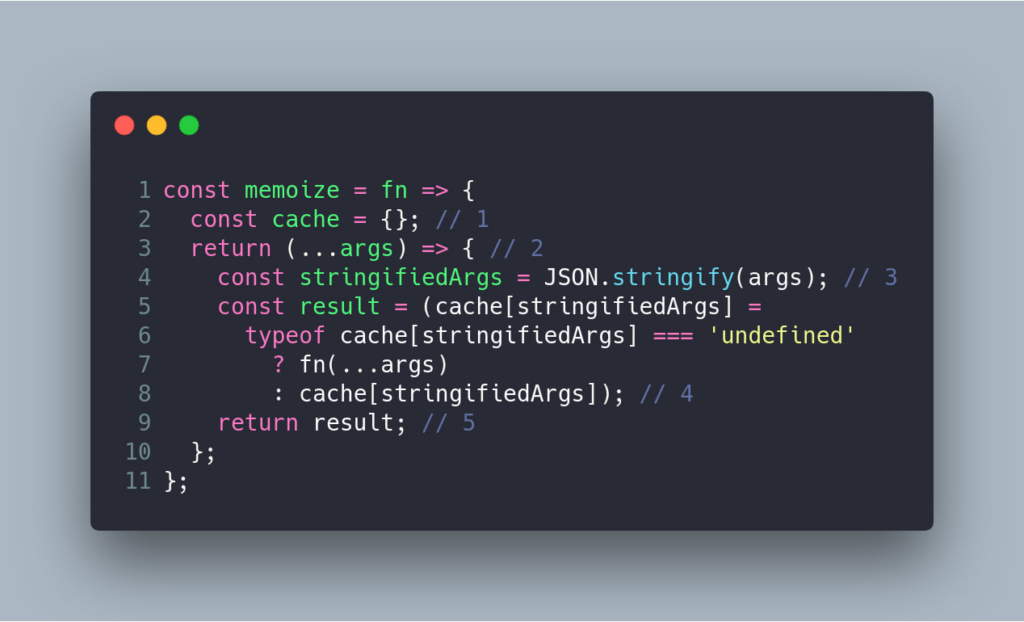
This implementation has five key components that work together:
- The
memoizewrapper (const memoize = fn => { ... }): This is our higher-order function. It accepts the function to be memoized (fn) as its only argument. - The
cachein the closure (const cache = {};): This object is the heart of our memoizer. It's defined once whenmemoizeis called. Because it's inside thememoizefunction's scope but outside the returned function's scope, it persists and is accessible to the returned function via its closure. Each function you memoize gets its own private cache. - The returned function (
return (...args) => { ... }): This is the new, "memoized" version of our original function. It uses rest parameters (...args) to accept any number of arguments, making ourmemoizefunction generic. - The cache key (
const stringifiedArgs = JSON.stringify(args);): This is the most crucial and nuanced part. To store and retrieve results, we need a unique key for each set of inputs. A simple and effective strategy is toJSON.stringifythe array of arguments.['foo', 1]becomes'["foo",1]', which works perfectly as an object key. - The core logic:
- The function first checks if a result for the current
stringifiedArgsalready exists in thecache. - If
cache[stringifiedArgs]is found, it's returned immediately. The original function (fn) is never even called. This is the "cache hit". - If it's not found (i.e., it's
undefined), the original functionfnis executed with the arguments (fn(...args)). - The
resultis then stored in the cache (cache[stringifiedArgs] = result). - Finally, the newly computed
resultis returned. This is the "cache miss".
- The function first checks if a result for the current
The following article provides a well-written breakdown of this exact pattern, emphasizing a critical detail about the cache key.
Memoization: What, Why, and How | Kyle Shevlin
Kyle Shevlin's article clearly defines memoization and walks through a robust implementation.
First, read the introduction to understand the core definition. Then, study the implementation in the code block and the explanation that follows. Pay special attention to the discussion on creating a key and the problem it solves: the key collision issue. For example, (1, 23) and (12, 3) could both become "123" if not handled carefully. JSON.stringify naturally avoids this.
Mental Model: The Doorman with a Memory
Think of your memoized function as an efficient doorman standing in front of an exclusive, "expensive" club (the original function).
- First Visit: When a group of guests (the arguments) arrives for the first time, the doorman doesn't recognize them. He has them go through the slow process of getting checked by the club's main security (the original function
fnexecutes). Once security gives the "OK" (the result), the doorman writes down the guests' names and their "OK" status in a notepad (thecache). - Subsequent Visits: When the same group of guests returns later, the doorman checks his notepad. He sees their names, immediately gives them the "OK," and lets them pass without ever bothering the main security again.
The doorman's notepad is the cache object, kept alive and private in the closure of the memoize function.
Common Misconceptions
- Many developers think
JSON.stringifyis a perfect cache key, but actually, it has important limitations. It will fail for arguments that can't be serialized to JSON. For example, it convertsundefinedtonullwithin arrays and omits object properties withundefinedvalues. It will throw an error on circular objects. It can't serialize Functions or Symbols. For many interview problems it's sufficient, but a senior developer must be aware of these edge cases. - Many developers think memoization is only for recursion, but actually, it's for any computationally expensive, pure function. While recursive functions like Fibonacci are classic examples because they generate many duplicate sub-problems, any function that is slow and is called repeatedly with the same inputs is a candidate—for instance, complex data transformations, layout calculations, or expensive regular expression matches.
- Many developers think more memoization is always better, but actually, it's a space-for-time trade-off. The cache consumes memory. If you memoize a function that is rarely called with the same arguments, you're just adding memory overhead for no performance gain. Worse, if the cache grows indefinitely, it can become a memory leak.
Senior Insight
A mid-level engineer implements memoize with a plain object cache and JSON.stringify and considers the job done. A staff-level engineer immediately thinks about the lifecycle of the cache.
- Cache Invalidation: What if the underlying data changes? The memoized cache might now hold stale results. The simple implementation we built has no mechanism to clear the cache. A more robust version might return an object containing both the memoized function and a
clear()method that resets the cache. - Memory Management: What if the arguments are large objects? The
cachewill hold references to these objects, preventing them from being garbage collected. This can lead to memory leaks. For functions whose arguments are objects, aWeakMapis often a superior choice for the cache. AWeakMapallows garbage collection of its keys (the objects) if they are no longer referenced anywhere else in the application, thus automatically clearing parts of the cache.
The article "Weak memoization in Javascript" explores this advanced concept, showing how you can evolve from a simple closure to using WeakMap for more sophisticated memory management.
Weak memoization in Javascript
This article explores advanced memoization patterns, culminating in the use of WeakMap.
Skim the earlier sections to see the progression, then focus on "Level 3 - The Better Place". Read the section that explains why WeakMap is a superior primitive for this task: it tracks relations without preventing garbage collection. This is a key differentiator for senior-level discussions on memory safety.
Production War Story
A team was building a charting library where a complex function, generateChartPath(dataPoints, options), calculated SVG path data. They correctly memoized it. The application was fast. Months later, a new developer added a "debug mode" that appended a lastRendered timestamp to the options object on every call.
Suddenly, performance tanked. The memoization was completely defeated because JSON.stringify(options) was now different on every single call due to the changing timestamp. The cache was being filled with single-use entries but never hit. The fix was to create a stable cache key by creating a new object that explicitly picked only the properties from options relevant to the path calculation, ignoring the volatile lastRendered property, before stringifying. This highlights a critical principle: the cache key must be a stable, canonical representation of the inputs that matter.
Conclusion
You have now built a general-purpose memoize function from scratch, turning your theoretical knowledge of closures into a practical, high-impact performance pattern. You understand the complete mechanism, from the higher-order function structure to the nuances of generating a reliable cache key.
Key Takeaways:
- Memoization is a specific form of caching for pure functions, trading memory (space) for execution speed (time).
- A closure is the perfect mechanism to create a private, persistent
cachefor a memoized function. - A robust
memoizeimplementation must be a higher-order function that can handle any number of arguments. - Generating a cache key is non-trivial;
JSON.stringifyis a common and effective strategy, but you must be aware of its limitations.
In our next lesson, we'll continue exploring practical closure patterns by implementing the Module Pattern and Factory Functions, which use closures to create private state and encapsulated logic—a cornerstone of building robust and maintainable JavaScript applications.