Hello! In our previous lesson, we explored the fascinating world of mathematical proofs, using the method of contradiction to firmly establish that numbers like are irrational. That discussion highlighted a fundamental split in the real number system between rational and irrational numbers.
Today, we'll focus our attention back on the rational numbers for the final lesson in this module. We know that every rational number can be expressed as a fraction and that its decimal form is either terminating (like 0.5) or non-terminating and repeating (like 0.333...). The question we'll answer is: can we predict which type of decimal expansion a fraction will have without actually performing the long division? This lesson will equip you with a powerful and efficient rule to do just that, providing a clear method that leverages the prime factorization concepts we've already mastered.
Revisiting Decimal Expansions
Let's begin by recalling the different types of decimal expansions. As we've discussed, any real number can be written as a decimal. These decimals fall into distinct categories that correspond to the type of number they represent.
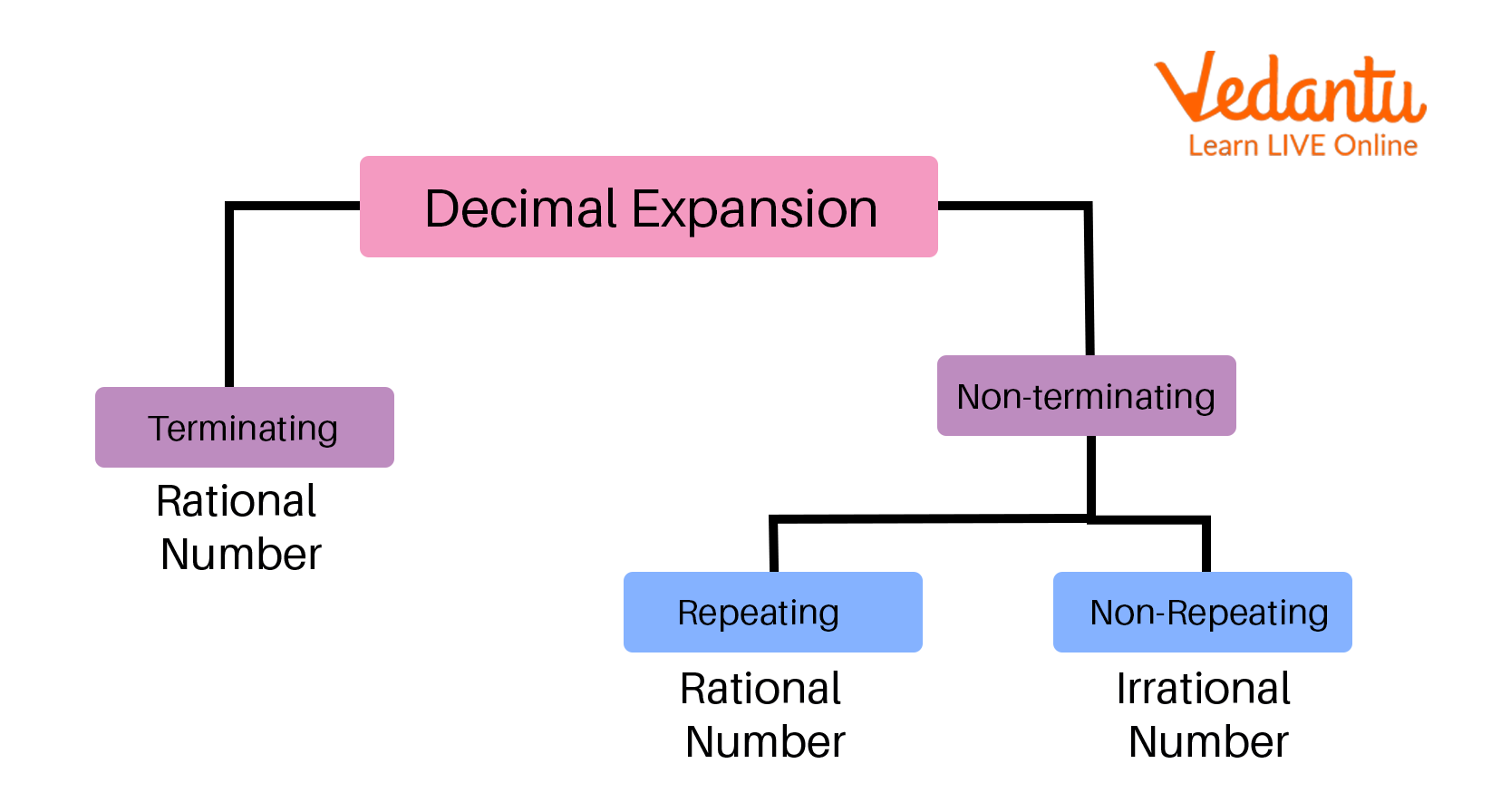
As you can see, rational numbers are associated with decimal expansions that are predictable: they either end (terminate) or they repeat a pattern forever. Irrational numbers are the ones whose decimal expansions go on forever without any repeating pattern.
The most direct way to see if a fraction gives a terminating or repeating decimal is to simply perform the long division.

In the case of 20/8, the process ends when we reach a remainder of 0, giving a terminating decimal (2.5). For 10/3, the remainder is never 0; we keep getting a remainder of 1, leading to a non-terminating, repeating decimal (3.333...).
While long division always works, it's not very efficient. For a fraction like 13/28, you might have to divide for a long time to determine the pattern. As an engineer, you're familiar with the value of finding an analytical shortcut to avoid brute-force computation. Let's find one.
The Key Insight: Working Backwards from Terminating Decimals
To find the rule, let's start with the answer and work backward. Consider a few simple terminating decimals and convert them into fractions:
Notice the pattern in the denominators: they are all powers of 10 (10¹, 10², 10³). This makes sense; our decimal system is base-10.
Now, let's apply a tool from our earlier lessons: prime factorization. What are the prime factors of 10?
This reveals the fundamental secret: any terminating decimal, when written as a fraction in its simplest form, will have a denominator whose prime factors are only 2s and/or 5s.
Why? Because to turn a fraction into a decimal, we are essentially trying to make its denominator a power of 10. If the denominator only contains factors of 2 and 5, we can always multiply the numerator and denominator by the missing factors of 2 or 5 to achieve this.
For example, consider :
- The denominator is .
- To make this a power of 10, we need three 5s to match the three 2s.
- We multiply the top and bottom by :
The decimal terminates!
What if the denominator has a prime factor other than 2 or 5, like in ? We can never multiply 3 by any integer to turn it into a power of 10. This inability to clear out other prime factors is what forces the decimal to repeat.
The following video provides an excellent and thorough explanation of this core concept.
Class 10 Cha 1 Testing Rational Number Being Terminating or Repeating Decimal Real Numbers 2022-23
This video from Magnet Brains derives the rule by starting with terminating decimals and analyzing their fractional form, just as we have done. It clearly explains why the prime factors of the denominator are the key.
Please watch the segment from this section, where the presenter converts terminating decimals to fractions and observes that the denominators are always powers of 10, which are composed of only 2s and 5s. Then, continue watching from the next part. This segment explains the crucial rule: even if the powers of 2 and 5 are unbalanced (e.g., only a 2 or only a 5 in the denominator), it still results in a terminating decimal because you can always balance it by multiplying.
Formalizing the Rules
Our observations can be summarized by three key theorems. These formalize the shortcut we've discovered.
Decimal Expansion of Rational Numbers: Types, Methods & Examples
This article from Testbook.com lays out the definitions and the formal theorems that govern the decimal expansion of rational numbers.
First, briefly read the sections Terminating and Non Terminating to solidify the definitions. Then, focus on the section Decimal Expansion of Rational Number Theorems. These three theorems are the formal statement of our rule.
To summarize the theorems: For a rational number that is in its simplest form:
- Terminating: If the prime factorization of the denominator is of the form (where are non-negative integers), then has a terminating decimal expansion. This means the only prime factors allowed in the denominator are 2 and 5.
- Non-Terminating Repeating: If the prime factorization of contains any prime factor other than 2 or 5 (such as 3, 7, 11, etc.), then has a non-terminating, repeating decimal expansion.
The Practical Algorithm
Now we can define a clear, step-by-step process to solve this problem for any rational number.
Step 1: Simplify the Fraction
This is the most important first step and a common place for errors. Always reduce the fraction to its simplest form by canceling any common factors.
Example: For 6/15, you must first simplify it to 2/5.
Step 2: Prime Factorize the Denominator
Take the denominator of the simplified fraction and find its prime factors.
Step 3: Analyze the Prime Factors
- If the only prime factors you find are 2s, only 5s, or a combination of both, the decimal is terminating.
- If you find any other prime factor (3, 7, 11, 13, etc.), the decimal is non-terminating and repeating.
Let's watch a couple of videos that demonstrate this algorithm with clear examples.
Trick to Identify Terminating Rational Numbers & Non-Terminating Recurring Decimals | Don't Memorise
This video from Don't Memorise provides a quick and concise summary of the trick, applying it to several examples.
Watch from this section. The presenter clearly demonstrates how to use the prime factors of the denominator to classify fractions, generalizing the rule into the formal 2^m \cdot 5^n format.
Class 10 Cha 1 Testing Rational Number Being Terminating or Repeating Decimal Real Numbers 2022-23
Let's return to the Magnet Brains video for a final, clear summary of the practical steps.
Please watch the summary segment from this part. The presenter outlines the exact algorithm we just discussed: simplify the fraction, prime factorize the denominator, and check the factors.
Check Your Understanding
Let's apply the algorithm to a few examples.
-
Is the decimal expansion of terminating or repeating?
- Step 1: Is 22/7 in simplest form? Yes.
- Step 2: What is the denominator? 7. Its prime factor is just 7.
- Step 3: The denominator has a prime factor (7) that is not 2 or 5.
- Conclusion: Non-terminating and repeating.
-
Is the decimal expansion of terminating or repeating?
- Step 1: Simplify the fraction. Both are divisible by 3. .
- Step 2: Prime factorize the new denominator: .
- Step 3: The prime factors are only 2 and 5.
- Conclusion: Terminating. (This shows the importance of simplifying first!)
-
Is the decimal expansion of terminating or repeating?
- Step 1: Is it simplified? 13 is prime. Is 3125 divisible by 13? No. So, yes, it's simplified.
- Step 2: Prime factorize the denominator: .
- Step 3: The only prime factor is 5.
- Conclusion: Terminating.
Conclusion
In this lesson, we've established a clear and efficient rule to determine the nature of a rational number's decimal expansion without performing long division. By connecting the type of decimal to the prime factors of the fraction's denominator, we've uncovered one of the elegant structures that underpins the number system.
Key Takeaways:
- A rational number has a terminating decimal expansion if and only if, in its simplest form, the denominator has only prime factors of 2 and/or 5.
- If the denominator of the simplified fraction has any prime factor other than 2 or 5, the decimal expansion will be non-terminating and repeating.
- The first and most critical step in this process is to simplify the fraction.
This concludes our foundational module on Real Numbers. We have journeyed from classifying numbers and finding HCF/LCM to proving irrationality and now, analyzing decimal expansions. In our next lesson, we will shift gears and begin our exploration of algebra with the module on Polynomials.