Welcome back! In our last lesson, we mastered calculating the area of a parallelogram using its base and height. Today, we'll continue our exploration of special quadrilaterals by focusing on the rhombus.
This lesson will teach you how to calculate the area of a rhombus using a very efficient formula that relies on its diagonals. You'll learn what makes a rhombus unique, understand where this new formula comes from, and apply it to solve problems. This is another essential formula for your collection and will help you tackle a new set of area problems with confidence.
1. What is a Rhombus?
In the last lesson, we saw that a parallelogram is like a slanted rectangle. A rhombus is a special type of parallelogram where all four sides are of equal length. You can think of it as a slanted square.
Like all parallelograms, the area of a rhombus can be found using the formula base × height. However, there's often a much simpler method. This method uses a unique property of the rhombus: its diagonals (the lines connecting opposite corners) bisect each other at a perfect right angle (90°). This property allows us to use a special formula.
To understand where this formula comes from, let's explore a resource from Cuemath.
Formula | How to Find the Area of a Rhombus? - Cuemath
This article provides a clear definition of a rhombus and a step-by-step derivation of its area formula.
First, read the introductory part under the heading What is a Rhombus? to review its properties. Pay close attention to the point that the diagonals bisect each other at right angles. Next, read the section Area of a Rhombus with Diagonals. This part explains how a rhombus can be split into two identical triangles. The derivation shows how the area formula for a triangle, which you already know, is used to find the area of the whole rhombus.
As the derivation shows, a rhombus is simply two congruent triangles joined at their base. The base of each triangle is one diagonal (), and the height of each triangle is half of the other diagonal ().
- Area of one triangle =
- Area of rhombus (two triangles) =
This gives us our powerful new formula.
2. The Area Formula and Examples
The formula for the area of a rhombus when you know the lengths of its two diagonals, and , is:
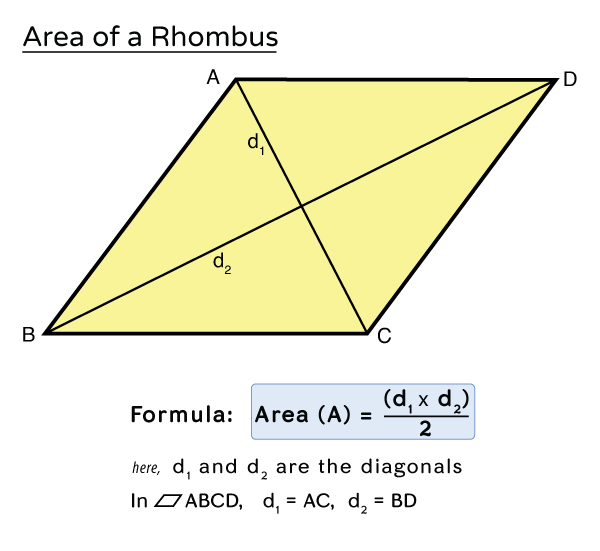
The area of a rhombus is calculated as half the product of its diagonals, d1 and d2.
Let's watch a very quick video that shows you exactly how to apply this formula.
How to Calculate the Area of a Rhombus
This short video from wikiHow clearly demonstrates the calculation in under a minute.
Watch the clip from the beginning. It walks you through the simple three-step process: measure the diagonals, multiply them together, and divide the result by two.
Here is another example presented as a static image, which you can study at your own pace. It breaks down the calculation just like in the video.

This example shows the calculation for a rhombus with diagonals of 10 cm and 8.2 cm. The area is found by calculating (1/2) * 10 * 8.2, which equals 41 cm².
3. A Common Mistake to Avoid
One of the most frequent errors when using this formula is simple but costly: forgetting the last step.
Area of a Rhombus: Formula, Diagonal Method & Examples - Vedantu
This resource from Vedantu points out common errors to help you avoid them.
Please read the short section Common Mistakes. The second point, "Forgetting to halve the product of diagonals," is the most important one for our lesson today.
Always remember to multiply the diagonals first, and then divide by 2. Thinking back to the derivation—where the rhombus is made of two triangles—can help you remember why that division is necessary.
Now, try one yourself:
Practice Problem: Find the area of a rhombus whose diagonals are 15 cm and 18 cm.
- Step 1: Multiply the diagonals: .
- Step 2: Divide by 2: .
- Answer: The area is 135 cm².
4. Your Formula Collection
Let's add today's formula to your growing collection.
| Shape | Formula | Variables |
|---|---|---|
| Parallelogram | Area = b × h |
b = base, h = perpendicular height |
| Rhombus | Area = (d₁ × d₂) / 2 |
d₁, d₂ = diagonals |
Conclusion
In this lesson, you've added the rhombus to your geometry toolkit. You now have a simple and effective method for finding its area when you know the lengths of its diagonals.
Here are the key takeaways from today:
- A rhombus is a quadrilateral with four equal sides, whose diagonals intersect at right angles.
- The area can be calculated with the formula: Area = (diagonal 1 × diagonal 2) / 2.
- A common mistake is forgetting to divide the product of the diagonals by two.
In our next lesson, we will tackle another special quadrilateral: the trapezium. You'll learn how its unique properties lead to yet another distinct formula for calculating area.