Hello! Welcome to the first lesson of our second module, "Scalability and Performance Principles."
In the previous module, we established a complete framework for navigating the system design interview, focusing on the process: clarifying requirements, creating a high-level design, diving deep, discussing trade-offs, and managing your time.
Now, we shift our focus from the how to the what. Over the next few modules, we will build a deep understanding of the core technical concepts that are the building blocks of any large-scale system.
Today's lesson addresses the learning outcome: Articulate the trade-offs of horizontal vs vertical scaling with specific criteria and examples. This is one of the most fundamental decisions in system design. Almost every interview question will require you to scale a system beyond a single server, and how you approach this first step sets the tone for the rest of the interview.
1. What is Scaling?
As your application's user base grows, a single server will inevitably be overwhelmed by the increasing load (e.g., requests per second, concurrent users, data storage). Scaling is the process of designing your system to handle this increased load without a significant drop in performance.
There are two primary ways to achieve this: make your server more powerful, or add more servers. These two approaches are known as vertical and horizontal scaling.
For a quick and clear introduction to these concepts, let's start with a video.
System Design BASICS: Horizontal vs. Vertical Scaling
This video from Gaurav Sen provides an excellent, concise introduction to the two main scaling strategies.
Watch from the beginning until 04:03. Focus on understanding the core idea behind vertical scaling ('scaling up') and horizontal scaling ('scaling out').
To summarize:
- Vertical Scaling (Scaling Up): Increasing the capacity of a single server by adding more resources like CPU, RAM, or faster storage. Think of it as upgrading from a standard laptop to a high-end workstation.
- Horizontal Scaling (Scaling Out): Adding more servers to a pool of resources and distributing the load among them. Think of it as going from one laptop to a network of multiple laptops working together.
2. The Core Trade-offs: A Comparative Framework
In a system design interview, simply defining these terms is not enough. You are expected to demonstrate senior-level judgment by analyzing their trade-offs across several key dimensions. An interviewer wants to see you make a deliberate, justified choice based on the system's requirements.
Let's watch the next segment of the same video, which presents a great framework for comparison.
System Design BASICS: Horizontal vs. Vertical Scaling
This next section of Gaurav Sen's video breaks down the comparison into five critical factors. This will form the basis of our trade-off analysis.
Watch from 04:03 to 06:21. Pay close attention to the five comparison points: load balancing, resilience, communication, data consistency, and hardware limits.
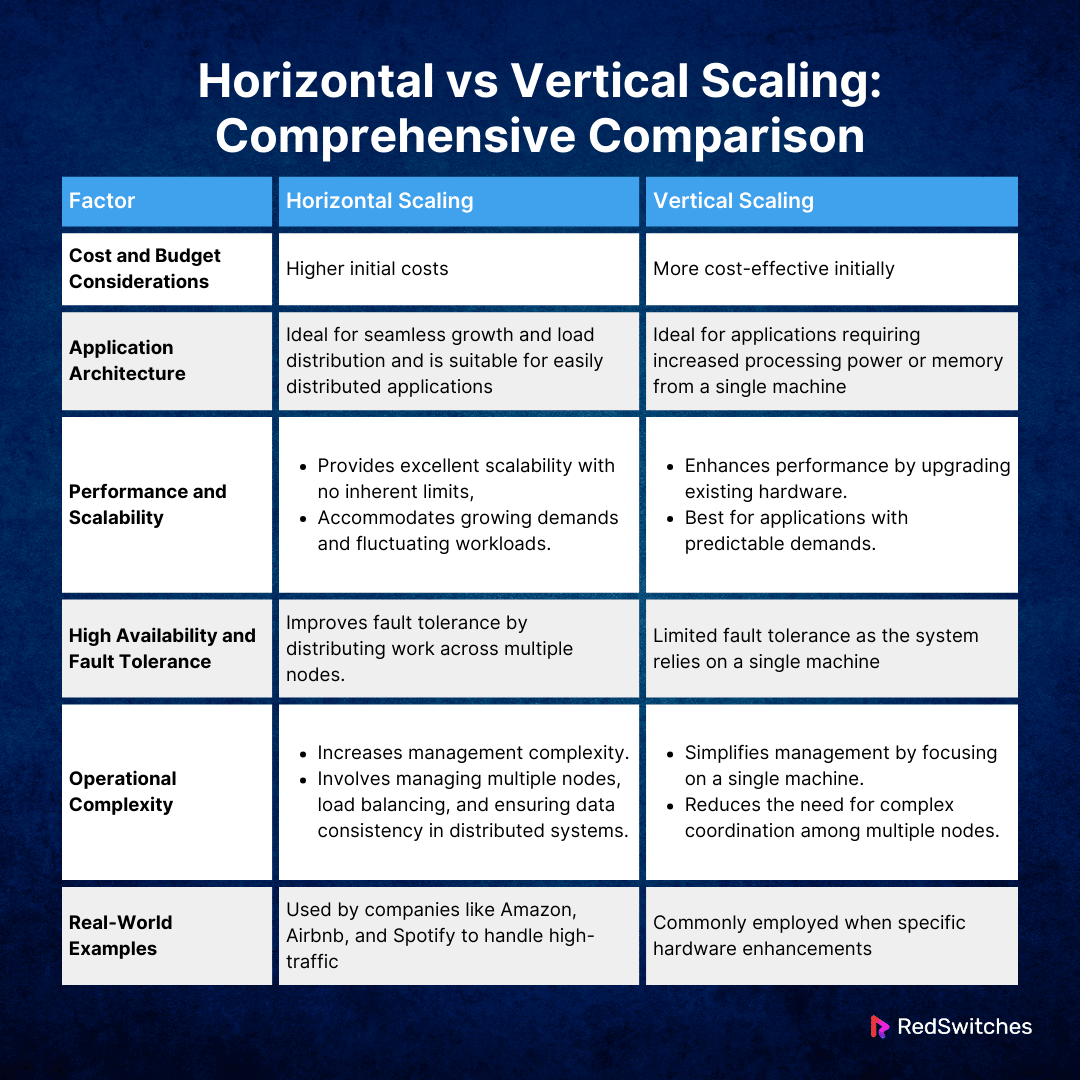
Building on the video, let's organize these trade-offs into a comprehensive table and add a few more dimensions that are crucial for a senior-level discussion.
| Aspect | Vertical Scaling (Scale Up) | Horizontal Scaling (Scale Out) |
|---|---|---|
| Architectural Change | Minimal. The application logic often remains the same. | Significant. Requires load balancing, service discovery, etc. |
| Fault Tolerance | Low. Creates a single point of failure (SPOF). | High. The system can tolerate the failure of one or more nodes. |
| Performance | Potentially lower latency (fast Inter-Process Communication). | Higher overall throughput. Latency may increase due to network calls. |
| Scalability Limit | Hard limit based on available hardware. | Theoretically unlimited, can scale to handle massive load. |
| Cost Profile | Becomes exponentially expensive at the high end. | Can be more cost-effective at scale using commodity hardware. |
| Data Consistency | Simpler. Data resides on a single machine. | Complex. Requires strategies for replication and consistency. |
| Maintenance | Requires downtime for upgrades. | Allows for rolling updates and maintenance without downtime. |
To deepen your understanding of these trade-offs, especially regarding cost, reliability, and performance, the following reading is highly recommended.
Horizontal Scaling vs Vertical Scaling | System Design
The article 'Horizontal Scaling vs Vertical Scaling' from System Design Handbook provides a thorough analysis that is perfectly tailored for interview preparation.
Read the following sections to get a deeper insight into the trade-offs: Start with 'Vertical Scaling Explained' and 'Horizontal Scaling Explained'. Then, review the sections on 'Performance Characteristics and Bottlenecks', 'Reliability and Fault Tolerance Considerations', 'Cost and Operational Trade-Offs', and 'Data Management Implications'. Focus on the distinction between improving latency (vertical) versus improving throughput (horizontal), and how horizontal scaling trades hardware cost for operational complexity.
This image provides a great visual summary of the points we've discussed.
3. Making the Decision: An Interview-Ready Approach
Knowing the trade-offs is step one. Applying them to a specific problem is step two. In an interview, you need to justify your scaling strategy based on the problem's functional and non-functional requirements.
A dogmatic stance like "horizontal scaling is always better" is a red flag. A seasoned engineer knows that the right choice depends on context.
A Framework for Your Decision
When an interviewer asks "How would you scale this?", you can structure your response by considering these factors:
Horizontal scaling vs vertical scaling: Choosing your strategy
This article from DigitalOcean provides a fantastic, actionable checklist of factors to consider when choosing a scaling strategy. This is an excellent framework for structuring your answer in an interview.
Read the section titled '10 factors for choosing between horizontal vs vertical scaling'. Pay particular attention to how factors like Traffic Patterns, Application Architecture, and Downtime Tolerance directly influence the decision.
For example, your thought process might sound like this:
"For this initial MVP, with an expected low and steady user load, I'd recommend vertically scaling our database server. It's simpler to manage, avoids the operational complexity of a distributed database, and keeps our costs down. However, our stateless web servers are perfect candidates for horizontal scaling from day one. We can place them behind a load balancer and easily add or remove instances to match traffic, ensuring high availability. As we grow, we'll hit the limits of our vertically-scaled database, at which point we will need a strategy to shard it, transitioning it to a horizontally-scaled architecture as well."
This kind of nuanced answer, which uses a hybrid approach, demonstrates practical, real-world experience. Most large-scale systems are not purely one or the other; they are a mix of both.
System Design BASICS: Horizontal vs. Vertical Scaling
Let's conclude with a final clip that discusses this hybrid approach and the importance of seeing scaling as a journey, not a single decision.
Watch from 06:21 to the end (07:37). The key takeaway is that real-world systems often use a combination of both scaling strategies, and the best choice evolves over the system's lifetime.
Conclusion
Today, we've explored the foundational concept of scalability. You've learned not just the definitions of vertical and horizontal scaling, but more importantly, how to articulate the complex trade-offs between them—a key skill for any senior engineering interview.
Key Takeaways:
- Vertical scaling (scale up) adds resources to a single machine. It's simple but has hard limits and creates a single point of failure.
- Horizontal scaling (scale out) adds more machines to a pool. It's highly scalable and fault-tolerant but introduces significant architectural complexity.
- A senior-level discussion must weigh trade-offs across multiple dimensions: cost, reliability, performance (latency vs. throughput), complexity, and scalability limits.
- Avoid a one-size-fits-all answer. The best strategy often involves a hybrid approach and evolves over time based on specific requirements like traffic patterns, budget, and application architecture.
In our next lesson, we will dive into one of the essential components required for horizontal scaling. We will discuss various load balancing strategies and their trade-offs, such as Round Robin, Least Connections, and Consistent Hashing.