Hello! Welcome to the next lesson in your interview preparation course.
In our last session, we delved into the CAP theorem and established that for modern distributed systems, Partition Tolerance is non-negotiable. This forces a critical choice between Consistency and Availability. We noted that building a strongly Consistent (CP) system often requires a single source of truth to coordinate operations, especially writes.
This lesson focuses on the very mechanism that establishes that single source of truth: leader election. Understanding how a distributed group of servers can agree on a leader is fundamental to designing many of the fault-tolerant, consistent systems you'll be asked about in an interview.
Today's learning outcome is to describe leader election mechanisms and their use cases. We will explore why leader election is necessary, how popular mechanisms like Raft and ZooKeeper-based election work, and where they are used in real-world systems you encounter daily.
1. The "Why": Solving Coordination and Split-Brain
In a distributed system, having multiple nodes acting as the primary decision-maker can lead to chaos. Imagine a sharded database where two different nodes both accept a write for the same piece of data. Which write is the correct one? This is known as a "split-brain" scenario, and it leads to data corruption.
Leader election is the pattern that solves this by ensuring that only one node at a time holds the "leadership" role, granting it unique responsibilities.
To understand the core problems leader election solves, let's start with a short reading.
Day 25: Implement Leader Election for Cluster Management
This article, 'Day 25: Implement Leader Election for Cluster Management', provides an excellent motivation for why this pattern is so critical in large-scale systems.
Read the section titled 'Why This Matters: The Coordination Problem at Scale'. Focus on the three fundamental problems that leader election solves.
As the article highlights, leader election provides:
- A single source of truth: The leader is responsible for coordinating writes or managing state, preventing conflicting operations.
- Split-brain prevention: During a network partition, leader election algorithms ensure that only one partition (typically the one with a majority of nodes) can elect a leader, preventing the minority partition from accepting writes.
- Automatic recovery: When a leader fails, the system automatically triggers a new election to promote a new leader, restoring system functionality without manual intervention.
In an interview, demonstrating that you understand why a leader is needed is the first step to showing seniority. You can frame the importance of leader election in terms of these desired properties:
- Uniqueness: At any given time, there is at most one leader.
- Liveness & Fault Tolerance: If a leader fails, the system will eventually and automatically elect a new one.
2. The "How": Mechanisms for Electing a Leader
Now that we know why we need a leader, let's explore how a leader is chosen. We'll focus on two dominant, production-grade approaches you should be prepared to discuss.
Mechanism 1: Consensus-Based Election (Raft)
Many modern distributed systems use consensus algorithms like Raft or Paxos. Leader election is a fundamental, built-in part of these protocols. Raft, in particular, was designed to be more understandable than Paxos and is a great example to discuss in an interview.
The following video gives a detailed walkthrough of the leader election process in Raft.
Distributed Consensus - Raft Leader Election | Systems Design Interview 0 to 1 with Ex-Google SWE
This video from 'Jordan has no life' provides a clear, step-by-step explanation of Raft's leader election mechanism. We'll watch it in two parts.
First, watch from 00:31 to 03:18. This section introduces the core concepts: nodes as followers, the leader sending heartbeats, and what happens when a follower stops receiving them (becoming a candidate).
Let's break down the initial state and the trigger for an election:
- Node States: Nodes in a Raft cluster can be in one of three states: Follower, Candidate, or Leader.
- Terms (Epochs): The system operates in a sequence of numbered terms. Each term begins with an election. A term acts as a logical clock to identify and reject stale leaders or candidates.
- Heartbeats: The current leader periodically sends lightweight heartbeat messages to all followers to assert its authority and prevent them from starting a new election.
- Election Trigger: If a follower doesn't receive a heartbeat within its randomized election timeout, it assumes the leader has failed. It then transitions to the Candidate state, increments the current term number, votes for itself, and requests votes from other nodes. The randomized timeout is crucial to prevent multiple nodes from becoming candidates simultaneously and splitting the vote.
Now, let's see how the voting process unfolds and a leader is chosen.
Distributed Consensus - Raft Leader Election | Systems Design Interview 0 to 1 with Ex-Google SWE
Let's continue with the same video to understand the voting rules and how a winner is declared.
Watch from 03:18 to 07:15. Focus on two key rules: how a node decides to vote 'yes' or 'no' (based on term number and log up-to-dateness), and how a candidate wins (by receiving a quorum of votes).
Here is a summary of the election and winning conditions:
- Voting Rules: When a follower receives a vote request, it will only grant its vote if:
- The candidate's term number is greater than its own.
- The candidate's log is at least as up-to-date as its own log. This is a critical safety property that ensures a new leader has all committed entries from previous terms.
- Quorum: A candidate wins the election and becomes the leader if it receives votes from a majority (a quorum) of the nodes in the cluster. For a cluster of N nodes, a quorum is
(N/2) + 1. This majority requirement mathematically guarantees that two leaders cannot be elected in the same term. - Fencing Tokens: The term number acts as a "fencing token." If an old, deposed leader (from a previous term) tries to issue a command, nodes will see its outdated term number and reject the request, effectively fencing it off from the system.
Mechanism 2: Using a Coordination Service (ZooKeeper)
Another widespread pattern is to offload the responsibility of leader election to a specialized coordination service like Apache ZooKeeper or etcd. This is common in systems like Kafka and HDFS.

This approach relies on two key features provided by ZooKeeper:
- Ephemeral Znodes: These are special nodes in ZooKeeper's hierarchical data store (
znodes) that exist only as long as the client session that created them is active. If the client disconnects or crashes, the znode is automatically deleted. - Sequential Znodes: When creating a znode, you can request that ZooKeeper append a monotonically increasing sequence number to its name.
The election process works as follows:
Leader Election — Distributed Systems
This article from Medium provides a concise explanation of the ZooKeeper-based approach and its real-world application in HDFS.
Read the sections 'ZooKeeper Basics for Leader Election' and 'How HDFS Uses ZooKeeper for NameNode Leader Election'. This explains the ephemeral/sequential znode mechanism.
To summarize the flow:
- All potential leader nodes attempt to create the same ephemeral znode (e.g.,
/election/lock). - Only one will succeed. That node becomes the leader.
- The other nodes fail to create the znode but can set a "watch" on it.
- If the leader node fails, its session with ZooKeeper times out, and its ephemeral znode is automatically deleted.
- The watch notifies all waiting nodes that the lock znode has been deleted, and they can all try again to acquire the lock. The first one to succeed becomes the new leader.
A more robust variant uses ephemeral sequential znodes to avoid a "thundering herd" problem where all nodes try to acquire the lock at once. In this version, every node creates an ephemeral, sequential znode (e.g., /election/node-0000000001). The node that created the znode with the lowest sequence number is the leader. All other nodes watch the znode immediately preceding their own. If that znode is deleted, they check if they are now the lowest-ranking node. This creates an orderly handover of leadership.
Other Classic Algorithms
For completeness, it's good to be aware of older, classic algorithms, though you likely wouldn't propose them for a modern system design.
- Bully Algorithm: The node with the highest ID "bullies" its way into leadership. When a node detects a leader failure, it sends election messages to all nodes with higher IDs. If it receives no response, it declares itself the leader. It's simple but can be very "chatty" (high message overhead).
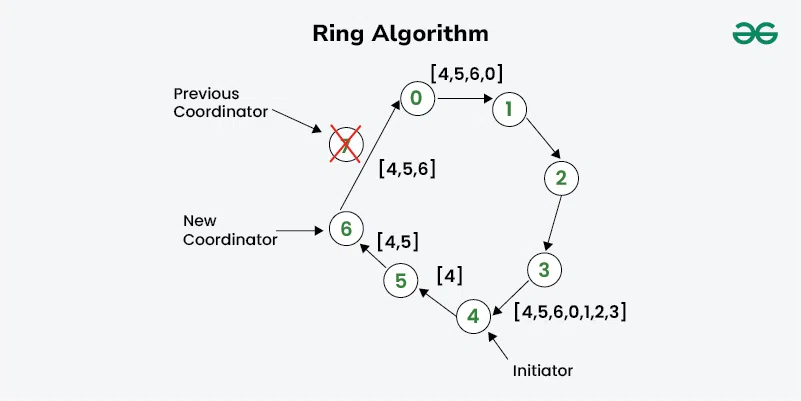
- Ring Algorithm: Nodes are arranged in a logical ring. An election message is passed around the ring, with each node adding its ID. When the message completes a full circle, a leader is chosen (e.g., the node with the highest ID).
3. Use Cases and Interview Discussion
In a system design interview, your goal is to connect these mechanisms to the problem you're solving.
| Use Case | Common Mechanism | Why? |
|---|---|---|
| Kubernetes Control Plane | Raft (via etcd) |
etcd is the brain of Kubernetes, storing all cluster state. Raft provides the strong consistency and fault tolerance needed to manage this critical data without an external dependency. |
| Distributed Databases (e.g., CockroachDB, MongoDB primary) | Raft or a variant | The database itself needs to coordinate transactions and replication. A built-in consensus algorithm is a natural fit. |
| Service Discovery (e.g., Consul) | Raft | Consul maintains a registry of healthy, available services. A strong leader is needed to manage this registry consistently. |
| Message Queue Controller (e.g., Apache Kafka) | ZooKeeper (classic) or Raft (modern KRaft) | A controller is needed to manage partition leadership and broker metadata. Using an external service like ZooKeeper was an early, robust pattern. Newer versions embed Raft to remove this external dependency. |
When asked to design a system that requires coordination, here's how you can approach it:
- Identify the need: "For this system, we need to coordinate tasks like X and Y. To avoid split-brain and ensure consistency, we'll need a single leader. I'll use a leader election mechanism to achieve this."
- Propose a solution: "A robust, production-grade approach is to use a consensus algorithm like Raft. Many modern systems like
etcdand CockroachDB use this. The leader would be responsible for..." - Discuss trade-offs: "...Alternatively, if we already use a service like ZooKeeper in our ecosystem, we could leverage it for leader election. This adds an external dependency and a potential point of failure, but it separates concerns and simplifies our application logic. The Raft-based approach is more self-contained but increases the complexity within our service."
This demonstrates you not only know the patterns but can also articulate the engineering trade-offs, a key signal of seniority.
Leader Election — Distributed Systems
For a final summary of how to frame this in an interview, review the 'Interview Insights' from the Medium article.
Read the sections 'Trade-offs' and 'Interview Insights'. This provides a perfect cheat sheet for your interview discussion.
Conclusion
Today we've demystified the process of leader election, a cornerstone of building reliable distributed systems.
Key Takeaways:
- Leader election is essential for coordination, split-brain prevention, and automatic failover in distributed systems.
- Modern systems primarily use two approaches: built-in consensus algorithms like Raft or external coordination services like ZooKeeper/etcd.
- Raft works through a system of terms, timeouts, and quorum-based voting, ensuring safety and liveness.
- ZooKeeper-based election leverages ephemeral and sequential nodes to provide a reliable locking mechanism for leadership.
- In an interview, your ability to articulate the 'why' (the problem being solved) and discuss the trade-offs between different mechanisms is more important than memorizing every detail of an algorithm.
In this lesson, we focused on how a leader is elected. In our next lesson, we will take a deeper look at consensus algorithms like Paxos and Raft to understand how, once elected, the leader ensures that all data is replicated safely and consistently across the cluster. This will complete the picture of how CP systems maintain their guarantees.