Hello! Welcome back to our module on "Foundational Design Problems."
In the last lesson, we designed a distributed rate limiter. That problem was focused on concurrency control, state management under high write throughput, and fault tolerance. We saw how using a centralized store like Redis with atomic operations was key to preventing race conditions.
Today, we shift our focus to a different, but equally important, class of problem: designing a search autocomplete system. Your learning outcome for this lesson is to be able to design this system from end to end. This is a classic, read-heavy system design question that tests your understanding of efficient data structures, caching strategies, and large-scale data processing pipelines. For a senior backend role, demonstrating a strong grasp of these concepts is crucial.
We will follow the same structured approach as before:
- Clarify requirements and estimate scale.
- Choose the core data structure.
- Develop a high-level architecture.
- Deep dive into optimizations for latency and scale.
- Discuss advanced topics and common interview follow-ups.
1. Requirements and Scale Estimation
As always, the first step in any system design interview is to understand the problem's scope. We need to define what the system should do (functional requirements) and how it should perform (non-functional requirements).
Design Search Autocomplete System - AlgoMaster.io
Let's start by reading the 'Clarifying Requirements' section of the article from AlgoMaster.io. This will give us a solid foundation for the functional and non-functional requirements, along with some initial scale estimations to guide our design.
Read the introduction and the sections '1. Clarifying Requirements', '1.1 Functional Requirements', '1.2 Non-Functional Requirements', and 'Scale Estimation'. Focus on the core needs: returning the top N ranked suggestions with very low latency at a massive scale.
From this, we can summarize our key requirements:
- Functional: For a given prefix, return the top N (e.g., 5-10) ranked suggestions. Suggestions should be ranked by factors like historical popularity and current trends.
- Non-Functional:
- Ultra-Low Latency: Suggestions must appear almost instantly, typically within < 100ms.
- High Availability: The system should be resilient to failures. Serving slightly stale data is better than returning an error.
- Scalability: The system must handle potentially millions of queries per second (QPS) for a global user base.
The latency requirement is the most critical constraint and will influence every decision we make.
2. The Core Data Structure: The Trie
With a requirement for ultra-low latency prefix matching, a standard SQL database query like SELECT ... WHERE query LIKE 'prefix%' is not a viable option. Even with an index, scanning a massive table of search terms would be far too slow.
We need a data structure specifically optimized for this task. The ideal choice is a Trie, also known as a prefix tree.

The key advantage of a Trie is that the time to find all suggestions for a prefix depends only on the length of the prefix itself, not on the total number of terms in the dictionary. This makes lookups extremely fast.
Design Search Autocomplete System - AlgoMaster.io
To get a solid understanding of why the Trie is the right tool for the job, please read the following section from the AlgoMaster.io article. It explains how a Trie works and its time/space complexity.
Read section '4.1 Data Model and Storage Design'. Focus on how the Trie structure allows for efficient prefix search and how metadata can be stored in its nodes.
3. High-Level Architecture: Read and Write Paths
A good design for a system like this often follows the Command Query Responsibility Segregation (CQRS) pattern. This means we'll have separate, highly optimized paths for writing data (building the Trie) and reading data (serving suggestions).
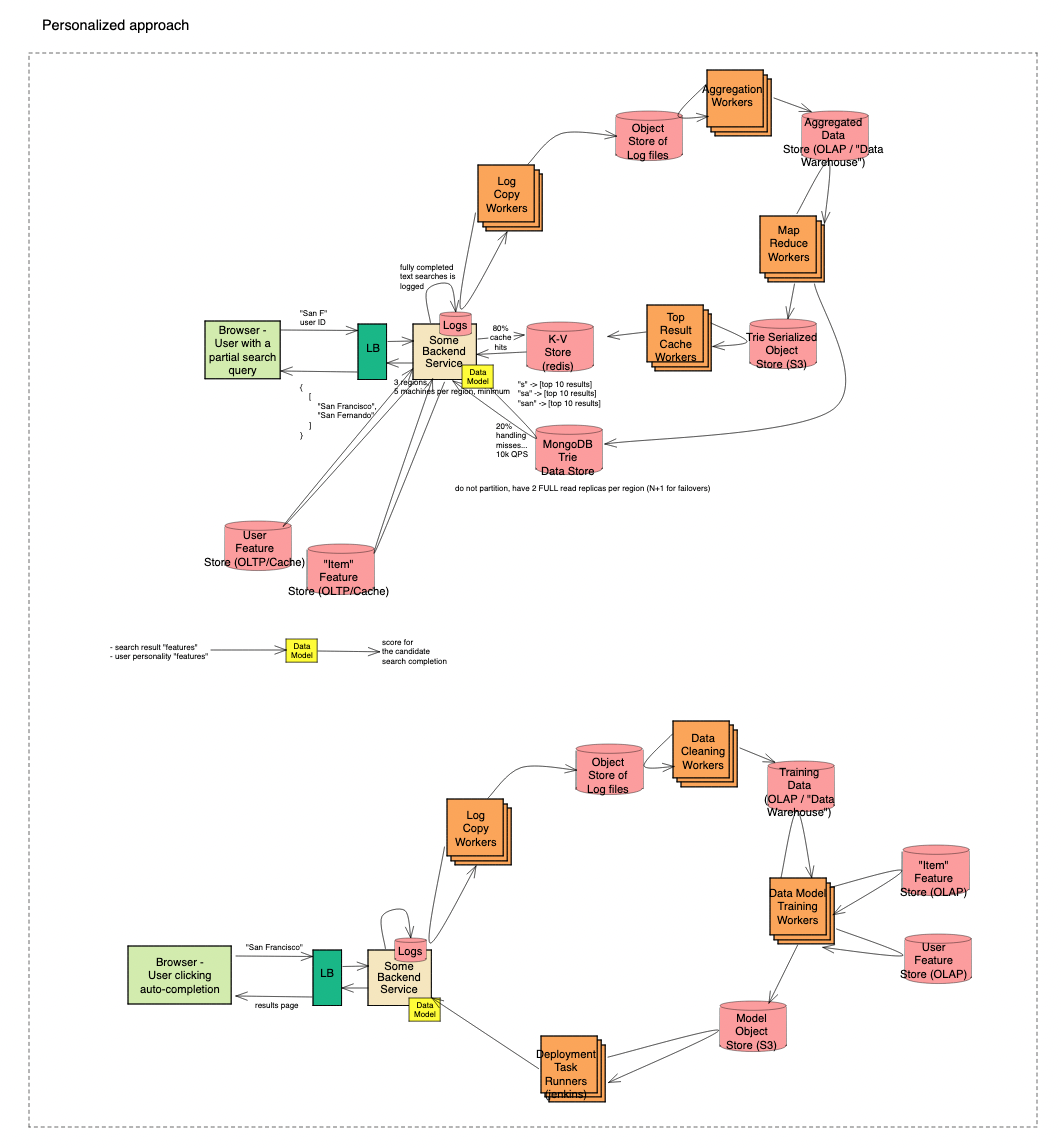
The Write Path: Data Ingestion and Indexing
The Trie needs to be built from data on what users are searching for. This is not a real-time process. It's an offline pipeline that runs periodically to keep the suggestions fresh.
The typical flow is:
- Data Collection: User search queries are logged and sent to a message queue like Apache Kafka. This decouples the live services from the data processing pipeline.
- Data Processing: A batch processing job (using tools like Apache Spark or Apache Flink) runs periodically (e.g., daily or hourly). It reads from Kafka, aggregates query counts, calculates ranking scores, and cleans the data.
- Trie Construction: The processed data is used to build a new, updated Trie.
- Deployment: The new Trie is then deployed to the read path servers.
Design Search Autocomplete System - AlgoMaster.io
This offline pipeline is critical for the system's accuracy. The 'Indexing and Ingestion Pipeline' section of the AlgoMaster.io article provides a detailed breakdown of this process.
Read section '4.4 Indexing and Ingestion Pipeline'. Pay attention to the different data sources and the steps involved: ingestion, cleaning, scoring, and indexing.
The Read Path: Serving Suggestions
This is the latency-critical path. It must be as fast and efficient as possible.
- Client Request: The user types a character, and the client (after some debouncing to avoid excessive requests) sends a request to the backend.
- Load Balancer: A load balancer distributes requests across a fleet of stateless Autocomplete Service instances.
- Autocomplete Service: This service handles the core logic. It first checks a cache.
- Cache: A distributed cache like Redis stores results for popular prefixes. If the result is in the cache (a "cache hit"), it's returned immediately.
- Trie Store: If it's a "cache miss," the service queries the in-memory Trie data store to find the suggestions, ranks them, and returns them to the user. It also populates the cache for subsequent requests.
This separation ensures that the complex, slow process of building the index doesn't interfere with the fast, simple process of serving requests.
4. Deep Dive: Optimizations for Latency, Scale, and Freshness
To meet our strict non-functional requirements, we need to make several key optimizations.
Multi-Level Caching
A single caching layer isn't enough. To achieve sub-100ms latency, we need a multi-level caching strategy:
- L1 Cache (In-Service Memory): Each autocomplete service instance can have a small in-memory LRU cache for the absolute hottest prefixes (e.g., top 1%). This avoids any network call.
- L2 Cache (Distributed Cache): A shared Redis cluster holds a much larger set of popular prefixes. This is the main cache, handling the vast majority of requests.
- CDN Cache: For globally popular, non-personalized queries (e.g., "weather"), the JSON response can even be cached at the CDN edge, serving users from a location physically close to them.
Scaling the Trie
For a service like Google Search, the full set of search terms is far too large to fit on a single machine. The Trie itself must be distributed. The most common technique is sharding.
Design Search Autocomplete System - AlgoMaster.io
Distributing a data structure like a Trie presents unique challenges, such as hotspots. This section from AlgoMaster.io explains the primary strategies for scaling a Trie in a distributed environment.
Read section '4.2 Scaling Trie in a Distributed Environment'. Focus on the trade-offs between 'Partitioning by Prefix' (and the hotspot problem) and 'Hash-Based Partitioning' (using a hybrid approach to maintain locality).
The key is to partition based on the first few characters of the query (e.g., hash("ne")). This ensures that related prefixes like "new" and "news" are routed to the same shard, preserving data locality, while still distributing the load more evenly than simple range-based partitioning.
Incorporating Real-Time Trends
Our daily batch job is great for historical popularity, but what about breaking news? We need a way to inject trending topics quickly. This is achieved by adding a "hot path" to our architecture.
Autocomplete System - System Design Interview Question (Google Search)
The TechPrep video provides an excellent explanation of combining historical data (cold path) with real-time data (hot path) to produce relevant suggestions.
Watch from 11:23 to 13:46. Focus on how a stream processor like Apache Flink can analyze a real-time stream of queries from Kafka to identify 'spiking' terms and how the autocomplete service merges these trending results with the main historical results.
This dual-path architecture—a robust, accurate "cold path" and a fast, agile "hot path"—is a hallmark of a sophisticated, senior-level design.
5. Common Interview Follow-up Questions
In a senior-level interview, after you present your design, the interviewer will probe your understanding with follow-up questions. Being prepared for these is essential.
Autocomplete/Typeahead System Design [Frontend Focused]
This resource is a goldmine of common interview questions specific to designing an autocomplete system. We'll review a few key ones together, but I highly recommend you browse the full list.
Read through the questions in section '11. Interview Cross-Questions'. Pay special attention to the answers for: Q1: Why use a Trie instead of a simple database query with LIKE? (Performance) Q3: Why REST API instead of WebSocket for autocomplete? (Simplicity, Caching) Q2: How would you handle typos and fuzzy matching? (Edit Distance, N-grams) Q6: How do you update the Trie when new queries come in? (Batch vs. Real-time)
Let's summarize the key points for these questions:
- Trie vs. DB
LIKE: The answer is performance. A Trie gives O(L) lookup (L=prefix length), which is independent of the dataset size. ALIKEquery is O(N) or worse, making it unscalable. - REST vs. WebSocket: While WebSockets seem appealing for real-time updates, autocomplete is fundamentally a client-initiated, request-response pattern. REST is simpler, stateless (easier to scale), and benefits massively from standard HTTP caching (CDNs, browsers). The overhead of managing persistent WebSocket connections is unnecessary.
- Handling Typos: This is typically handled by finding terms with a small Levenshtein distance (edit distance) from the user's query. This search can be done as a fallback if the primary Trie lookup yields no results. More advanced systems use search engines like Elasticsearch that have built-in fuzzy matching capabilities.
Conclusion
You have now designed a comprehensive, scalable, and low-latency search autocomplete system. This is a read-heavy design that contrasts nicely with the write-heavy rate limiter we designed previously.
Key Takeaways:
- Core Data Structure: The Trie is the optimal choice for efficient prefix matching.
- Architecture Pattern: CQRS is used to separate the asynchronous, slow write path (data ingestion and indexing) from the synchronous, fast read path (serving suggestions).
- Latency Optimization: Achieved through multi-level caching (in-memory, distributed, CDN) to serve the majority of requests without touching the primary data store.
- Scalability: The massive Trie data store is scaled by sharding based on a hash of the first few characters of a prefix.
- Ranking: Suggestions are ranked using a hybrid model that combines long-term popularity from a cold path (batch processing) and real-time trends from a hot path (stream processing).
Next Lesson Preview:
In this lesson, we introduced the Trie as the core data structure. In our next lesson, "Design the data storage and retrieval strategy for an autocomplete system," we will perform a much deeper dive. We will explore optimizations for the Trie structure itself, such as flattening it for even faster lookups, and compare it in detail with alternative approaches, like using a dedicated search index like Elasticsearch for the primary data store.