Hello! Welcome to the third lesson in our module on the Psychology of Decision-Making.
In our last lesson, we identified several key cognitive biases—anchoring, framing, and scarcity—that act as mental shortcuts in consumer choice. We saw how framing a choice as a gain versus a loss can dramatically change behavior. Today, we're going to explore the powerful psychological theory that explains why this happens.
Your learning outcome is to explain the core principles of Prospect Theory, including reference points, loss aversion, and the value function. Developed by Nobel Prize-winning psychologists Daniel Kahneman and Amos Tversky, this theory is a cornerstone of behavioral economics. It moves beyond how "rational" people should behave and describes how they actually make decisions when faced with risk and uncertainty. Mastering this will give you a much deeper understanding of consumer motivation.
Beyond Absolute Value: The Importance of a Reference Point
Traditional economic theory assumes people make decisions based on absolute outcomes. Having £10,000 should, in theory, create the same level of happiness for everyone. But we know this isn't true. Prospect Theory introduces a simple but revolutionary idea: we evaluate outcomes relative to a reference point.
This reference point is our baseline—our current status quo, or what we expect to happen. An outcome isn't just a number; it's a "gain" or a "loss" from that starting point.
Prospect Theory Explained at 5 Levels of Difficulty
To see this in action, let's watch a segment from the video 'Prospect Theory Explained at 5 Levels of Difficulty' by Pete Judo. It uses a very clear example to illustrate why reference points are so crucial.
Watch the section from 00:37 to 01:34. Focus on the story of Gary and Steve and how their different starting points (reference points) lead to vastly different emotional reactions to the same final outcome.
As you saw, even though Gary and Steve both end up with £10,000, their experience is completely different.
- Gary experienced a gain of £5,000 from his reference point of £5,000. He's happy.
- Steve experienced a loss of £5,000 from his reference point of £15,000. He's distraught.
This is the first core principle of Prospect Theory: value is subjective and is judged from a reference point. For marketers, this means the consumer's current situation and expectations are the true starting line for any decision.
The Power of Pain: Loss Aversion
So, we evaluate outcomes as gains or losses. But are gains and losses felt equally? Kahneman and Tversky's second major insight was that they are not. This brings us to loss aversion.
Simply put, the pain of losing something is psychologically about twice as powerful as the pleasure of gaining the exact same thing. This is a fundamental aspect of human psychology, likely rooted in our evolutionary past where avoiding threats was more crucial for survival than chasing rewards.
To understand how powerful this is, let's look at a classic experiment.
In this video, 'Prospect Theory: An Overview,' Dr. Ashley Hodgson explains the famous mug/pen experiment, which brilliantly demonstrates loss aversion in a real-world setting.
Watch from 01:47 to 04:10. Pay close attention to how simply owning an object for a short time changes a person's valuation of it, because giving it up is now perceived as a loss.
This experiment shows that once something becomes part of our reference point (we "own" it), we don't want to lose it. The prospect of losing the mug feels more painful than the potential pleasure of gaining the pen, so people stick with what they have.
This is the engine behind many marketing tactics:
- Free Trials: Once you've used a premium software feature (which fits with your sales background), losing it at the end of the trial feels like a significant loss, making you more likely to pay.
- "Don't Miss Out!": This language frames inaction as a loss.
- No-Questions-Asked Returns: This removes the perceived risk of loss, making the initial purchase decision easier.
Visualizing Value: The Value Function
We can bring these first two principles—reference points and loss aversion—together in a single graph called the value function. This graph is the visual heart of Prospect Theory.
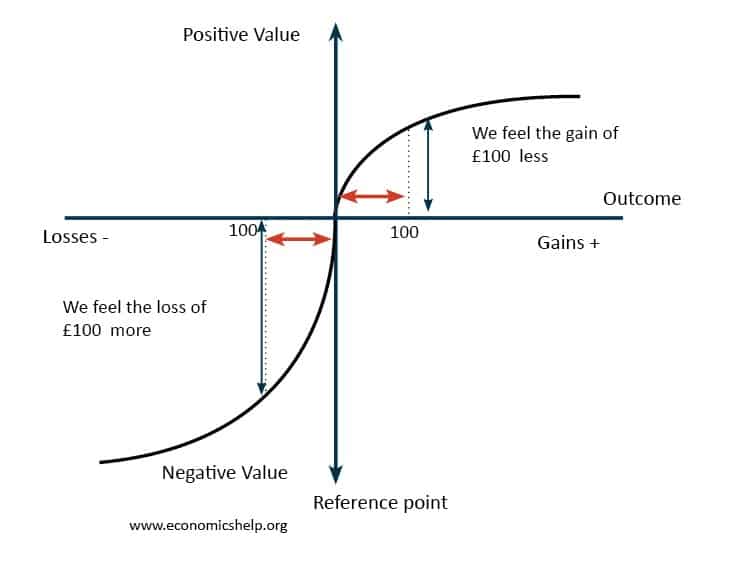
Look closely at the graph. It tells us a story:
- The center is the Reference Point: This is the "zero" point from which gains and losses are measured.
- The curve is steeper for losses: The line goes down more sharply on the left (losses) than it goes up on the right (gains). This is the visual signature of loss aversion. Losing £100 hurts more than gaining £100 feels good.
- The curve flattens out: This illustrates the third principle: diminishing sensitivity. The difference between gaining £10 and £20 feels significant. But the difference between gaining £1,010 and £1,020 feels much smaller. The same is true for losses. This explains why a £5 discount on a £15 coffee feels more impactful than a £5 discount on a £500 suit.
Let's watch one more short clip that explains this S-shaped curve perfectly.
Prospect Theory Explained at 5 Levels of Difficulty
We return to Pete Judo's video, where he explains the value function graph and the concept of diminishing sensitivity using clear, everyday examples.
Watch from 02:55 to 05:06. Focus on how the emotional response to gaining or losing money changes as the amounts get larger.
To solidify your understanding of these interconnected concepts, let's turn to a concise written summary.
What Is Prospect Theory In Marketing?
The article 'What Is Prospect Theory In Marketing?' from Oddit provides excellent, clear definitions for the key concepts we've just covered.
Please read the section titled 'Key Concepts Of Prospect Theory.' This will give you a solid text-based reinforcement of Reference Points, Loss Aversion, and Diminishing Sensitivity.
Test your understanding!
Imagine you are trying to convince an existing customer to upgrade from their "Basic" software plan (£50/month) to the "Pro" plan (£150/month). How might the three core principles of Prospect Theory influence their decision-making process?
- Reference Point: How does their current plan affect their view of the upgrade?
- Loss Aversion: What potential "loss" could you frame to motivate them to upgrade?
- Diminishing Sensitivity: Why might a simple "Save £10 on your first month of Pro" offer not be very effective for a large corporate client?
Show answer
- Reference Point: The customer's reference point is their "Basic" plan at £50/month. The £150/month "Pro" plan is perceived as a £100 "loss" in money, not as an absolute cost. All features and benefits of the Pro plan will be weighed against this perceived financial loss.
- Loss Aversion: You could offer a free trial of the "Pro" plan. After the trial, the customer would face the loss of the advanced features they've gotten used to. The desire to avoid this loss could be a stronger motivator than the desire to gain the features in the first place. Another angle is framing the limitations of the Basic plan as "losing out on efficiency" or "losing potential revenue."
- Diminishing Sensitivity: For a large corporate client with a budget of thousands, a £10 discount is trivial. Due to diminishing sensitivity, the subjective value of saving £10 is almost zero when the overall cost is so high. A more meaningful incentive, like a percentage discount (e.g., 20% off the first year) or an additional high-value feature, would be necessary to overcome their inertia.
Conclusion
Today we unpacked the science behind why we are "predictably irrational." Prospect Theory gives us a framework for understanding how people truly evaluate their options, not in a world of pure logic, but one of psychology, context, and emotion.
Key Takeaways:
- Reference Points: All decisions are evaluated as gains or losses relative to a starting point (the status quo or an expectation).
- Loss Aversion: We are wired to avoid losses. The pain of losing is about twice as intense as the pleasure of an equivalent gain.
- The Value Function: This S-shaped curve visually represents our decision-making. It's steeper for losses (loss aversion) and flattens at the extremes (diminishing sensitivity).
In our next lesson, we will move from theory to direct application. We will use the principles you learned today to practice applying gain vs. loss framing to a marketing message, turning this powerful psychological insight into a practical communication tool.