Hello! Welcome to the fourth lesson in our module on "Synthesizing and Applying Neuromarketing."
In our previous lessons, you've acted as a diagnostician, a scientist, and a detective. You've learned to identify marketing problems, form testable hypotheses based on cognitive biases, and deconstruct competitor campaigns to reveal their psychological machinery.
Today, we transition from analysis to creation. Our learning outcome is to create a creative brief for an advertising campaign that integrates the principles of attention, emotion, and memory. This is where we synthesize everything we've discussed into a single, powerful document. For anyone in business development or sales, the creative brief is a critical tool. It's the bridge that connects high-level business strategy to the creative work that will actually engage customers.
1. The Modern Creative Brief: From "About Us" to "For You"
Traditionally, a creative brief is a document used by advertising agencies and internal marketing teams to guide the development of creative work. It typically outlines the project's objectives, target audience, key message, and competitive landscape.
Here is an example of a standard creative brief structure:

While this structure is useful, traditional briefs often have a fundamental flaw: they are written from the brand's perspective. They are full of what the brand wants to say about itself—its features, its benefits, its history. The problem? As we've learned, customers are not primarily interested in your brand; they are interested in themselves.
To create truly effective advertising, we need to upgrade the brief by applying a neuromarketing lens.
Applied Neuromarketing: Improving the Creative Brief
The article 'Applied Neuromarketing: Improving the Creative Brief' by Kevin Perlmutter does an excellent job of explaining this necessary shift in perspective. It argues for moving from a 'brand-out' to a 'consumer-in' approach.
Please read the sections 'Key Takeaway: How Can We Improve People's Lives?', 'Call to Action: What Behavior Change Do We Want to Inspire?', and 'Emotional Benefits: Why Should People Care?'. Focus on the core argument of flipping the perspective from 'About Us' to 'For You' and prioritizing 'Reasons to Care' over 'Reasons to Believe.'
As the article argues, our brains are not wired to care about "reasons to believe" in a product until we first have an emotional "reason to care." This is the essence of System 1 (fast, emotional, unconscious) versus System 2 (slow, logical, conscious) thinking. An effective brief doesn't just list product facts (System 2); it provides the creative team with the insight needed to trigger an unconscious emotional connection (System 1).
2. Weaving Attention, Emotion, and Memory into the Brief
A neuromarketing-informed brief must provide clear direction on how to strategically engage three core brain functions: attention, emotion, and memory. These are not separate goals; they work together to create a lasting brand impression.
A. Capturing Attention
Your audience is bombarded with thousands of messages a day. To even have a chance, your ad must first cut through the noise. This is achieved by creating stimuli that the primitive, "reptilian" part of our brain cannot ignore.
Is There a Buy Button Inside the Brain: Patrick Renvoise at TEDxBend
In his TEDx talk, Patrick Renvoise outlines six stimuli that reliably capture the attention of our instinctual, decision-making 'reptilian brain.' These are direct, practical tools you can build into a creative brief.
Please watch the segment from 09:18 to 12:17. As you watch, list the six stimuli: Self-centered, Contrast, Tangible, Beginning & End, Visual, and Emotion. Think of each as a potential tactic for your campaign.
When writing your brief, you should include a section with guidelines for capturing attention. Ask your creative team to consider:
- Contrast: How can we show a clear before-and-after?
- Tangibility: How can we make an abstract benefit concrete and simple to grasp?
- Visuals: What is the core visual that will communicate our idea faster than words? (Remember, the optic nerve is much faster than the auditory nerve).
- Beginning & End: How can we create a powerful opening hook and a memorable closing?
B. Triggering Emotion
Once you have their attention, you must make them feel something. Emotion acts as a gatekeeper for what we remember and a driver for what we decide. As the famous New Coke failure demonstrated, the rational "better taste" of a product is often no match for the deep emotional connections and memories associated with a brand.
Emotion, Attention and Memory in Advertising
The paper 'Emotion, Attention and Memory in Advertising' by Ipsos explains the scientific link between these three elements. It details how emotion prioritizes what we pay attention to and what gets encoded into our memory.
Please read the sections 'How does emotion capture attention?' and 'What are the implications of how emotion, attention and memory interact for ‘emotional advertising’?'. Focus on how emotional relevance sustains engagement and why the brand must be linked to the story.
In your brief, don't just describe the brand's personality. Define the target emotional state. What specific feeling should the audience be left with?
- Is it confidence?
- Is it relief?
- Is it a sense of belonging?
- Is it the thrill of "subversive pleasure," like we saw with Cheetos?
This provides a clear emotional bullseye for the creative team, ensuring the ad connects on a human level.
C. Building Memory
An ad that is seen but not remembered is a wasted investment. The ultimate goal is to build or reinforce a strong, positive memory structure associated with your brand. Emotional moments are prime real estate for memory encoding.
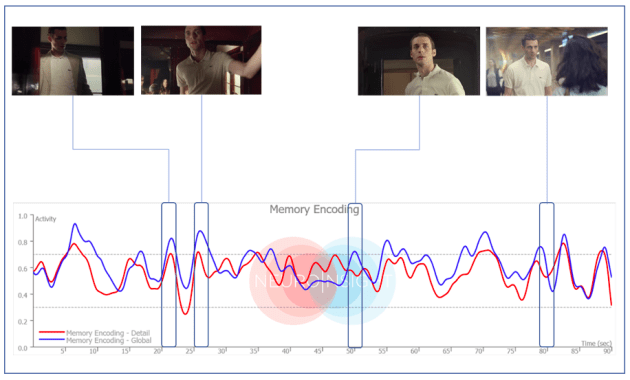
The Ipsos paper you just read highlights that emotional arousal leads to selective memory. We don't remember everything; we remember the parts of an experience that are tied to the emotional peak. Therefore, your brief must be prescriptive about what to make memorable.
This means specifying the retrieval cues—the distinctive brand assets that need to be tightly integrated with the peak emotional moment of the ad. These could be:
- The logo or brand name
- A specific color palette
- A jingle or sonic logo
- A unique package shape
If the brand is not present during the emotional peak, the audience might remember the cute dog in your ad, but they won't remember who the ad was for.
3. Case Study: Building a Neuro-Informed Brief
Let's imagine we're creating a campaign for a new brand of sparkling water called "Clarity." It's targeted at busy professionals who feel overwhelmed by digital noise and seek moments of mental calm.
Here's how we could structure parts of a brief using our principles:
- Project Objective: Not just "Increase market share by 5%." Instead: "Establish Clarity as a mental reset button, associating the brand with the feeling of calm focus in a chaotic world."
- Target Audience: Demographics: 25-45, urban professionals. Psychographics/Pains (Reptilian Brain): Feels constantly distracted, fears burnout, struggles to switch off from work, seeks control over their mental state.
- The Single Most Important Message (The "Reason to Care"): "Find your focus." (This speaks directly to solving their pain, not just to a feature like "natural flavors.")
- Creative Guidelines (Integrating Attention, Emotion, Memory):
- Attention: Use strong contrast. Show a visually chaotic, noisy scene (notifications popping, phones ringing) that instantly cuts to a silent, clean, minimalist shot of someone drinking Clarity. The opening shot must be visually jarring to grab attention.
- Emotion: The target emotion is relief and serene confidence. The talent's expression should not be sleepy, but calm and in control. The overall tone is minimalist, elegant, and quiet.
- Memory/Retrieval Cues: The emotional peak is the moment of the first sip and the visible feeling of relief. At this exact moment, the unique, minimalist "Clarity" logo and the distinct sound of the can opening must be featured. The ad must end with a clean shot of the product.
Test your understanding!
Imagine you're writing a brief for a new, high-end, durable luggage brand called "Atlas." The key feature is that it's virtually indestructible.
How would you translate the feature "indestructible" into a "Reason to Care" that targets an emotional, System 1 response?
Show answer
A feature-based message (System 2) would be "Our luggage is indestructible."
A "Reason to Care" (System 1) speaks to the underlying emotional need. The real pain isn't a broken suitcase; it's the anxiety and chaos that a broken suitcase causes during travel.
Therefore, a strong emotional message would be: "Travel with complete peace of mind." or "One less thing to worry about."
This reframes the product from being about its physical properties to being about the emotional benefit it provides the user—freedom from travel anxiety. This is a much more powerful and memorable angle for a creative campaign.
Conclusion
Today, we've transformed the creative brief from a simple instruction sheet into a strategic blueprint for influencing the consumer brain. You've learned how to build a document that is not only more inspiring for creative teams but also far more likely to produce effective work.
Key Takeaways:
- A modern, effective creative brief must shift from a "brand-out" perspective ("About Us") to a "consumer-in" one ("For You").
- It must focus on creating a "Reason to Care" (emotional benefit) before providing "Reasons to Believe" (rational facts).
- A neuro-informed brief gives explicit guidance on how to leverage Attention (e.g., using contrast, tangible ideas), Emotion (defining a target feeling), and Memory (specifying retrieval cues at peak moments).
Mastering this skill is a crucial step toward your goal of communicating neuromarketing science. When you can author a brief like this, you are directly translating brain science into business strategy, ensuring that marketing efforts are not just creative, but also neurologically resonant.
Preview of Next Lesson:
We've focused today on crafting the message for an ad campaign. In our next lesson, we will broaden our scope from a single message to an entire environment. Your challenge will be to propose a multisensory strategy for a physical retail store to enhance customer experience and increase dwell time.