Hello! Welcome to your next lesson in our module on The Science of Emotional Branding.
In our last session, we focused on the "how" of brand storytelling, learning to structure narratives with frameworks like StoryBrand to create a specific emotional journey for the customer. We established that making the customer the hero and the brand the guide is a powerful recipe for connection.
Today, we delve into one of the most powerful story types a brand can tell—one that doesn't just present a new narrative but reactivates one that already exists deep inside the consumer's mind. Our goal is to define autobiographical memory and apply nostalgia marketing principles to evoke positive personal memories. You'll learn the science behind why the "good old days" feel so good and how brands can strategically tap into those feelings to build profound, lasting connections.
1. Your Brain's Personal Time Machine: Autobiographical Memory
Before we can leverage the past in marketing, we first need to understand how our brain stores it. We're not talking about remembering facts, like a company's founding date. We're talking about the rich, vivid, emotional memories that make up the story of our lives. This is called autobiographical memory.
To begin, let's get a clear definition from a leading neuroscientist.
The Neuroscience of Memory - Eleanor Maguire
This video, 'The Neuroscience of Memory' from The Royal Institution, features Professor Eleanor Maguire, who provides an excellent introduction to the different types of memory. Pay close attention to her definition of autobiographical memory.
Please watch from 00:10 to 03:43. Notice how she distinguishes the rich, personal 'autobiographical memories' from other types, like short-term memory or learned habits.
As Professor Maguire explains, autobiographical memories are the episodes that punctuate our lives. They are multi-sensory and soaked in emotion. Think about the memory of your first day at school or a significant family holiday. You don't just recall the facts; you recall the sights, sounds, and feelings.
So, how does the brain do this?
A key player is a small, seahorse-shaped structure deep in the brain called the hippocampus. In her talk, Professor Maguire later explains that the hippocampus acts like a "scene construction" engine. It doesn't just store a memory like a file in a cabinet. Instead, it reconstructs the scene—the spatial and emotional context—allowing you to mentally re-experience that moment. This is why damage to the hippocampus can prevent people from recalling their past experiences or even imagining future ones. They lose their ability to mentally "time travel."
From a marketing perspective, it's crucial to understand the difference between two types of long-term memory:
- Semantic Memory: This is your brain's encyclopedia of facts, concepts, and knowledge about the world. "Coca-Cola is a soda brand" is a semantic memory.
- Autobiographical Memory: This is your personal story archive. "I remember drinking ice-cold Coca-Cola with my friends on hot summer afternoons" is an autobiographical memory.
While semantic memory is useful for brand recognition, autobiographical memory is the key to building deep emotional resonance. An advertisement that successfully triggers an autobiographical memory doesn't just remind you of the product; it reminds you of who you were and the positive emotions you felt with the product.
2. The Power of Nostalgia: Why We Love Looking Back
When marketing taps into autobiographical memory, it often creates the feeling of nostalgia. But what exactly is nostalgia, and why is it such a potent emotion? Let's explore its evolution from a "disease" to a psychological superpower.
Why do we feel nostalgia? - Clay Routledge
This wonderful TED-Ed animation, 'Why do we feel nostalgia?', clearly explains the modern psychological understanding of this complex emotion.
Watch from the beginning to 03:28. Focus on how the view of nostalgia shifted from a negative illness to a positive, restorative emotion that boosts well-being and social connection.
As the video explains, nostalgia isn't just a simple, happy memory. It's often a "bittersweet" feeling—a longing for a past that's gone. However, research shows that engaging in nostalgia generally has powerful positive effects: it increases feelings of self-esteem, social belonging, and meaning in life.
This is partly due to a cognitive bias known as "rosy retrospection." Our brains are wired to remember past events as being more positive than they actually were at the time. We tend to forget the mosquito bites on a family vacation and remember the beautiful sunset.
From a neurochemical perspective, nostalgia is rewarding. When we re-experience these positive, idealized memories, our brains can release:
- Dopamine: The "reward" chemical, making the experience feel pleasurable.
- Oxytocin: The "bonding" hormone, strengthening our feelings of trust and social connection.
By evoking nostalgia, a brand can literally make you feel more positive, more connected, and more trusting—all feelings that can be transferred directly to the brand itself.
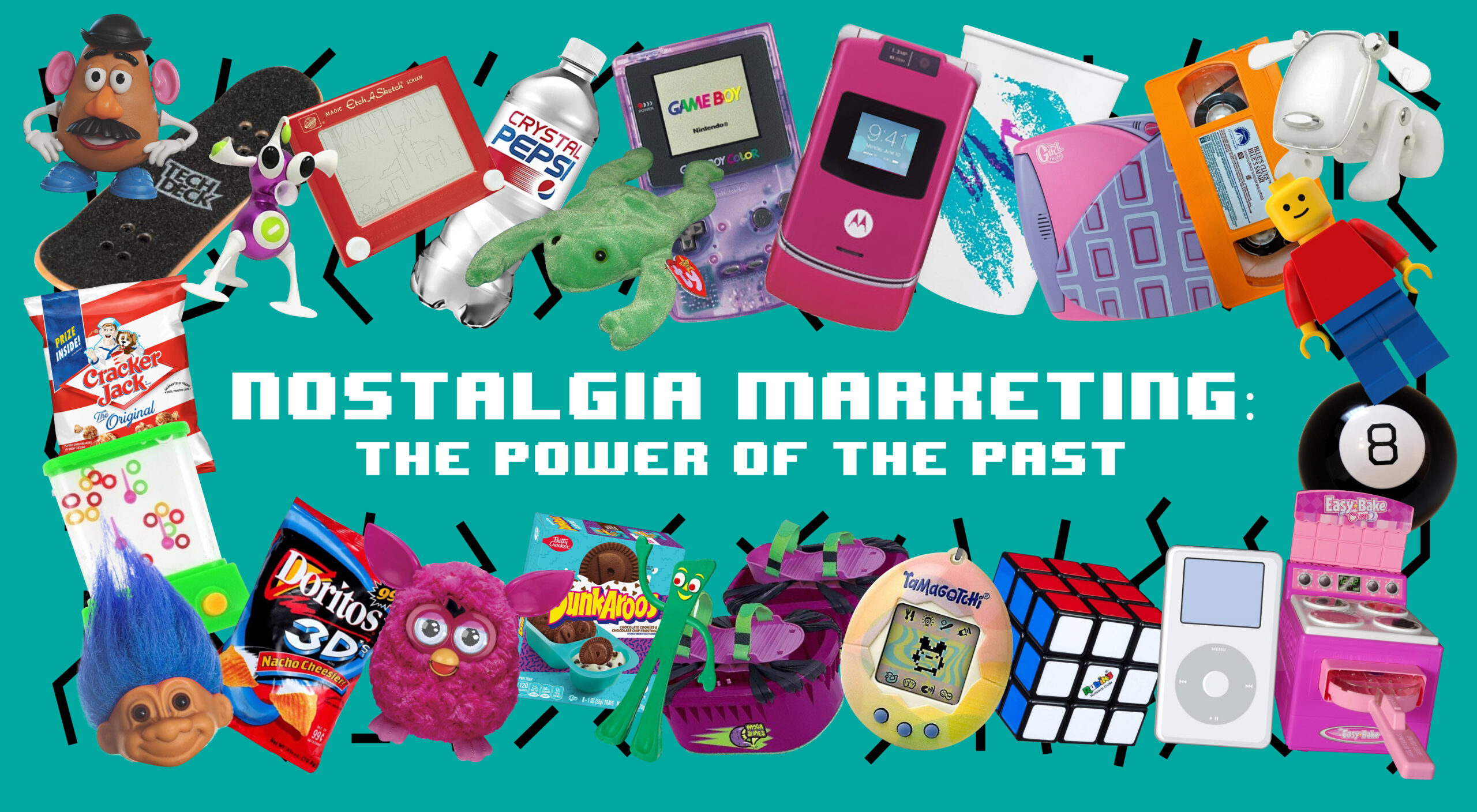
3. How to Apply Nostalgia Marketing: A Science-Backed Approach
Knowing that nostalgia is powerful is one thing; knowing how to use it effectively is another. Simply showing an old product isn't enough. The success of nostalgia marketing hinges on a few key principles, which are brilliantly demonstrated in a recent study.
Eye-tracking data shows how nostalgic stories unlock brand memory
This article, 'Eye-tracking data shows how nostalgic stories unlock brand memory,' breaks down a series of experiments that tested exactly when and why nostalgic ads work. It provides clear, evidence-based rules for application.
Please read the article, focusing on the descriptions of the three studies and the 'Implications for Business Strategy.' Pay attention to how the researchers proved their hypothesis, moving from self-reported recall to physiological evidence (eye-tracking).
This research gives us a precise, actionable playbook for using nostalgia. Let's distill the key principles:
Principle 1: Reactivate, Don't Just Remind
The study's most important finding was that nostalgic ads are most effective for established brands with which consumers already have a personal history. For brands where participants had strong prior memories, the nostalgic ads massively outperformed factual ads in boosting brand recall a week later. For unfamiliar brands, there was no advantage.
- Your takeaway for clients: "Nostalgia marketing isn't about teaching customers something new. It's about unlocking a positive memory they already have. It works by reactivating an existing neural pathway to your brand, making that connection stronger and more emotional."
Principle 2: Target the Formative Years
The study confirmed that the effect works across generations, but only when the nostalgic content is tailored to the correct audience. An ad referencing the 1980s won't create nostalgia for a Gen Z consumer.
- Your takeaway for clients: "To make nostalgia work, we must align the campaign's cultural references—the music, fashion, and events—with the target audience's adolescence and early adulthood (roughly ages 12-22). This is the period when we form many of our most powerful autobiographical memories."
Principle 3: Use Sensory and Story-Based Cues
The eye-tracking data showed that nostalgic ads for familiar brands caused pupils to dilate (a sign of emotional arousal) and eyes to move more (a sign of vivid mental imagery). The ads used audio narratives to create this effect.
- Your takeaway for clients: "We need to use triggers that help people reconstruct the 'scene' of their memory. This includes era-specific music, retro visuals and logos, and storytelling that references universal experiences like a first car, a family holiday, or Saturday morning cartoons."
The business impact of getting this right is significant. Nostalgia doesn't just create warm feelings; it drives behavior.

Test your understanding!
Imagine you are the marketing manager for LEGO. Your goal is to launch a campaign targeting Millennials (born approx. 1981-1996) to encourage them to buy LEGO sets for their own young children.
Based on the principles we've discussed, outline a concept for a nostalgia-driven ad campaign. Consider the following:
- Core Message: How would you frame the message to connect their past with their present?
- Sensory Cues: What specific visuals, sounds, or story elements would you use to trigger autobiographical memories from the 80s and 90s?
- Targeting: Why is this strategy particularly well-suited for both the LEGO brand and the Millennial target audience?
Show answer
Here is one possible concept:
-
Core Message: The campaign theme could be "Build Their Memories, The Way You Built Yours." This directly links the parent's positive autobiographical memories of playing with LEGO to the act of creating new memories with their own children. It reframes buying a toy as an act of emotional connection and legacy.
-
Sensory Cues:
- Visuals: The ad could open with grainy, home-video-style footage (a VHS filter) of a child in the 80s/90s building a classic LEGO castle or spaceship. It could then transition to a crisp, modern shot of that same person, now a parent, watching their own child open a new LEGO set. They could show classic LEGO pieces (like the iconic yellow spaceman) mixed in with new ones.
- Sound: The ad could start with a faint, synthesized soundtrack reminiscent of 80s/90s pop music or even the iconic "click" sound of LEGO bricks snapping together. The narration would be warm and reflective.
-
Targeting: This strategy is ideal because:
- Brand: LEGO is a legacy brand with a presence in the childhood of nearly every Millennial. Strong prior autobiographical memories already exist.
- Audience: Millennials are now at an age where they are raising their own children and are often nostalgic for their own "simpler" childhoods. They are also highly active on social media, where shareable, emotional content like this performs very well. The campaign taps into the universal theme of parenthood and passing down traditions.
Conclusion
Today, you've moved beyond general storytelling to understand a highly specific and emotionally resonant technique. You've seen that what we call nostalgia is the marketing application of a fundamental brain system—autobiographical memory.
Key Takeaways:
- Autobiographical memory is our personal story archive, reconstructed by the hippocampus as rich, emotional scenes.
- Nostalgia taps into these memories, often through "rosy retrospection," and triggers a rewarding neurochemical response (dopamine and oxytocin), fostering trust and positive feelings.
- Effective nostalgia marketing is not a one-size-fits-all tool. Its success depends on reactivating existing memories for an established brand and targeting the correct generational cohort with authentic sensory cues.
Preview of the Next Lesson:
In our final lesson for this module, we will zoom out. Having explored narrative structure and specific emotional triggers like nostalgia, you will learn to analyze a brand's communication to identify its intended brand personality and emotional positioning. This will equip you to deconstruct any brand's emotional strategy and understand the complete picture of how they build their identity in the consumer's mind.