Hello. The previous lesson examined the Nazi promise of a racial “national community” and the persecution of people excluded from it. Here the question shifts to economic power. If the regime directed production toward war, did it also own the firms doing the producing? And what power did owners and workers retain? Allow about 40–45 minutes for the lesson, including the selected readings and video passages.
Separate ownership from direction
Earlier in the course, you distinguished legal ownership, effective decision-making power, and entitlement to profits. Nazi Germany is a case where those questions cannot be answered with one word. A private company could keep its owners and earn profits while government authorities constrained what it produced and who could work there. Conversely, the existence of a state-owned plant would not mean that workers controlled it.
A short contemporary account provides a starting point. Otto Nathan, writing in 1944, described an economy that retained private property and profit while subordinating production to rearmament. His language about government control is sweeping; as you read, treat it as an interpretation to test against specific firms and institutions.
The Nazi Economic System - NBER
Read Otto Nathan’s account, published by the National Bureau of Economic Research, for the distinction between private property and autonomous markets.
In “The Nazi Economic System” (pp. 3–4), read his characterization of ownership, profit, and planning. Then, beginning with the paragraph about the network of organizations, read his account of controls. Notice that a loss of freedom to respond to market prices is not, by itself, a transfer of ownership to workers or the state.
Nathan rejects a simple choice between “free-market capitalism” and “state ownership of everything.” That distinction matters, but the phrase state control still needs precision. A ministry choosing a military priority, an official allocating scarce materials, and a factory manager supervising a production line all exercised different kinds of power. The rest of the lesson examines how those powers fitted together.
Firms could remain private—and earn profits
Some firms were not merely left in private hands: the Nazi government sold state-held shares during the mid-1930s. Several of those holdings had entered public ownership during earlier financial crises. In one steel concern, a pre-Nazi government had acquired a controlling stake in 1932; the Nazi government sold its remaining shares in 1936. This is evidence about an actual change in ownership, not an inference drawn from the party’s name.
Nazi privatization in 1930s Germany1
Read economic historian Germà Bel’s account to see both what was sold and why a sale did not necessarily produce a free market.
In the Introduction (p. 2), find the paragraph beginning “It is a fact that the Nazi government sold off public ownership” and read the qualification through its final sentence. Then, in the account of the steel and mining sector (pp. 5–6), read the steel example. Track the difference between the government’s shareholding before the sale and its capacity to direct the economy afterward.
Why sell shares while expanding regulation? Bel identifies more than one motive, including obtaining revenue as rearmament strained public finances and building cooperation with business. Privatization was neither proof that the regime embraced unrestricted competition nor an empty gesture: a share sale changed who held a legal claim on a firm and its returns.
Private firms also received substantial military orders. Profit remained possible, and owners and managers continued to organize production within firms. But a profitable contract does not tell us who set the economy’s overall priorities. Nor does it imply that industrialists uniformly supported the Nazis before they took power or could dictate the regime’s aims afterward. Owners could benefit from an arrangement in which the state held the stronger political position.
Rearmament narrowed the owner’s choices
The regime’s central economic priority was preparation for war. It could direct a privately owned firm through large orders, rules governing prices and inputs, and the power to intervene when production did not meet its priorities. This did not require nationalizing every factory. It did, however, make the ordinary picture of an owner freely deciding what to make and sell misleading.
The following passage illustrates both sides of that relationship. Watch especially for the difference between a contract that a firm might decline and a situation in which the government’s purchasing power leaves it little room to negotiate.
Watch “The Nazi Economy Explainer” from the Institute of Economic Affairs for its concrete account of state-owned production alongside government orders to private firms.
In industrial direction, the speaker discusses a new state enterprise and the use of procurement contracts. Focus on why a firm could retain private ownership even as much of its capacity served government priorities. Do not read “take it or leave it” as meaning every firm made the same choice.
Direction intensified with the Four-Year Plan launched in 1936, which sought to accelerate rearmament and reduce dependence on imported materials. The regime also established state enterprises when it wanted production that private firms were unwilling to undertake on the desired terms. Private and public production thus existed side by side; both could be put to military purposes.
The Economy of the Third Reich: How to finance War against the World? | FD Finance
Continue with “The Economy of the Third Reich: How to finance War against the World?” from FD Finance for an example of public production and private production under the Four-Year Plan.
Watch the Four-Year Plan. Note the contrast between the state-owned iron and steel works and a private firm’s synthetic-material production. The useful question here is not whether either was called “industry,” but who owned it and why the government wanted its output.
Banking shows another means of direction. The government strengthened supervision of private banks and then sold its stakes in several major ones. Selling a stake reduced direct public ownership; the new regulatory framework still gave the government leverage over the banks’ activities.
Nazi privatization in 1930s Germany1
Return to Bel’s article for a compact example of private ownership combined with tight regulation.
In Section III, in the discussion of the Banking Inquiry Committee (pp. 16–17), start where Bel describes its recommendation for public supervision. Read the banking decision. Continue through the following paragraph on the sale of state-held bank shares. Keep the order of events in mind: regulation was strengthened before the banks were reprivatized.
These examples put a limit on two opposite claims. “The firms were private, so the state did not direct them” ignores procurement, regulation, and public enterprises. “The state directed them, so private ownership was meaningless” ignores ownership claims, retained managerial roles, and the possibility of private profit. Direction and ownership were distinct, even where they reinforced one another.
Labor reveals who did not control production
A full account of economic power must include workers. The Nazi regime destroyed independent trade unions in 1933 and replaced them with the German Labour Front, which did not provide independent collective bargaining against employers and the state. Strikes were prohibited. Workplace hierarchy gave managers authority over employees, while government policy constrained wages and labor relations. Workers did not gain control of firms because the state was intervening in them.
The Economy of the Third Reich: How to finance War against the World? | FD Finance
Return to the FD Finance video for its brief description of the change in workplace authority.
Watch labor relations. Focus on what happened to independent unions, work stoppages, and managerial authority. Distinguish a state organization that claimed to speak for labor from workers’ ability to organize independently.
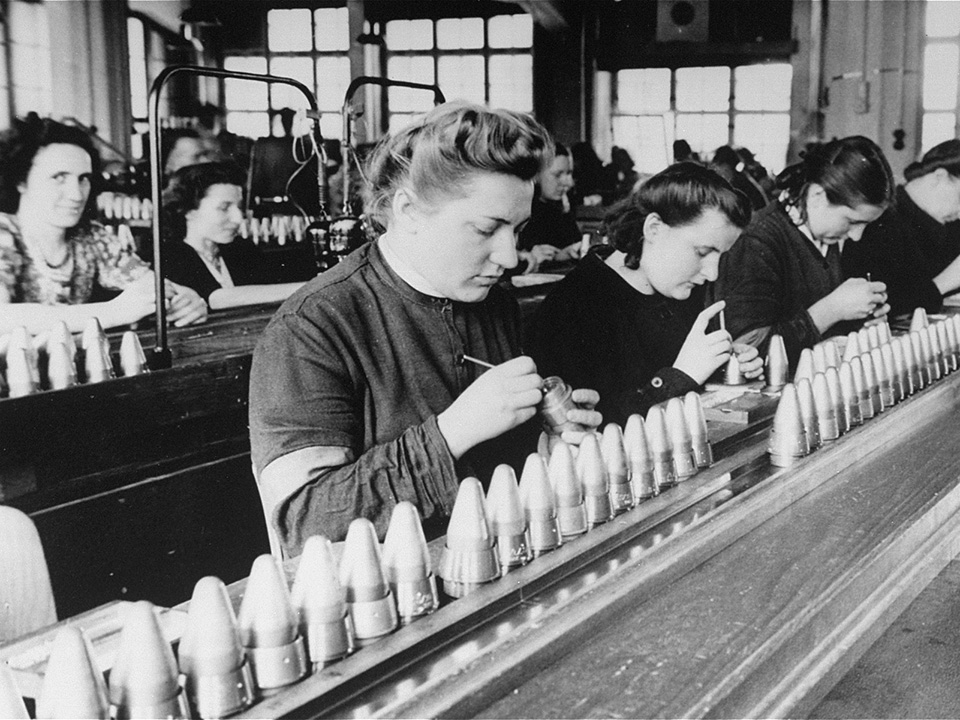
During the war, the regime’s exploitation of labor extended to millions of people brought from occupied countries, many by force, and to prisoners subjected to forced labor. Firms could use workers whose freedom had been taken away by state violence. The photograph below shows foreign women assembling artillery shells. The image alone cannot establish any particular woman’s legal status, whether she was coerced, or her conditions of work. It does show people whose labor was part of munitions production—people a discussion limited to shareholders, contracts, and output could overlook.
The previous lesson’s account of racial exclusion also matters here. Private-property rights were not secure rights for everyone under Nazi rule: Jewish owners were systematically dispossessed, with businesses and assets transferred under coercion or seized. Thus, “private property existed” is true but incomplete. Whose property the regime protected, and whose it attacked, depended on its political and racial priorities.
What classification does the evidence support?
The Nazi economy combined predominantly private ownership of firms with extensive state direction toward rearmament, some state-owned production, continued opportunities for private profit, and the suppression and exploitation of labor. The balance of instruments changed over time; direction became more intensive as war approached and during the war. No single instrument defines the whole period.
That pattern does not fit socialism’s working criterion from earlier lessons—social ownership or effective social control of productive resources—simply because the government intervened. Independent workers did not acquire control over firms, and state decisions served militarized and racial aims, not an egalitarian transfer of power to labor. Equally, the survival of private firms and profits does not make the economy a free market. An accurate assessment names both sides: private owners and managers retained consequential roles within an economy whose major priorities the Nazi state increasingly imposed.
Conclusion
In Nazi Germany, ownership, profit, and control over economic priorities did not always sit in the same hands. Privatization and continuing private profits show that state direction was not equivalent to general state ownership; procurement, regulation, public enterprises, and coercion show that private ownership was not equivalent to economic independence. Workers—especially those deprived of freedom under wartime labor policies—had far less power than either owners or the regime.
The next lesson turns from economic institutions to political authority: how the leadership principle and the destruction of opposition concentrated power in Nazi Germany.