Hello. This lesson brings the course’s distinctions together in one comparison. You will use short evidence cards to compare socialist traditions, Stalin-era Soviet institutions, Italian Fascism, and Nazism across five dimensions: nation, class, ownership, hierarchy, and political power. The aim is not to decide an ideology from a party name or a single policy. It is to make each conclusion traceable to an idea, an institution, or both.
The evidence cards deliberately mix statements of principle with accounts of governing practice. Keeping those kinds of evidence separate is central to the comparison.
The comparison needs two levels
An ideology describes what its advocates believe society ought to become. Institutions show who actually makes decisions, controls resources, and can challenge those decisions. The two may diverge sharply.
This matters especially for socialism. Social ownership or control of productive resources is a useful working criterion, but socialists disagree about how to achieve it and what would count as genuine public control. A state can legally own factories while workers have little say over them. Conversely, a government can provide extensive welfare benefits while most firms remain privately owned. In neither case does the policy label settle the institutional question.
Begin with the economic criterion, then with a reading that tests it against the Soviet case.
Socialism (Stanford Encyclopedia of Philosophy)
Read the Stanford Encyclopedia of Philosophy’s “Socialism” for a precise distinction between socialist aims and one historical attempt to implement them.
In Section 1, “Socialism and Capitalism,” read the core comparison. Follow the account of capitalist ownership and class relations through the proposed minimum criterion for socialism. Then, in Section 4.1, the discussion of “Central Planning,” read planning and its record. Stop after the paragraph assessing the Soviet model; the later participatory-planning proposal is beyond this comparison.
Notice the reading’s distinction between state ownership and social, democratic control. It allows a specific criticism of Soviet institutions without treating every socialist proposal as a description of the Soviet Union.
Evidence cards: socialist traditions and Soviet institutions
Treat each card as evidence for particular claims, not as a complete account of a movement.
S1 — Socialist economic aim. Socialist traditions challenge the concentration of productive assets and decision-making power in private owners’ hands. The working criterion used here is social, democratic control of the bulk of the means of production. This is an aim, not a claim that every government calling itself socialist achieved it. The Stanford Encyclopedia reading supplies the criterion.
S2 — Different political routes. Revolutionary communists have sought a break with capitalist ownership, often through seizure of state power. Democratic socialists seek to extend democratic control into economic life while defending political participation; proposed forms of ownership vary. Social democrats have often pursued redistribution, labor protections, and public services within economies that remain predominantly privately owned. These traditions share concerns about economic inequality but should not be entered as one institutional arrangement in the matrix.
The Soviet evidence concerns a narrower subject: Stalin-era institutions, particularly industrial planning and the concentration of party power. Read the following account with two questions in mind as analytical lenses: who held title to industry, and who could actually direct its work? These are lenses for the reading, not an exercise to submit.
Internal Workings of the Soviet Union - Revelations from ...
Read the Library of Congress exhibit “Internal Workings of the Soviet System” to connect Soviet claims about socialism with evidence about planning and political authority.
In the opening section, “Internal Workings of the Soviet System,” read the account of power, ending with the description of Stalin-era party control. Then go to “Collectivization and Industrialization” and read the economic account, from Stalin’s stated goals through the results of collectivization. Pay particular attention to who set factory quotas and what role trade unions were assigned.
U1 — Ownership and work. Industry and services were nationalized. Central planners set targets, managers received output quotas, and trade unions were turned into instruments for raising productivity. This establishes extensive state ownership and direction; it does not establish that workers directed production. The Library of Congress account supplies these institutional details.
U2 — Class claim and political authority. The ruling party claimed to build socialism in the name of workers and treated the elimination of capitalist ownership as a central goal. In practice, major decisions were concentrated at the top of the party-state, with little input from below and severe repression of opposition under Stalin. The Library of Congress account also notes deportations of non-Russian nationalities during World War II. Soviet policy therefore cannot be inferred simply from an internationalist socialist ideal.
The distinction is not that the Soviet project secretly retained an ordinary private-capitalist ownership structure. Nor is it that party control and worker control are interchangeable. Its legal ownership, declared class purpose, and effective political power must each occupy a separate place in the comparison.
Evidence cards: Italian Fascism and Nazism
The curated readings above give detailed evidence for socialism and the Soviet Union. The remaining cards supply the historical evidence needed for the Fascist and Nazi columns. As with the Soviet cards, an assertion of national unity is not proof that everyone within the nation had equal standing or power.
I1 — Italian Fascist nation and class. Italian Fascism presented the nation, led by the state, as more fundamental than conflict between owners and workers. It sought national strength and expansion, including imperial conquest. It rejected the socialist aim of replacing class domination with social control of production; instead, it demanded that class interests be subordinated to a claimed national interest.
I2 — Italian Fascist labor and ownership. The regime suppressed independent unions and strikes and organized officially recognized employers’ and workers’ bodies within a corporatist system. Employers generally retained private firms and managerial authority, although the state intervened extensively and acquired major holdings, particularly during the 1930s. Official representation of labor did not give workers an independent power to bargain with employers or oppose the regime.
N1 — Nazi national community and hierarchy. Nazism imagined a racially defined national community, not a community of equal human beings. It classified people as worthy or unworthy of belonging and used claims about heredity to stigmatize them. Nazi persecution culminated in genocide. The 1937 chart below is evidence of the regime’s propagandistic attempt to portray a stigmatized status as inherited; it is not evidence that the chart’s purported hereditary claims were true.
The image contains dehumanizing classifications used in Nazi propaganda.
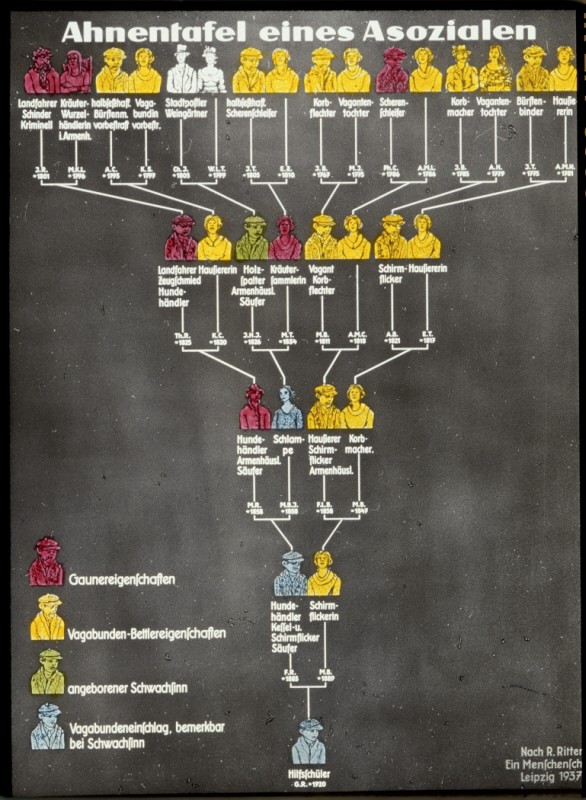
N2 — Nazi firms, labor, and state direction. Private firms and profits continued under Nazi rule, while the regime directed much investment and production toward rearmament and war. It destroyed independent unions, subordinated workers to the German Labour Front, and later used forced labor on a vast scale. Strong state direction therefore coexisted with private legal ownership and private returns; it was not, by itself, social ownership.
N3 — Nazi political power. The Nazis eliminated rival parties and independent organized opposition, concentrating authority around Hitler and the leadership principle. Their promise of unity did not mean democratic participation by everyone they claimed to represent. Nazi inclusion was racially bounded, while their governing institutions made meaningful political challenge dangerous or impossible.
Italian Fascism and Nazism belong in related but not identical columns. Both subordinated labor to authoritarian national projects. Nazi racial ideology, exclusion, and genocide must also be stated explicitly rather than dissolved into the general word nationalism.
Constructing the five-dimensional comparison
A good matrix uses short conclusions in its cells and leaves the evidence cards available to explain them. The socialist column below reports differing traditions and aims; the other three columns describe historical regimes. That asymmetry is intentional and must remain visible when interpreting the table.
| Dimension | Socialist traditions | Stalin-era Soviet institutions | Italian Fascism | Nazism |
|---|---|---|---|---|
| Nation | Varies; revolutionary internationalism and other approaches, not one required ethnic nation (S2) | Socialist claims alongside state priorities and repression of some nationalities (U2) | Nation and imperial strength placed above class conflict (I1) | Racially defined national community; exclusion central (N1) |
| Class | Challenge to owners’ economic dominance; routes differ (S1–S2) | Claimed to govern for workers; party directed labor (U1–U2) | Class conflict officially subordinated; independent labor suppressed (I1–I2) | Class conflict subordinated to racial-national unity; labor controlled (N1–N2) |
| Ownership | Social control is the working aim; social democracy may retain private firms (S1–S2) | Industry nationalized; planners and managers held effective authority (U1) | Private firms remained, alongside intervention and state holdings (I2) | Private firms and profits remained under extensive state direction (N2) |
| Hierarchy | Economic hierarchy challenged in principle (S1) | Party and managerial hierarchy over workers (U1–U2) | National, political, and workplace hierarchy upheld (I1–I2) | Leadership and racial hierarchy constitutive of the project (N1–N3) |
| Political power | Revolutionary and democratic routes differ; do not infer one regime form (S2) | Power concentrated in party-state leadership (U2) | Opposition and independent unions suppressed (I2) | Rival parties and opposition destroyed; leader-centered rule (N3) |
The matrix is useful precisely where its columns resist an easy equation. Soviet and Nazi institutions could both concentrate political power and suppress opposition. That is a real institutional similarity, with grave consequences in both cases. But the same observation does not settle their economic ownership structures, their stated accounts of class, or the Nazi project of a racially defined community. Similarly, Soviet nationalization and Italian or Nazi economic intervention all involved a powerful state, but they did not assign the same legal ownership, effective business authority, or entitlement to profits.
There is also an important tension within the socialist/Soviet comparison. The working socialist criterion asks for social, democratic control; the Soviet evidence shows state ownership without broad worker control. Calling this a tension is more informative than either assuming nationalization fulfilled the ideal or assuming the regime’s socialist claims explain nothing about its choices.
What the matrix can—and cannot—establish
Each cell should be read as a bounded claim. U1 supports the conclusion that Soviet workers lacked control over planning decisions; it does not prove that every enterprise functioned identically. I2 and N2 support the conclusion that state intervention did not eliminate private firms; they do not imply that owners operated free of state pressure. N1 documents a form of Nazi stigmatization; the image alone cannot stand in for the full history of persecution and genocide.
The most reliable comparisons therefore pair a stated goal with a mechanism. “National unity” becomes more specific when set beside the suppression of independent unions. “Workers’ rule” becomes testable when set beside planning authority and political participation. “State control” becomes more specific when separated into legal title, day-to-day decisions, and returns from production.
The five dimensions give you a way to acknowledge similarities without turning them into equivalence. Authoritarian rule is a regime characteristic, not a complete account of an ideology. Intervention is an economic action, not a complete account of ownership. And a party’s name is a claim to examine against its institutions, not a substitute for that examination.
Conclusion
The comparison yields three durable distinctions. Socialist traditions differ among themselves, but the working economic criterion asks about social control of production, not welfare policy alone. Stalin-era Soviet nationalization removed much private ownership while concentrating effective economic and political authority in the party-state. Italian Fascism and Nazism subordinated class conflict to authoritarian national projects while retaining important private firms; Nazism additionally made racial hierarchy and exclusion central to its vision of the nation.
The next lesson applies this evidence-based method to a narrower claim: whether the Nazi Party’s name and socialist-sounding language establish its ideological identity once its governing institutions are examined.