Hello! Welcome back to our study of electromagnetic waves.
In the previous lesson, we achieved a significant result: by manipulating Maxwell's equations in a vacuum, we derived the three-dimensional wave equation for both the electric () and magnetic () fields. This proved that self-propagating electromagnetic disturbances are a direct consequence of the fundamental laws of electromagnetism. We also found their speed of propagation, , which identified light as an electromagnetic wave.
Today, we will investigate the solutions to this wave equation, known as plane waves. Our goal is to describe the properties of plane electromagnetic waves, including their transverse nature and polarization. We will use Maxwell's equations not to derive the wave equation this time, but to impose powerful constraints on the nature of its solutions. This will reveal the geometric relationship between the field, the field, and the direction of travel.
1. Plane Wave Solutions and their Properties
The wave equations we derived, such as , are linear partial differential equations. One of the most fundamental solutions is the harmonic plane wave. In its complex exponential form, the electric field can be written as:
Here:
- is a constant vector representing the complex amplitude and polarization.
- is the wave vector, which points in the direction of propagation. Its magnitude, , is the wave number, related to wavelength by .
- is the angular frequency, related to the period by .
- The phase velocity of the wave is . As we saw last lesson, for waves in a vacuum, this is .
While this is a valid solution to the wave equation, it must also satisfy the four fundamental Maxwell's equations from which the wave equation came. By substituting this plane wave solution back into Maxwell's equations for a vacuum, we uncover the intrinsic properties of electromagnetic waves.
The following video provides a concise and rigorous derivation of these properties.
Electromagnetic waves from Maxwell's equations
This video starts with the wave equation and the plane wave solution, then uses Maxwell's equations in free space to derive the geometric properties of the wave and the relationship between the electric and magnetic fields.
Please watch from 04:54 to 20:01. The video breaks down the process into clear steps: (04:54) It starts by proposing the plane wave solution and substituting it into the wave equation to find the dispersion relation \omega = ck. (08:10) It uses Faraday's Law (( abla imes \mathbf{E} = -\partial\mathbf{B}/\partial t)) to find the magnetic field \mathbf{B} corresponding to the electric field \mathbf{E}. Pay close attention to the resulting cross-product relationship. (14:54) It uses Gauss's Law (( abla \cdot \mathbf{E} = 0)) to show that the electric field must be perpendicular to the direction of propagation. (18:07) Finally, it combines these results to establish the relationship between the magnitudes of the electric and magnetic fields.
Let's summarize the key results derived in the video. When we substitute the plane wave solutions and into Maxwell's equations in a vacuum, we find:
-
From :
This proves the electric field is always perpendicular to the direction of propagation. It is a transverse field. -
From :
Similarly, the magnetic field is also transverse to the direction of propagation. -
From :
This crucial result shows two things:- is perpendicular to both and . Since we already know , this means , , and are mutually orthogonal.
- The electric and magnetic fields are in phase. When the field is at its maximum, so is the field.
Combining these, , , and the propagation vector form a right-handed orthogonal system. The direction of energy flow is given by the cross product , which points in the direction of .
Furthermore, from the magnitude of the relationship , we get:
Since the wave speed is , this simplifies to:
The magnitude of the electric field in an electromagnetic wave is times the magnitude of the magnetic field. Since is a very large number, the electric field component dominates most interactions with matter.
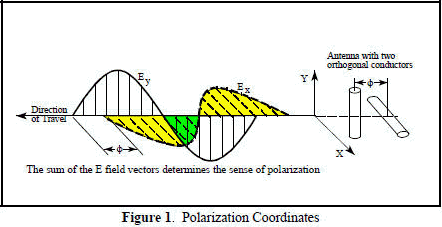
2. Polarization
We've established that the field vector must oscillate in a plane perpendicular to the direction of propagation, . Polarization is the property of a wave that describes the direction and form of this oscillation within that plane.
For a wave traveling in the -direction, the electric field is confined to the -plane. The most general form for the complex amplitude is , where and are complex numbers encoding both amplitude and phase:
The resulting physical electric field is the real part of . The nature of the polarization is determined by the relative amplitudes and the relative phase .
The following lecture provides a comprehensive explanation of the different types of polarization.
Professor J. C. Séamus Davis from MIT OpenCourseWare explains the different types of polarization by considering the superposition of two orthogonal, transverse waves.
Please watch from 19:20 to 46:21. The lecture covers: (19:20) Setting up the mathematical language using a complex vector (the Jones vector) to represent the two components of the E-field. (23:36) Linear Polarization: The case where the two components are in phase. (30:53) Circular Polarization: The case where the components have equal amplitude but a \pi/2 phase difference. (37:42) Elliptical Polarization: The general case with arbitrary amplitudes and phase differences. (44:33) A helpful visual summary of all three types.
For a supplementary text-based reference that rigorously defines these concepts, you can consult the following resource.
Lecture 1 Notes, Electromagnetic Theory II
This section from a lecture note by Dr. Christopher S. Baird provides a concise, mathematically rigorous definition of the different polarization states.
Read the section titled '5. Wave Polarization'. This section formalizes the concepts of linear, circular, and elliptical polarization using the complex amplitude vector \mathbf{E}_0. It provides the exact mathematical conditions for each case, complementing the conceptual explanation in the video.
Let's summarize the main types of polarization:
-
Linear Polarization: This occurs when the phase difference is 0 or . The field vector oscillates back and forth along a fixed line in the transverse plane. The angle of this line depends on the ratio of the amplitudes and .
-
Circular Polarization: This occurs when the amplitudes are equal () and the phase difference is . The tip of the field vector traces a circle in the transverse plane.
- Right-circular polarization (): The vector rotates clockwise when viewed by an observer looking towards the source of the wave.
- Left-circular polarization (): The vector rotates counter-clockwise.
-
Elliptical Polarization: This is the most general case. It occurs for any other combination of amplitudes and phase differences. The tip of the field vector traces an ellipse in the transverse plane. Linear and circular polarization are special cases of elliptical polarization.
Finally, most natural light sources (like the sun or a light bulb) emit unpolarized light. This is not a different type of polarization, but rather a stream of photons where the polarization state changes rapidly and randomly over time. On average, there is no preferred direction of oscillation.
Test your understanding!
An electromagnetic wave is traveling in the direction in a vacuum. The electric field is given by .
- What is the polarization state of this wave?
- Write down the corresponding magnetic field vector .
Show answer
-
Polarization State: The complex amplitude vector is . We can identify the components as and .
- The amplitudes are equal: .
- The phase difference is .
Since the amplitudes are equal and the phase difference is , the wave is right-circularly polarized.
-
Magnetic Field: We use the relation . Here, .
Using the cross products and :
Notice that the B-field is also circularly polarized, but its plane of rotation (-plane) is the same, and its magnitude is times that of the E-field.
Conclusion
In this lesson, we have uncovered the fundamental geometric properties of plane electromagnetic waves, which are dictated by Maxwell's equations.
Key Takeaways:
- Electromagnetic waves in a vacuum are transverse: both the electric field and magnetic field are perpendicular to the direction of wave propagation .
- The fields and are also mutually perpendicular and are in phase with each other. The set {} forms a right-handed orthogonal system.
- The magnitudes of the fields are related by the speed of light: .
- Polarization describes the behavior of the electric field vector in the plane transverse to propagation. The primary types are linear, circular, and elliptical polarization, which depend on the phase and amplitude relationships between orthogonal components of the field.
Preview of the Next Lesson:
We have established what electromagnetic waves are and what they look like. The next logical question is: what do they do? In our next lesson, we will explore the dynamics of these waves. We will learn how to calculate the Poynting vector, energy density, and intensity of electromagnetic waves, thereby quantifying the flow of energy and momentum they carry through space.