Hello. In the previous lesson, you separated confirmed tournament rules from plausible airsoft conventions. Apply the same discipline to equipment: a loadout is not competition-ready because it works well in practice; it must satisfy the requirements for the correct event edition and division and pass the organiser’s checks.
This lesson gives you a repeatable loadout audit for protection, replica energy, ammunition, and other required equipment. Allow about 40 minutes, including the short resources and a check of your own kit.
Start with the applicable specification
The organiser’s website gives a useful published baseline for Tactical Airsoft. Read its FAQ before turning individual items into a checklist.
World Airsoft Games 2027 | Al Ain, UAE | Jan 12–17
Read the organiser's FAQ for its published division-specific loadout and chrono requirements. It is more relevant here than a retailer's product description or another field's rules.
On the event homepage, find the "Frequently Asked Questions" section under "Briefing." Read the FAQ answers, beginning with the paragraph about the two divisions and ending with the answer about HPA regulators. Focus on the Tactical Airsoft answers; do not import Speedsoft's different equipment or ammunition requirements.
For Tactical Airsoft, the published FAQ specifies safety goggles, a safety helmet, a body protector, a primary and a secondary replica, and 0.28 g green tracer BBs. It also says every replica must operate semi-automatic only and pass the pre-play chrono check; Tactical replica energy is capped at 1.4 joules. HPA is allowed with a tournament lock fitted, while unlocked HPA regulators are prohibited.
That is a strong starting specification, not a claim that the FAQ contains every equipment rule. Before treating your audit as final, confirm that this page applies to your entry’s edition and division, and check for a more detailed organiser rulebook or authorised briefing. The FAQ does not, for example, specify a goggle certification standard, a particular body-protector design, magazine limits, or a required tracer device. Record those as unconfirmed, rather than silently inventing requirements or assuming every optional item is permitted.
Check protection as equipment you must actually be able to wear
For the first pass, lay out the three published Tactical protection items: safety goggles, safety helmet, and body protector. Mark each as present or missing. Then make an operational check: can the goggles sit securely while the helmet and body protector are worn together, without the helmet shifting the goggles or the rest of the kit interfering with them?
This separates two questions that are easy to conflate. “Listed on my inventory” is not the same as “protective and usable during play.” Equally, a comfortable setup is not automatically organiser-approved. If your goggles, helmet, or body protector have an uncertain rating, design, or fit, resolve that with the organiser’s detailed safety requirements and inspection staff. Do not substitute a Speedsoft mask for the Tactical items merely because it looks more comprehensive; the published lists differ.
A compact audit record is useful here:
| Item | Published Tactical requirement | Your evidence | Status |
|---|---|---|---|
| Eye protection | Safety goggles | Item and fit inspected; approval details checked against current rules | Pass / pending / fail |
| Head protection | Safety helmet | Item and fit inspected | Pass / pending / fail |
| Body protection | Body protector | Item and fit inspected | Pass / pending / fail |
“Pending” is a real status. If the organiser has not yet clarified whether a particular piece of protection qualifies, an inventory photo cannot turn that uncertainty into a pass.
Check each replica against the energy and firing-mode rules
You need both a primary and a secondary replica for the published Tactical loadout. Each must be semi-automatic only and pass the organiser’s chrono check before play. A compliant primary does not compensate for a non-compliant secondary.
The Tactical cap is stated in joules, a measure of projectile energy, not as a velocity alone. For a BB of mass kilograms leaving at speed metres per second, the calculated kinetic energy is
For example, a g BB has a mass of kg. At m/s, the calculation gives J—exactly the published Tactical cap. This is an illustration of the units, not a recommended target setting or a substitute for an official chrono pass. Measurements vary, and an apparent boundary reading offers no assurance that later readings will pass.
BB weight also matters when interpreting a velocity reading. Watch these selected portions for the reason a replica’s energy with one BB mass need not match its energy with another.
Joule Creep in Airsoft: Why you should only chrono with play-weight BBs! Feat. Begadi Pocket Chrono
Watch "Joule Creep in Airsoft: Why you should only chrono with play-weight BBs!" by Rummbolt for the distinction between measuring velocity and checking energy. Its demonstrations explain measurement risk; they do not set tournament limits or replace the organiser's chrono procedure.
Watch the measurement problem, then joule creep. Compare the different observed trends in the AEG test and the gas replica test. Finish with the safety implication. Focus on why a velocity figure without its BB mass cannot establish compliance.
For your audit, record the BB mass used, the measured energy or velocity and its units, the replica tested, and the date. Use the organiser’s prescribed chrono procedure at the event. If that procedure is not yet published, ask how it handles ammunition and each replica; do not assume that a home test establishes an official pass. If a replica uses HPA, add a separate check for the required tournament lock. An unlocked regulator fails the published condition regardless of its earlier chrono reading.
Verify ammunition and the remaining kit
The FAQ calls for 0.28 g green tracer BBs in Tactical Airsoft. Check all three properties—mass, green colour, and tracer type—against what you intend to load. A Speedsoft-compliant g green tracer BB is still the wrong mass for the published Tactical requirement.
The bottle pictured below is an example of a label advertising 0.28 g green tracer BBs. It helps illustrate what to inspect on packaging; the image alone cannot establish what is inside a bottle you bring, or whether an organiser approves a particular product.
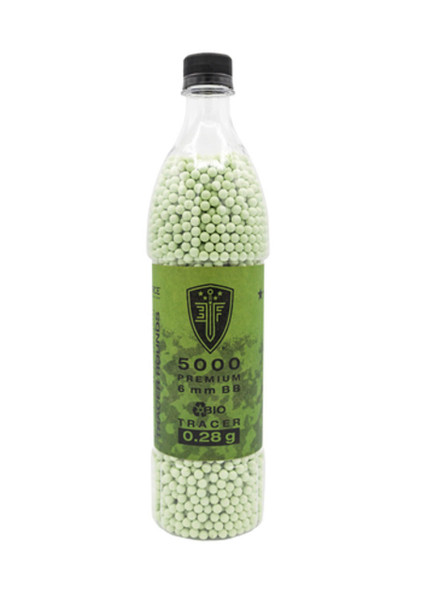
“Bio” appears on this product label, but the FAQ excerpt does not state that biodegradable BBs are mandatory. Nor does its requirement for tracer BBs, by itself, specify a particular tracer unit. Keep those distinctions visible in your notes.
Reliability is a separate gate from rules compliance. A replica that passes chrono but fails to operate on match day is not ready. The following short packing advice is useful for making the inspection repeatable, rather than relying on memory.
Airsoft Packing Made EASY! (Essential Gear List)
Watch "Airsoft Packing Made EASY! (Essential Gear List)" by Airsoft University for a practical pre-match inspection habit. Its packing suggestions are not additional organiser rules.
Watch the replica check for test-firing and damage inspection, power-source checks for batteries and gas equipment, and the inventory habit. Carry out any test-firing only in an authorised area under the applicable safety rules.
An effective preflight has two gates:
- Compliance: Correct edition and division confirmed; required protection present; primary and secondary each semi-automatic and officially chrono-approved; g green tracer ammunition confirmed; HPA lock fitted if applicable; any additional current organiser requirements resolved.
- Function: Protection fits together; replicas and power supplies have been inspected; the intended ammunition and needed accessories are packed; faults found during testing are addressed.
Record pass, fail, or pending beside each line. A fail means the loadout is not ready. A pending item—such as an unpublished inspection detail or an untested secondary—means you cannot yet assert that it is ready.
Consider a loadout with all three protection items, the specified BBs, and a primary that passes chrono at J using the recorded test ammunition. If its secondary records J under the official Tactical check, the loadout fails: the J cap applies to every replica. Replacing or correcting that secondary would require another official check; the primary’s result cannot be transferred to it.
Key takeaways
A competition loadout needs more than a convincing gear list. Check the applicable organiser specification, verify required protection and ammunition, and treat the primary and secondary as separate semi-automatic and chrono checks. Keep uncertain rules and unverified items marked pending, and distinguish an official pass from your own useful preflight measurements.
That completes the rules-and-equipment module. Next, the course turns to a short, pain-free movement warm-up so that field practice begins with the same attention to readiness.