Welcome to your first lesson in the Go-to-Market Strategy course! Today, we will build the foundation for everything that follows. Our goal is to demystify the term "Go-to-Market (GTM) strategy" by defining what it is, exploring its crucial purpose in business, and identifying its core components. Think of this lesson as learning the basic anatomy of a GTM strategy before we begin to dissect each part in the upcoming modules. By the end of our session, you'll have a clear conceptual map of how companies plan to bring their products to the market successfully.
The GTM Strategy: A Bridge to the Market
At its heart, a business must answer a fundamental question: "We have built a product, but how do we successfully get it into the hands of customers?" Simply creating a great product is not enough. A Go-to-Market (GTM) strategy is the comprehensive plan that answers this question. It acts as a strategic bridge connecting your product strategy (what you build and why) to the market (your customers).
This diagram illustrates the concept perfectly:
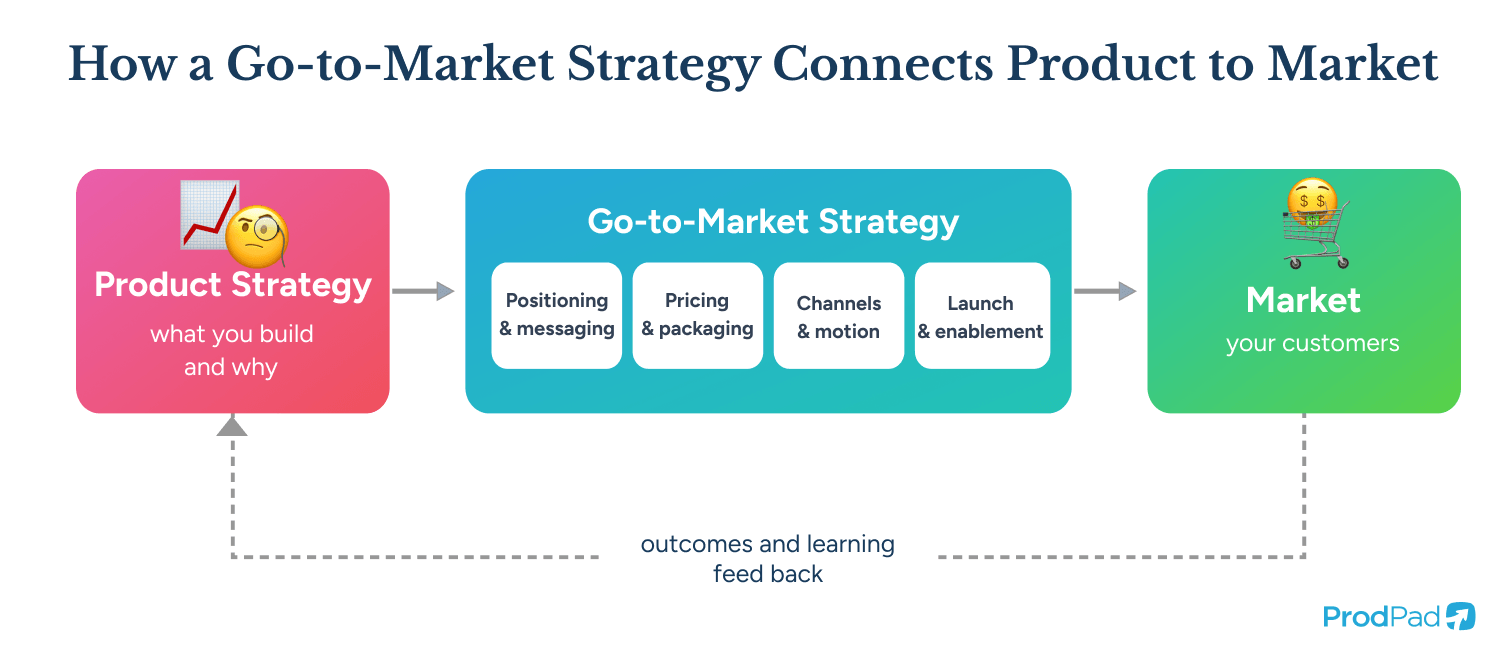
This flowchart shows the GTM strategy as the central link between the internal 'Product Strategy' and the external 'Market'. It also highlights a critical feedback loop, where market outcomes inform future product decisions.
A GTM strategy is not just a marketing checklist or a launch plan. It's a holistic, cross-functional approach that ensures every part of the business—from product and sales to marketing and customer support—is aligned and moving in the same direction to achieve a specific market outcome.
To get a concise and clear definition, let's hear from an expert.
What is a Go-To-Market strategy? Fully Explained by an Ex-CMO
The following video, from the channel Hattie the PMM, features a former Chief Marketing Officer explaining the concept. Please watch the first part where she defines what a GTM strategy is and, just as importantly, what it is not. Then, skip ahead to the end where she distinguishes it from a marketing strategy.
Watch from the beginning to the definition of GTM. Then, jump to the section explaining the difference between a GTM strategy and a marketing strategy.
As you just heard, a GTM strategy is a company-wide plan, whereas a marketing strategy is more focused on the promotional activities within that broader plan. The GTM strategy provides the overarching direction, while the marketing plan details the specific tactics to execute a part of it.
The Purpose: Why Bother with a GTM Strategy?
If a GTM strategy is so comprehensive, what is its ultimate purpose? Why do companies invest significant time and resources in creating one? The primary purpose is to maximize the chances of a product's success while minimizing risks and the inefficient use of resources. It forces a company to think deliberately and make conscious choices rather than stumbling into the market.
A great way to understand the purpose of a GTM strategy is to see it as a framework for answering four fundamental questions.
Go-to-Market Strategy for Product Marketing Teams
This article from Product School provides an excellent breakdown of modern GTM thinking. We'll start by focusing on the definition and the key questions a GTM strategy must answer.
Please read the first few paragraphs of the article, starting from the four big questions. This section clearly frames the strategic purpose of a GTM plan.
These four questions—Who, What, How, and How (to measure)—are the pillars of any GTM strategy. To build on this, we can use another conceptual framework, the "Five W's," which is a classic tool for strategic thinking.
What is a Go-To-Market strategy? Fully Explained by an Ex-CMO
Let's return to the video from Hattie the PMM. In this next segment, she introduces the "Five W's" as the foundation for building an effective GTM strategy. This aligns perfectly with the four questions we just read about and provides a memorable model.
Watch the segment from the five W's. Pay attention to how each "W" corresponds to a critical strategic decision.
By answering the "Five W's" (Who, What, Where, When, Why), a company creates a clear and intentional path forward. This process ensures that everyone is aligned on the objectives and the rationale behind the strategy, which is critical for effective execution.
The Core Components of a GTM Strategy
Now that we understand the what and the why, let's examine the core components—the "how." A GTM strategy is built from several key building blocks. For this introductory lesson, we will focus on the four most fundamental ones: Market, Product, Pricing, and Channels.
This diagram provides a clear visual summary of these core components.
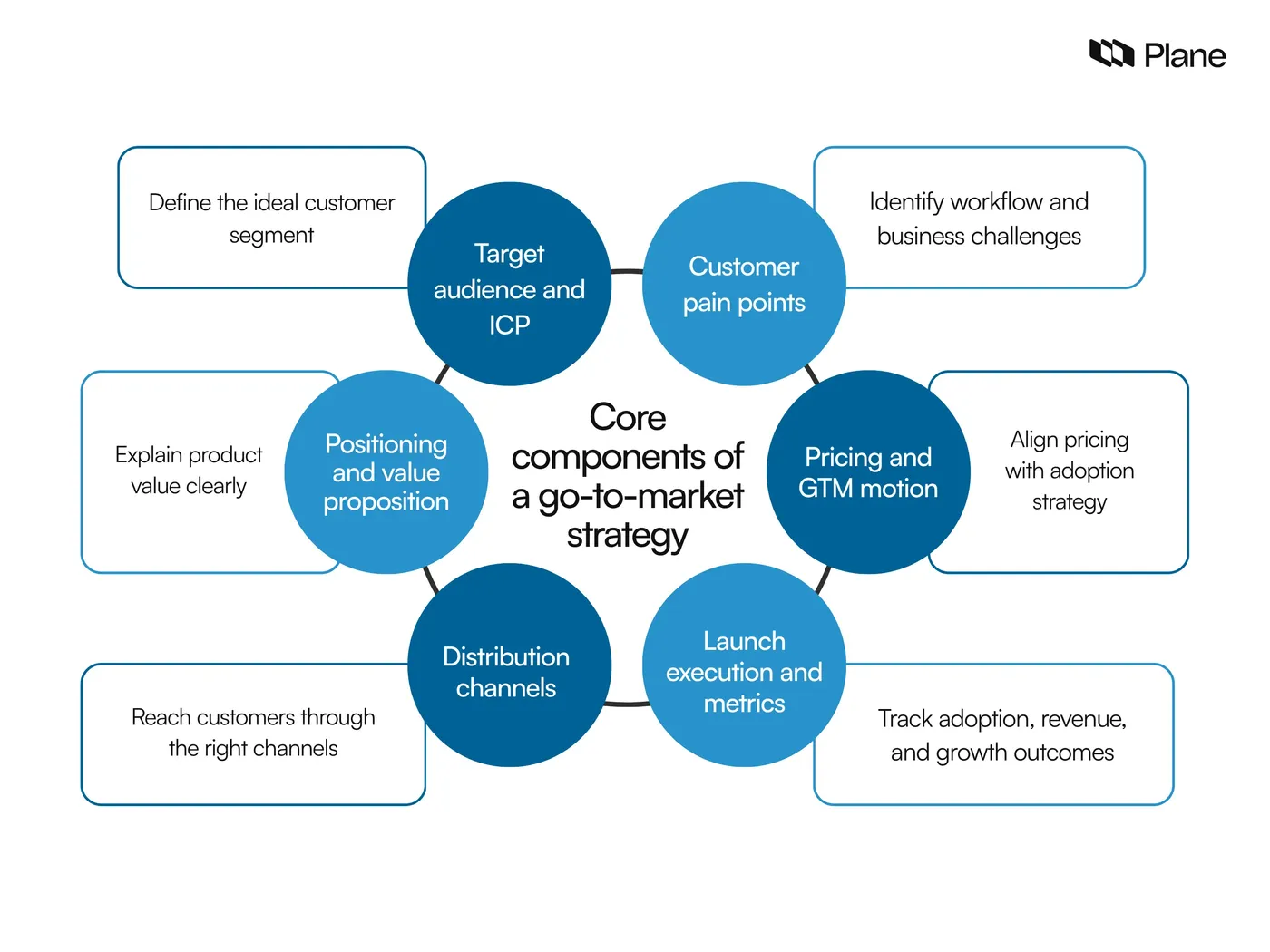
This image displays the interconnected components of a GTM strategy. We will focus on Target audience, Positioning, Pricing, and Distribution channels.
To understand each of these components in more detail, we will turn back to the Product School article, which provides clear explanations for each one.
Go-to-Market Strategy for Product Marketing Teams
This article breaks down the GTM strategy into its constituent parts. As you read, think about how each component answers one of the key questions we've discussed.
In the article, find the section titled "What Is Included in a Go-to-Market Strategy?" First, read the introductory paragraph before the numbered list. Then, read the following subsections: Market and customer definition: This explains the "Who." Positioning, value proposition, and narrative: This addresses the "What" and "Why." Pricing, packaging, and commercial model: This details one part of the "How." Channels and GTM motion: This covers the other essential part of "How."
Let's briefly summarize those key components, connecting them to a classic framework you may encounter in your business studies: the 4 Ps of Marketing (Product, Price, Place, Promotion). While a GTM strategy is broader, this framework offers a familiar lens.
-
Market (Who): This is the foundation. It involves defining your Target Audience and Ideal Customer Profile (ICP). You can't be everything to everyone, so you must decide precisely which segment of the market you will serve. This corresponds loosely to the "people" aspect often added to the marketing mix.
-
Product (What): This component is about more than just the physical item or software. It's about your Positioning and Value Proposition. How do you want your target market to perceive your product relative to competitors? What unique value or benefit does it deliver that solves a customer's pain point? This is the core of the Product 'P'.
-
Pricing (How): Here, you define your Pricing and Packaging model. This is your strategy for capturing value. Will you use a subscription model? A one-time fee? A free trial? Your pricing must align with the value you provide and the market you are targeting. This directly maps to the Price 'P'.
-
Channels (How): This component concerns your Distribution Channels and GTM motion. How will you reach, sell to, and deliver your product to customers? Will you use a direct sales team, an e-commerce website, retail partners, or a mobile app store? This is the Place 'P' in the marketing mix. Your "promotion" strategy is also embedded here, as your chosen channels will dictate many of your promotional tactics.
Mastering these four components is essential to building a coherent and effective plan for bringing a product to market.
Conclusion
In this introductory lesson, we have established a solid conceptual foundation for understanding Go-to-Market strategy.
Key Takeaways:
- A GTM strategy is a comprehensive, company-wide plan that acts as a bridge between a product and the market. It is more holistic than a simple marketing or launch plan.
- Its primary purpose is to provide a clear, intentional path to market success by answering the crucial questions of who to target, what problem to solve, how to reach them, and why the plan will work.
- The core components of a GTM strategy are the Market (your target customer), Product (your value proposition and positioning), Pricing (your monetization model), and Channels (your path to the customer).
In our next lesson, we will begin our deep dive into these components, starting with the first and most critical one: Market and Customer Analysis. We will explore how businesses segment a broad market to identify the specific target audience where they have the best chance of winning.