Introduction
In our last lesson, you analyzed how fundamental principles from mathematics and physics, like the catenary curve and the minimal surface, give rise to the overall form of iconic structures. We saw how pioneers like Gaudí and Frei Otto used physical "form-finding" to discover these optimal shapes. Today, we shift our focus from the macro-scale form to the micro-scale articulation. We will investigate the generative strategies—the specific rules, algorithms, and procedures—that architects use to create the intricate patterns, components, and textures that define a parametric design.
This lesson directly addresses the next step in your capstone project analysis: understanding the computational logic used to develop a design's finer-grained details. We will explore two powerful and common strategies: using attractors to create controlled variation and applying tessellation algorithms to subdivide and rationalize complex surfaces for construction. By analyzing how these strategies are applied in precedent projects, you'll build a catalog of techniques to draw upon when you begin designing your own pavilion.
Strategy 1: Attractor-Based Modulation
One of the most elegant concepts in parametric design is the use of an attractor. An attractor is a geometric entity—a point, a curve, a surface—that exerts an influence on other objects in its vicinity. This influence is defined by a rule: for example, "the closer an object is to the attractor point, the smaller its size" or "the farther away a panel is from the attractor curve, the more it rotates."
This method allows a designer to introduce complex, yet highly controlled, variation into a system of otherwise regular components. Instead of manually adjusting hundreds of elements, the designer manipulates a single attractor, and the entire system responds according to the predefined logic. Your background in physics provides a direct analogy: this is conceptually similar to how a massive object's gravitational field warps spacetime or how a magnet orients iron filings.
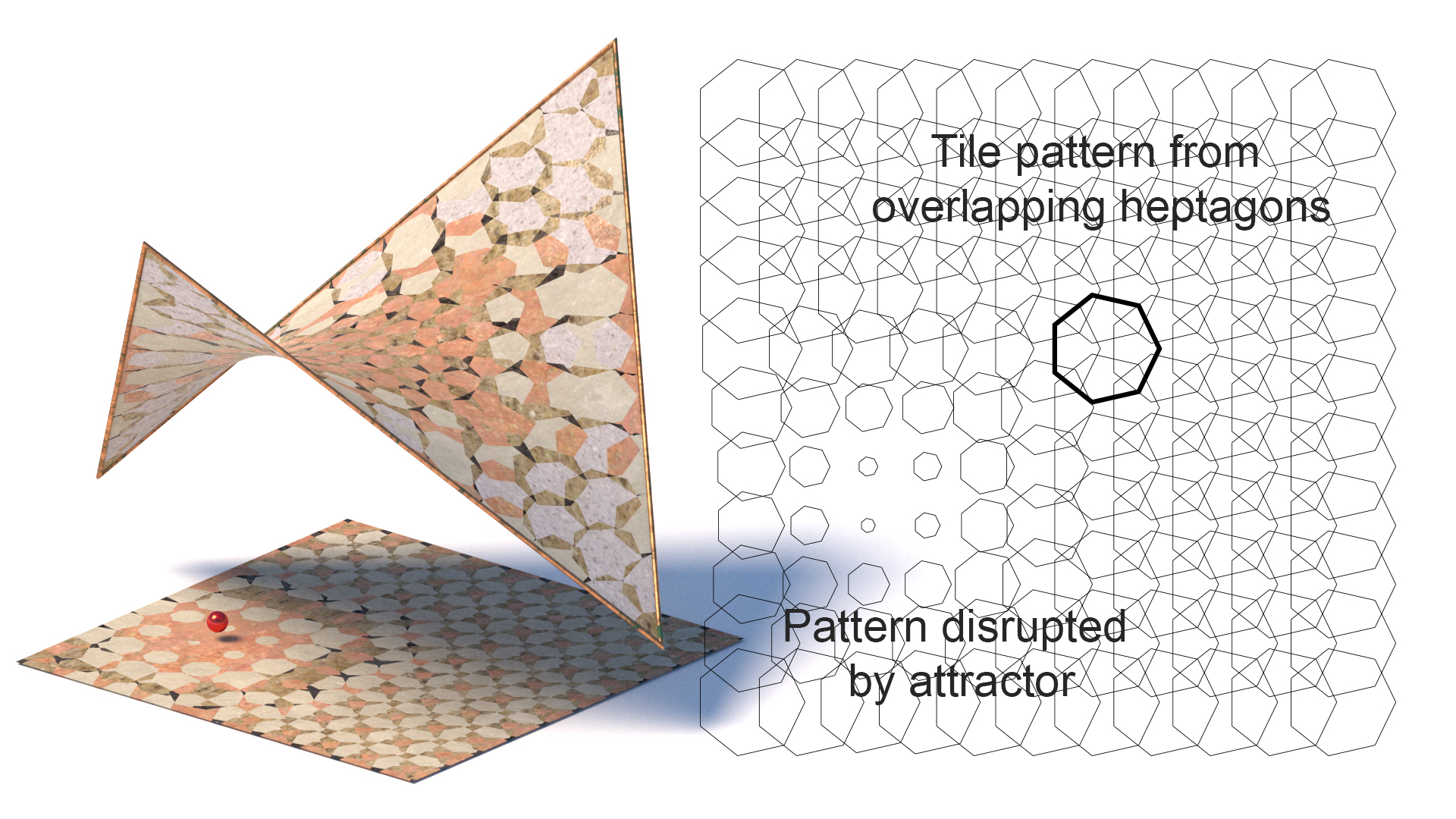
A brilliant architectural application of this strategy can be seen in a project that literally models a concept from physics.
Case Study: The Dark Matter Garden
The "Dark Matter Garden," a gold-medal-winning installation at the Chelsea Flower Show, was designed to be a physical representation of the astrophysical phenomenon of gravitational lensing. This effect describes how the gravity of a massive object (like dark matter) can bend the path of light rays passing nearby. The architects translated this concept into a generative algorithm using attractor points.
[PDF] DARK MATTER GARDEN - University of Liverpool Repository
This paper by the project's designer, Asterios Agkathidis, details the concept and execution. It's a perfect case study of how a scientific principle can become a generative design driver.
Please read the following sections to understand the generative strategy: First, read the abstract and the first two paragraphs of the main text, under "Introduction, Materials and Methods," ending at "Dark Matter phenomenon". This will give you the project's core concept. Continue reading the next paragraph, which explicitly states the strategy: "Point attractor algorithms...". Note how the attractors represent the dark matter and the linear elements represent the light rays. Skim the description of the software used, at the end of that section: "The chosen operative software...". You'll see familiar tools like Rhinoceros and Grasshopper. Now, jump to the "DESIGN PROCESS" section. Study Figure 03 and the accompanying text, which describes the core of the generative algorithm. This shows how sliders controlling the magnitude of four attractor points generate infinite variations of the deformed grid. Finally, read the first paragraph of the "DISCUSSION AND CONCLUSIONS" section. This reflects on how the attractor-based algorithm functioned as a powerful collaborative tool.
The Dark Matter Garden is a masterful example of a generative strategy. The algorithm doesn't define a fixed shape; it defines a system of relationships. The "design" emerges from the interplay between the grid of pipes (light rays) and the deforming influence of the attractor points (dark matter). The architects could explore countless design iterations not by redrawing the pipes, but by simply moving the attractors or changing their "mass" (magnitude), allowing the aesthetic and programmatic needs to be met through the parametric model.
Strategy 2: Tessellation and Rationalization
While attractors introduce variation, tessellation deals with subdivision. It is the process of covering a surface with a pattern of smaller geometric shapes, or "tiles," with no overlaps and no gaps. In architecture, this is the fundamental step for taking a continuous, free-form surface (like those you studied in Module 4) and breaking it down into a collection of discrete, buildable components, such as glass panels or structural members.
However, simply breaking up a complex curved surface can result in thousands of unique, non-planar, and expensive-to-fabricate parts. This leads to the crucial process of rationalization: using algorithmic and geometric techniques to optimize the tessellation for construction. This might involve:
- Adjusting the grid to make panels as planar as possible.
- Minimizing the number of unique panel shapes and sizes.
- Optimizing the grid for structural performance.
Let's examine two landmark projects that showcase distinct tessellation and rationalization strategies.
Case Study: The British Museum Great Court Roof
The iconic glazed roof of the British Museum's Great Court, designed by Foster + Partners with engineers Buro Happold, presented a formidable geometric challenge: spanning an irregular space between a rectangular courtyard and a circular reading room. The solution involved a multi-stage generative process combining physics simulation with geometric grid transformation.
Modelling the British Museum with Grasshopper (Gh, Kangaroo, PanelingTools)
This tutorial by architect and computational designer Arturo Tedeschi masterfully deconstructs the generative process behind the roof. We'll focus on the two key strategic steps.
Mesh Relaxation: First, watch the section that introduces the use of the Kangaroo physics engine to perform a "mesh relaxation." This is a form-finding process similar to Frei Otto's models, but performed digitally. Watch from the introduction to mesh relaxation and then see how the simulation is set up with springs, loads, and anchors from here. Observe how a flat mesh is "inflated" into its final, doubly-curved form by the simulated forces. Grid Conversion for Rationalization: The relaxed mesh has a quad-based grid, but the final roof uses triangular panels for a crucial reason: any three points define a plane, so triangular panels are guaranteed to be flat and thus easier to manufacture. Watch the section explaining this logic and demonstrating the conversion process using the PanelingTools plugin. Start at the discussion on triangular grids and continue through the complex process of sorting and intersecting curves to finally generate the diamond grid.
The British Museum roof perfectly illustrates a layered generative strategy.
- Form-Finding: A physics-based algorithm (Kangaroo) relaxes an initial mesh into a structurally efficient, minimal-energy shape.
- Rationalization: A second, purely geometric algorithm (using PanelingTools) transforms the underlying topology of the mesh from quadrilaterals to triangles (a "diamond grid"). This critical step rationalizes the complex surface into a collection of flat, manufacturable glass panels.
Case Study: The Beijing "Water Cube"
The National Aquatics Center for the 2008 Beijing Olympics, known as the "Water Cube," is another icon of parametric design. Its structure is not based on a traditional beam-and-column grid but on a seemingly random, organic cellular arrangement. This pattern is directly derived from a mathematical concept for efficiently packing cells, known as the Weaire–Phelan structure, which mimics the geometry of soap bubbles. The generative strategy employed here is a 3D tessellation using a Voronoi diagram.
Beijing Water Cube (Grasshopper Tutorial)
This Grasshopper tutorial demonstrates how to model a structure inspired by the Water Cube. We will focus on the core generative algorithm that creates the bubble-like cells.
3D Voronoi Tessellation: The fundamental strategy is to fill the building's volume with 3D Voronoi cells. Watch the segment from where the Voronoi 3D component is used to populate a box with random points and generate cells, which are then intersected with the building's shell. This is the key generative move. Panel Articulation: Once the primary structure is defined by the Voronoi cells, the "ETFE pillow" cladding is created. Watch the process from the creation of the pillow meshes using the Weaverbird plugin, which subdivides and smooths the facets of the cells to create the inflated appearance.
The generative strategy for the Water Cube is a direct application of a spatial partitioning algorithm. The architects used a 3D Voronoi tessellation to divide the entire building volume into a space-filling frame. This single algorithmic move generates the structure, the facade pattern, and the building's unforgettable aesthetic. The apparent randomness is a direct result of the initial random seed points, creating a design that is both organic in appearance and rigorously defined by a mathematical rule.
Conclusion
In this lesson, you moved beyond the primary form of a building to analyze the generative strategies that create its detailed articulation. You've seen how architects use algorithms as a design tool to manage complexity and embed logic into their work.
Here are the key takeaways from our analysis of these precedents:
- Generative Strategies Define Detail: These are the rules and algorithms that create patterns, components, and variations within a larger design.
- Attractors Create Responsive Variation: By linking an object's properties (like size or orientation) to its distance from an attractor, designers can create complex, gradient-like effects that can be controlled with simple inputs. The Dark Matter Garden is a prime example of this.
- Tessellation Enables Fabrication: Complex surfaces are made buildable by subdividing them into tiles or panels. This process often involves rationalization strategies, such as the grid relaxation and transformation used for the British Museum roof, to ensure manufacturability.
- Algorithms as Form-Givers: In some cases, like the Water Cube's use of a 3D Voronoi diagram, the generative algorithm is so fundamental that it dictates the entire structural and aesthetic system of the building.
You have now analyzed precedent projects from two critical perspectives: their underlying mathematical form and their detailed generative strategies. This analytical foundation is essential for the next step. In our upcoming lesson, you will synthesize these ideas and begin to formulate your own design intent by drafting a design brief for your parametric pavilion project.