Welcome to the final lesson of our first module. In our previous lesson, we traced the history of parametric thinking, from Gaudí's physical chain models that used gravity as an analog computer, to the sophisticated digital tools like Grasshopper that empower contemporary architects. We established that the core idea is a shift from designing a static object to designing a dynamic, rule-based system.
Today, we will explore the profound consequences of this shift. We'll answer the question: why is this approach so important? Our focus will be on the tangible benefits of parametric design, which we can group into three main categories: performance, fabrication, and adaptability. By the end of this lesson, you will be able to describe the key advantages that have made parametric design a transformative force in modern architecture.
Advantage 1: Fabrication and Rationalization
One of the most significant challenges with geometrically complex architecture is simply figuring out how to build it. A beautiful, sculptural form on a computer screen is useless if it cannot be constructed efficiently and accurately in the real world. Parametric design offers a powerful solution to this problem through a process called rationalization.
To understand this, it's helpful to distinguish between two approaches to making complex designs buildable.
Architectural Mathematics for Parametric Design – Session 3
This article provides a clear distinction between older and newer methods for rationalizing complex forms.
Please read the two short subsections under "Rationalization in architectural design": Post-rationalization and Pre-rationalization. As you read, focus on the fundamental difference in workflow: does the consideration of fabrication happen after the design is complete, or is it an integral part of the design process from the beginning?
As you've just read, traditional methods often rely on post-rationalization: a design is finalized, and only then do engineers attempt to fit fabrication constraints to it, often leading to compromises and inefficiencies. Parametric design enables pre-rationalization, where the logic of construction, materiality, and assembly is embedded into the design model from the outset. The parameters and rules of the model don't just define the shape; they define a buildable shape.
This direct link between the digital model and physical construction is often called digital fabrication. A parametric model is not just a picture; it's a database of precise geometric information that can be directly fed to computer-controlled machines like CNC routers or 3D printers.

This image illustrates the link between a 3D parametric design and its fabrication. The complex, curved form of the bench is deconstructed into a series of unique, flat 2D profiles that can be nested onto sheets of material for efficient cutting on a CNC machine. The digital model contains all the data needed to generate these cutting patterns automatically.
A prime example of this advantage in action on a massive scale is the Morpheus Hotel in Macau, designed by Zaha Hadid Architects. Its defining feature is a free-form structural steel exoskeleton. Building such a complex structure, where nearly every connection point is unique, would have been a logistical nightmare using traditional methods. The following video explains how the engineering team solved this problem.
Computational/Parametric Design vs Computational Engineering
In this video, a computational engineer who worked on the Morpheus Hotel explains the practical challenges and solutions.
Please watch from the introduction of the Morpheus Hotel, where the speaker describes the structural exoskeleton. Then, continue through the core of his explanation from how code was used to design the 2,500 unique steel connections. Pay close attention to how he frames the problem: the architect provides the "wacky geometry," and the engineer's computational task is to make it buildable, efficient, and safe. Note the remarkable outcome regarding Requests for Information (RFIs) on site.
The Morpheus Hotel demonstrates that by encoding engineering and fabrication logic into an algorithm, it was possible to automate the design of thousands of unique components. This not only made the project possible but also led to incredible efficiency, material optimization, and accuracy, drastically reducing problems during construction.
Advantage 2: Performance and Optimization
Because a parametric model is a system of inputs and outputs, it can be linked to analysis tools to create a feedback loop. This allows architects to move beyond designing based on intuition alone and instead use data to optimize a design for specific performance goals. These goals can be structural (minimizing material while maximizing strength), environmental (maximizing daylight, minimizing solar heat gain), or functional (improving circulation).
This process often uses evolutionary algorithms, a concept borrowed from biology. A "population" of design variations is generated by the parametric model. Each variation is automatically tested against a "fitness function"—a measure of how well it meets the performance criteria. The "fittest" designs are then "bred" together to create a new generation of variations, and the process repeats. Over many generations, the design evolves towards an optimal solution.
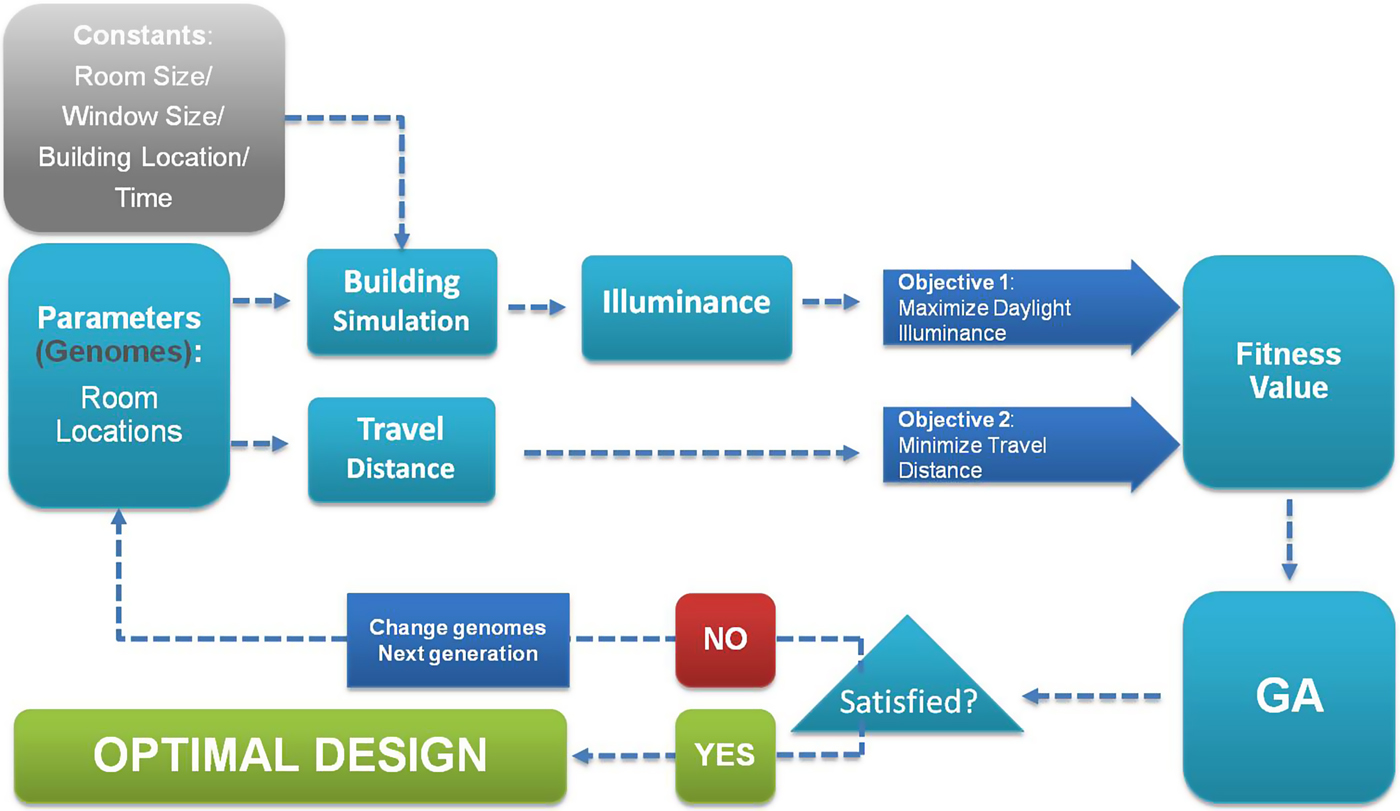
This flowchart visualizes a typical optimization loop. A set of parameters (genomes) generates a design, which is simulated and evaluated against objectives (e.g., maximize daylight, minimize travel distance) to calculate a fitness value. A genetic algorithm (GA) then uses this value to decide whether the design is satisfactory or if it needs to change the parameters to create a new, better generation.
This data-driven approach allows for the creation of highly efficient and informed architectural forms. Let's examine a research project that applies this idea to create a lightweight, structurally optimized pavilion.
[PDF] Computational design, engineering and manufacturing of a material ...
This research paper details a complete computational workflow, from design inspired by bone structure to fabrication. Given your background, you'll appreciate the rigorous, systems-based approach.
First, read the sections on biomimetic studies and the computational workflow. Notice how the logic of bone remodeling—adding material where stress is high and removing it where it's low—is translated into a computational algorithm using Finite Element Methods (FEM). Next, read section 3.4 on Topology and Material Optimization. This section explains how the results of the stress analysis directly inform the geometry, varying both the topology (the number and connection of struts) and the thickness of the lattice. This is a perfect example of performance-driven form generation.
The Trabeculae Pavilion project you just read about is a powerful demonstration of performance-driven design. The final form is not arbitrary; it is a direct result of a structural analysis and optimization process. Every part of the lattice is precisely sized and configured to do its job with maximum efficiency, using the minimum amount of material necessary. This integration of analysis and form generation is a core advantage of the parametric approach.
Advantage 3: Adaptability and Design Exploration
A traditional architectural drawing represents a single, static design. A parametric model, by contrast, represents a design space—an entire family of potential solutions. By simply adjusting the input parameters, a designer can generate and evaluate countless variations in a fraction of the time it would take to draw them manually. This accelerates the creative process and allows for a much broader exploration of possibilities.
Furthermore, this adaptability means a design can be made to respond to its specific context. A parametric facade system, for example, could be designed to automatically adjust the size of its apertures based on the building's orientation to the sun, with smaller openings on the sun-drenched south face and larger ones on the north.
Visionary architects have pushed this concept even further, imagining buildings that are not just adapted to their environment during the design phase, but are actively and continuously adaptable throughout their lifespan.
John Frazer. Computational Design. 2014
In this lecture, pioneering computational designer John Frazer discusses the idea of embedding intelligence directly into the fabric of a building.
Please watch the segment from embedding intelligence to the end of the discussion on the "bored" building. This project, for Cedric Price's "Generator," explored how a building could reconfigure itself in response to user needs, or even mischievously provoke users to interact with it, creating a system that learns and evolves over time.
While the idea of a "bored" building that reconfigures itself may seem radical, it powerfully illustrates the ultimate potential of this advantage. Parametric design allows us to think of buildings less as static, finished objects and more as dynamic, responsive systems that can adapt to changing needs, user feedback, and environmental conditions.
Conclusion
In this lesson, we have moved from the "how" of parametric design to the "why." We've seen that by defining architecture as a system of rules and relationships, we unlock significant advantages that were unavailable with traditional methods.
Let's summarize the key takeaways:
- Fabrication: Parametric design enables pre-rationalization, where manufacturing logic is embedded in the model. This makes complex forms buildable and allows for the automation of fabrication data, increasing efficiency and accuracy.
- Performance: By creating a feedback loop with analysis software, parametric models can be optimized to meet specific performance goals. This data-driven process, often using evolutionary algorithms, leads to more efficient and sustainable designs.
- Adaptability: A parametric model defines a design space, allowing for rapid exploration of many variations. This adaptability can be used to tailor a design to its context or even create dynamic buildings that respond to their environment in real time.
This concludes our first module on the foundations of parametric design. We have defined what it is, traced its history, and understood its primary advantages. Now, we are ready to dive into the mathematical tools that make all of this possible. In our next lesson, we will begin Module 2 by reviewing the fundamentals of vectors and coordinate systems—the very language we use to describe geometry in a computational environment.