Introduction
Congratulations on completing your capstone project and reaching the conclusion of our course on parametric design. Over the past twelve modules, you have built a comprehensive understanding of this transformative field, progressing from the foundational mathematics of vectors and curves to the sophisticated logic of generative algorithms and performance-driven design.
This final lesson offers a moment of reflection. Instead of introducing new material, we will look "under the hood" at the course itself, examining the pedagogical structure and the reasoning behind its design. The learning outcome for this session is to understand the "why" of your learning journey—how the syllabus was intentionally structured to align with your background in mathematics and physics, and your goal of mastering not just the "how" but the "why" of parametric architecture. This review will consolidate your knowledge by framing it within a professional and academic context.
1. The Course Blueprint: A Parametric Approach to Learning
In our very first lesson, we defined parametric design as a process driven by parameters and rules. In many ways, this course was designed using the same philosophy. Your background, goals, and learning preferences were the key input parameters that shaped the curriculum's structure and flow.
The aim was to move beyond simply teaching software commands and instead cultivate a specific way of thinking. Early pioneers of this systemic approach, like the Italian architect Luigi Moretti, explored form-finding through rule-based diagrams long before modern computers. His studies for a stadium, for instance, used contour-like lines to represent fields of influence, translating abstract forces into geometric form.
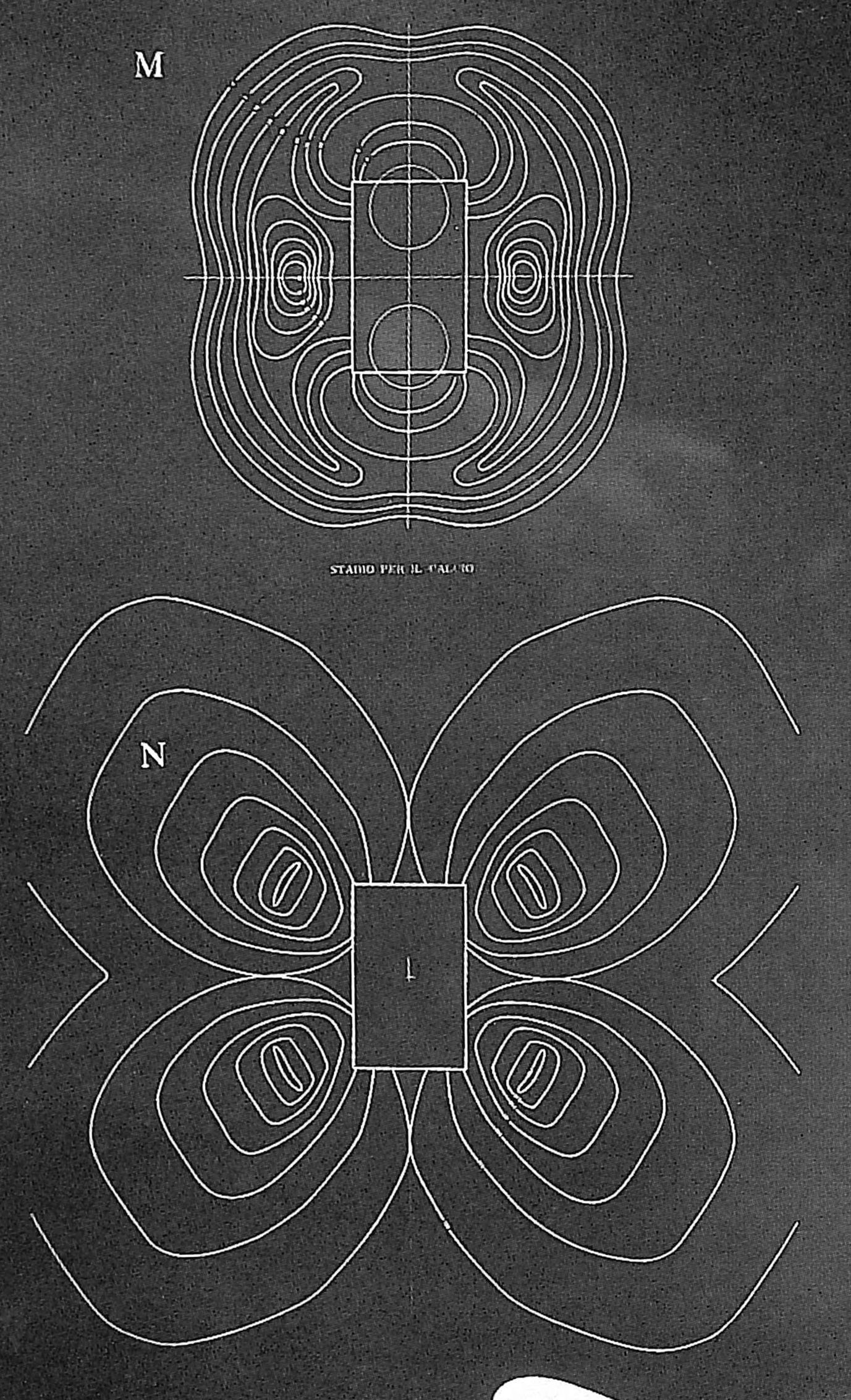
This course was structured to mirror that systemic thinking, building a logical path from abstract principles to tangible architectural outcomes.
2. The "Math-First" Foundation
A key decision, guided by your background and stated interest in the "mathematics behind it," was to establish a robust theoretical foundation before diving into software. Modules 2, 3, and 4 on Vector Math, Parametric Curves, and Parametric Surfaces were deliberately placed at the beginning.
This front-loading of mathematics served a crucial purpose: it provided you with the fundamental language of parametricism. To design a free-form surface, one must first understand what it is mathematically. Let's briefly revisit the core concept of a parametric surface.
Parametric surfaces r(u,v), Multivariable Calculus
This short video recap explains the essential idea of using two parameters, typically denoted u and v, to describe any point on a surface.
Please watch the introduction from the beginning to the explanation of why a surface requires two parameters. This distinction between a one-parameter curve and a two-parameter surface is the conceptual bedrock of everything we've built since.
By mastering concepts like the parametric surface equation , you gained the ability to think about geometry not as a static object, but as a dynamic system generated by mathematical rules. This mathematical fluency is what separates a technician from a true designer.
This approach allows for a deep understanding of iconic architectural forms. For example, your interest in the catenary curve is a perfect case study.
This video on arches and chains provides an excellent physical demonstration of why the catenary is such a powerful form in architecture.
Recall our discussion from Module 3 by watching these key segments: First, review the definition of a catenary. Next, observe the relationship between a chain and an arch. Finally, see how Antoni Gaudí used this principle in his work, as explained from this section.
Gaudí's hanging chain models were a physical algorithm—a form of pre-digital parametric design. By understanding the underlying physics and mathematics, he could derive a structurally perfect form. Our "math-first" approach aimed to equip you with the modern equivalent of this knowledge.
3. A Professional Framework: Pre-Rationalization
As the course progressed, we shifted from pure theory to application. This transition mirrors a crucial concept in contemporary practice: the distinction between "post-rationalization" and "pre-rationalization." A deeper look at this idea will frame the entire methodology you have learned.
Architectural Mathematics for Parametric Design – Session 3
This text from "Open Structures" discusses the challenges of designing non-standard forms and introduces a powerful methodological framework that aligns perfectly with the philosophy of this course.
Please read the following sections to situate your learning within a professional context: First, read the section Rationalization in architectural design to understand the difference between post-rationalization (forcing a free-form shape to be buildable, often with compromises) and pre-rationalization (designing with fabrication and material constraints from the start). Next, read the authors' proposed approach. Note the central role of differential geometry in creating a "design library" of shapes with known fabrication properties. This is the essence of a sophisticated parametric workflow. Finally, review the tri-nodal work-flow. This diagrammatically links Material-fabrication, Differential Geometry, and a Visualization/Design Tool into a continuous loop.
The methodology taught in this course is a form of pre-rationalization. You learned not just to create complex shapes, but to construct them from principles that respect material, structural, and fabrication logic. The "tri-nodal work-flow" described in the reading provides a superb map of your learning journey:
- Differential Geometry (The 'Math'): This corresponds to Modules 2-5, where you learned about vectors, curves, surfaces, and patterns—the geometric language of form.
- Visualization and Design Tool (The 'Software'): This covers Modules 6-9, where you mastered Rhino and Grasshopper, learning to translate geometric concepts into computational instructions.
- Material-Fabrication (The 'Application'): This is addressed in Modules 10-11, where you used your skills for facade design, rationalization, and performance analysis, preparing your geometry for the real world.
Your capstone project was an exercise in navigating this loop, balancing design intent with the logical constraints of your system.
4. A Scaffolded Path to Complexity
Knowing that you preferred complex topics to be broken down, the syllabus was carefully "scaffolded" to manage cognitive load. The most significant example of this was creating a dedicated module, "Mastering Data Structures in Grasshopper" (Module 8).
In many curricula, this topic is briefly covered, but its central importance justifies a deep dive. The ability to manage data trees is what unlocks the full potential of Grasshopper, enabling the move from simple scripts to complex, multi-object systems. This pedagogical choice is reinforced by how parametric work is evaluated in academic and professional settings.
[PDF] A pedagogical introduction to parametric modeling as a formal ...
This academic paper discusses how parametric design is taught and evaluated, highlighting the skills that are truly important.
Please read these two sections: First, review the list of skills needed for parametric design. Note that they range from abstract (math, computer science) to concrete (construction, software). This course was designed to touch on all of them. Next, read the section on student project evaluation. Observe the evaluation criteria: the "relevance of the choice of parameters," the presentation of different instances, and the illustration of the model through the "GH chain" and a "schematic conceptual representation."
As the paper highlights, a successful parametric designer is evaluated not just on the final form, but on the elegance and logic of the process. A clear, well-organized Grasshopper definition (the "GH chain") is evidence of clear thinking. By dedicating an entire module to data structures, we ensured you had the skills to build this clarity into your work, preventing your definitions from becoming an unmanageable tangle as complexity increased.
Conclusion
Your journey through this course was designed to be more than a software tutorial. It was a comprehensive introduction to a design methodology—a way of thinking that integrates mathematics, computation, and architectural logic.
The key takeaways from this reflection are:
- The course followed a "math-first" principle to provide you with a robust theoretical language for describing and manipulating form.
- The overall methodology can be framed professionally as pre-rationalization, where design is inherently linked to the logic of geometry and fabrication from the outset.
- The curriculum was scaffolded to manage complexity, with topics like data structures given dedicated focus to build a strong foundation for advanced techniques.
- The ultimate goal was to synthesize these elements into a holistic design process, which you demonstrated in your capstone project.
You now possess the foundational skills and, more importantly, the conceptual framework to continue exploring the world of parametric design independently. The ability to define your own parameters, write your own rules, and generate novel solutions is now yours. You have learned the language of a new architecture.

Congratulations once again on your dedication and achievement. I wish you the best in applying these powerful ideas to your future endeavors.