Welcome to our fifth lesson on parametric surfaces. In the last session, we constructed Bézier surfaces from a grid of control points, a powerful method for creating smooth, sculpted forms. However, we also noted their limitations; for instance, a single Bézier patch cannot perfectly represent a simple sphere or circle. This limitation hints at the need for a more robust and versatile geometric system.
Today, we will explore that system: NURBS (Non-Uniform Rational B-Splines). This lesson addresses the learning outcome: Define NURBS surfaces and describe their role in creating free-form architectural geometry. NURBS are the industry standard in architecture and industrial design, forming the mathematical backbone of software like Rhino, which we will study later. You'll see that NURBS are a brilliant synthesis, extending the concepts of B-splines we saw for curves and incorporating the "rational" element needed to overcome the limitations of Bézier surfaces.
The Role of NURBS in Architecture
Before diving into the mathematics, it's crucial to understand why NURBS are so fundamental to contemporary architecture. The complex, fluid forms of architects like Zaha Hadid or Frank Gehry would be nearly impossible to design, rationalize, and fabricate without them. NURBS provided the language for what is often called "topological" or "free-form" architecture.
The following article discusses how NURBS were appropriated from the automotive and aerospace industries to revolutionize architectural design.
[PDF] Computer Aided Physical Models: Introducing Nurbs ... - ASEE PEER
This paper from ASEE PEER provides an excellent overview of the impact of NURBS on architectural form-making.
Please read the introduction, starting from the quote by Peter Zellner and continuing through the discussion on how NURBS were adopted. Focus on the paragraph describing how NURBS geometry is represented and controlled, from "NURBS were developed" to "computationally possible". This section highlights the key control mechanisms—control points, weights, and knots—that we will dissect in this lesson.
As the paper explains, NURBS represent a departure from both traditional Euclidean geometry and simple mesh modeling, which you may be familiar with from Blender. While a mesh approximates a curve with a series of discrete flat polygons, a NURBS surface is a continuous and mathematically precise entity. This distinction is crucial for fabrication and analysis.
The video below gives a great high-level overview of NURBS, their history, and this critical difference between a true NURBS surface and the render mesh used to visualize it on screen.
The Language of ORGANIC Shapes? NURBS!
This video from the ProArchitect channel contextualizes NURBS within the history of architecture and design software.
First, watch the segment on the history and adoption of NURBS in industry and architecture. Then, pay close attention to the section explaining the difference between NURBS and meshes, where the presenter demonstrates how a CAD program uses a discretized mesh for visualization but performs calculations on the underlying, precise mathematical surface.
Defining NURBS Surfaces
So, what exactly is a NURBS surface? It is a generalization of the B-spline and Bézier surfaces we have already encountered. Let's recall the definition of a Bézier surface:
A NURBS surface builds on this in three key ways, reflected in its name:
- B-Spline: It uses B-spline basis functions, , instead of Bernstein polynomials. As we saw with curves, this provides local control (moving one control point only affects a nearby part of the surface) and allows for easier joining of surface patches with desired continuity.
- Non-Uniform: The B-spline basis functions are defined over a knot vector that does not need to have uniform spacing. This allows for fine-tuning the shape, for instance by creating kinks or areas of high curvature.
- Rational: Each control point is assigned a scalar weight, . This is the most powerful addition. It provides an extra "knob" to control the shape, effectively pulling the surface closer to or pushing it further from a control point. This "rational" property is what enables NURBS to perfectly represent conic sections like circles, cylinders, and spheres.
Combining these concepts, the formal definition of a NURBS surface looks like this:
This formula may seem complex, but it has a very elegant interpretation. The numerator describes a non-rational B-spline surface in a 4D space (using homogeneous coordinates, which we saw in Module 2), and the denominator is a scalar field that projects this 4D surface back into our 3D world. If all weights are set to 1, the denominator simplifies to 1, and the formula becomes that of a standard (non-rational) B-spline surface.
The following seminal paper on NURBS provides the formal definition and outlines the very reasons for their widespread adoption.
[PDF] On NURBS: a survey - IEEE Computer Graphics and Applications
This paper by Les Piegl is a foundational text in the field. It's mathematically dense but provides the authoritative definitions.
First, in the section "Why NURBS?", read the bulleted list of reasons for the popularity of NURBS. These points concisely summarize their power. Then, in the section "What are NURBS?", focus on the mathematical definitions. Read the part that defines the NURBS curve and surface. Don't worry about memorizing the formulas, but try to recognize the components we've discussed: control points (\vec{P}), weights (w), and B-spline basis functions (N(u)).
The Designer's Toolkit: Controlling NURBS Geometry
While the math is powerful, designers interact with NURBS through a more intuitive set of controls. Let's break down the components from a practical standpoint.
Control Points and the Control Net
Just as with Bézier surfaces, a NURBS surface is primarily defined by a grid of control points, often called a control net. Pushing and pulling these points provides the primary method of sculpting the form.
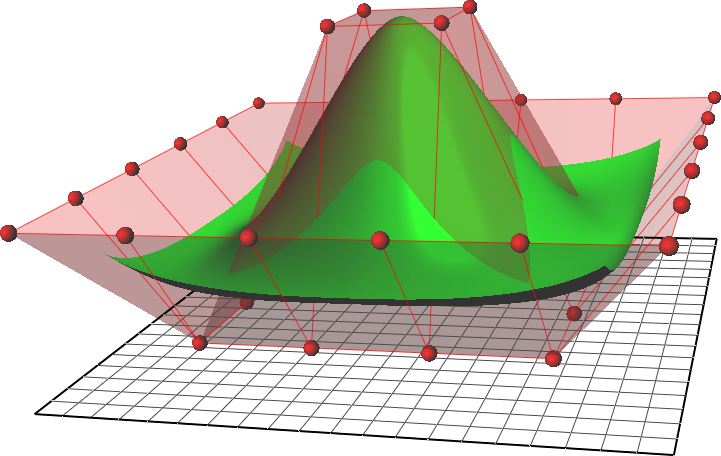
The UV Parameter Space
A NURBS surface is fundamentally a mapping from a 2D rectangular space (the domain) to a 3D surface (the range). This 2D space is defined by the parameters and . Every point on the 3D surface corresponds to a unique coordinate pair. This concept is essential for many operations in parametric modeling, such as subdividing a surface or applying a pattern to it.
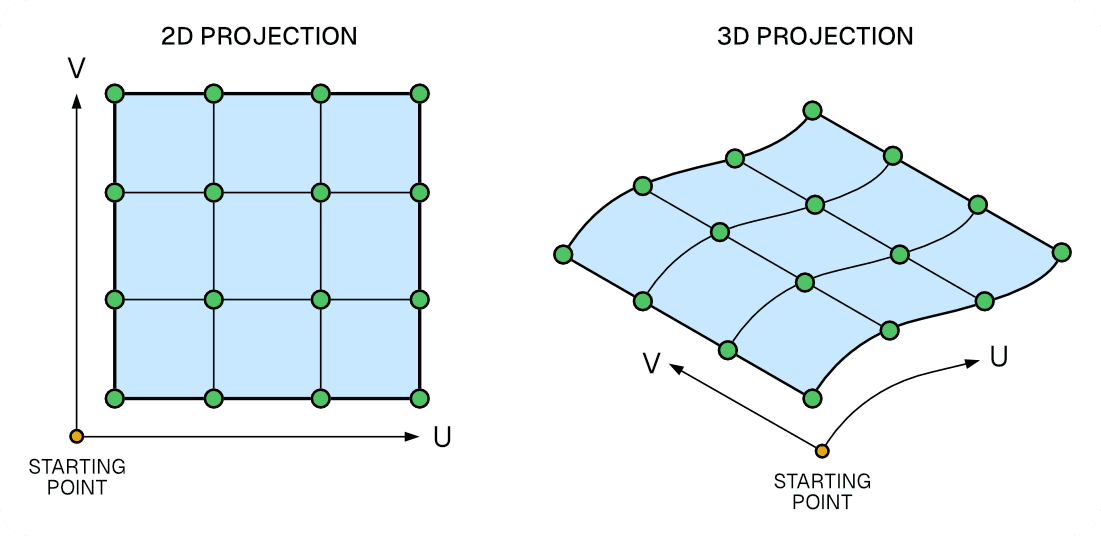
The following video provides an exceptionally clear explanation of NURBS curves and surfaces from a parametric modeling perspective, focusing on concepts like control points, degree, and the UV domain.
4.1 Introduction to NURBS Geometry - Intro to Parametric Modeling
This video from ParametricCamp breaks down the core concepts of NURBS in a very accessible way, preparing you for how you will use them in Grasshopper.
First, watch the segment that explains the properties of NURBS curves. This covers control points, degree, and the concept of a curve's domain. Although it's about curves, the concepts are identical for surfaces. Then, watch the next segment which extends these ideas to NURBS surfaces, introducing the U and V directions and the idea of a local UVW coordinate system.
The Power of Weights
The truly unique feature of NURBS is the weight associated with each control point. By changing a control point's weight, you can adjust its "influence" on the surface.
- Increasing a weight pulls the surface closer to that control point.
- Decreasing a weight allows the surface to relax away from it.
This is a more subtle form of control than moving the point itself. Critically, it is the use of non-uniform weights that allows NURBS to perfectly model rational shapes. For example, a circle can be defined by a quadratic NURBS curve where the weights of certain control points are adjusted in a specific ratio.
[PDF] On NURBS: a survey - IEEE Computer Graphics and Applications
Let's return to the Piegl paper to understand weights more deeply.
Please read the section "More about the weights". The text and Figure 5 give a clear geometric interpretation of what happens when a weight is changed. Then, skim the section "Shape modifications", which contrasts changing the position of a control point with changing its weight.
A Unified Framework for Geometry
One of the most elegant aspects of NURBS is that they provide a single, unified mathematical framework to create a vast range of shapes. Geometries that we previously treated as distinct constructions—like ruled surfaces or surfaces of revolution—can all be precisely represented as special cases of NURBS surfaces. A simple plane, a cylinder, a sphere, and a complex free-form facade panel can all be stored and manipulated using the exact same data structure. This is immensely powerful for developing a consistent geometric kernel in a CAD program.
[PDF] On NURBS: a survey - IEEE Computer Graphics and Applications
Finally, let's see how standard shapes are generated within the NURBS framework.
Read the section titled "Commonly used surfaces". This part explains how extruded surfaces, quadrics (like spheres and cylinders), and ruled surfaces are all generated as specific configurations of NURBS. This should connect directly back to our earlier lessons on these surface types.
Conclusion
In this lesson, we have moved from Bézier surfaces to the more general and powerful NURBS framework. We've seen that NURBS are the cornerstone of modern free-form architectural design, enabling a complexity and precision that was previously unattainable.
Here are the key takeaways:
- NURBS (Non-Uniform Rational B-Splines) are a mathematical representation for free-form curves and surfaces.
- They are defined by a control net, degree, knot vector, and weights.
- The "Rational" component (weights) allows NURBS to precisely model conic sections (circles, spheres, etc.) and gives designers an additional layer of shape control.
- The "B-Spline" basis provides for local control and seamless joining of surface patches.
- NURBS provide a unified mathematical system capable of representing everything from simple planes to the most complex doubly-curved surfaces, making them the standard in architectural CAD software.
In our previous lessons, we built surfaces from geometric rules (revolution, ruling) or direct control (Bézier, NURBS). In our next lesson, we will explore a different paradigm: surfaces defined by a physical principle. We will investigate minimal surfaces, which are shapes that minimize their surface area, famously demonstrated by soap films. This will provide another fascinating link between mathematics, physics, and architectural form.