Hello! Welcome to the next lesson in our journey to build a Random Forest from scratch.
In our last lesson, you masterfully constructed a recursive function to build a complete DecisionTree. You now have a working model that can learn splitting rules from data. However, a single decision tree, while powerful, can be sensitive to the specific data it's trained on, making it prone to overfitting.
To build a more robust and accurate model, we'll use an ensemble of trees. The key is to make sure each tree in the ensemble is slightly different from the others. The primary technique for achieving this is called bootstrap aggregating, or bagging.
Today's lesson focuses on the first and most crucial part of this technique. Our learning outcome is to implement bootstrap sampling ('bagging') from scratch. This will be the function that generates the varied datasets we need to train each tree in our upcoming forest.
What is Bootstrap Sampling?
Bootstrap sampling is a resampling method that involves drawing samples from a dataset with replacement.
Imagine you have a bag of marbles. If you sample with replacement, you:
- Draw one marble and note its color.
- Put the marble back into the bag.
- Repeat the process.
Because you put the marble back each time, you might draw the same one multiple times. By contrast, if you sample without replacement, each marble can only be drawn once.
In machine learning, we apply this to our training data. A bootstrap sample is a new dataset of the same size as the original, but created by sampling with replacement.
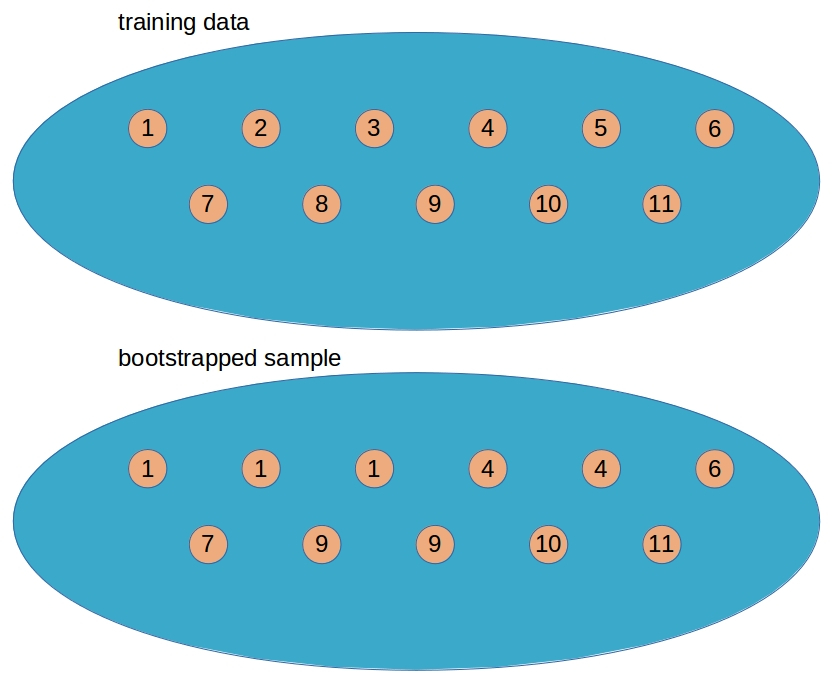
This process of creating datasets via bootstrapping and then training a model on each one is the core idea of Bagging (Bootstrap Aggregating).

Implementing Bootstrap Sampling in Python
Given your background, you'll appreciate that the most efficient way to implement this is with NumPy. We can generate random indices with replacement and then use those indices to select data from our original arrays. This is much faster than looping in pure Python.
The logic is straightforward:
- Determine the number of samples,
n_samples, in the original dataset. - Generate an array of
n_samplesrandom indices, from0ton_samples - 1. The key is to allow these indices to be chosen more than once (replace=True). - Use this array of indices to create the new bootstrapped dataset from the original
Xandy.
Here is a Python function that accomplishes this:
import numpy as np

def bootstrap_sample(X, y):
    """
    Creates a bootstrap sample from the dataset.

    Args:
        X (np.ndarray): The feature matrix.
        y (np.ndarray): The target vector.

    Returns:
        tuple[np.ndarray, np.ndarray]: The bootstrapped feature matrix and target vector.
    """
    n_samples = X.shape[0]

    # Step 1: Generate random indices with replacement
    # np.random.choice is perfect for this. 'replace=True' is the key.
    bootstrap_indices = np.random.choice(
        n_samples,
        size=n_samples,
        replace=True
    )

    # Step 2: Use the indices to create the new dataset
    X_bootstrapped = X[bootstrap_indices]
    y_bootstrapped = y[bootstrap_indices]

    return X_bootstrapped, y_bootstrapped

# --- Example Usage ---
# Create some dummy data
X_original = np.array([[1,1], [2,2], [3,3], [4,4], [5,5]])
y_original = np.array([1, 2, 3, 4, 5])

# Generate a bootstrap sample
X_boot, y_boot = bootstrap_sample(X_original, y_original)

print("Original y:\n", y_original)
print("\nBootstrapped y:\n", y_boot)
# You will likely see repeated and missing numbers here!
As you can see, the implementation is concise and powerful, leveraging NumPy's optimized array operations.
The following video walks through an almost identical implementation within the context of a full RandomForest class. Watching this will help solidify how our standalone function will fit into the larger algorithm.
How to implement Random Forest from scratch with Python
The video 'How to implement Random Forest from scratch with Python' from the AssemblyAI channel directly implements the function we've just discussed.
Please watch the segment from 05:18 to 06:44. The host implements a bootstrap_samples method. Notice the use of np.random.choice with replace=True to generate the indices, just as we did. This directly demonstrates the from-scratch implementation of bootstrap sampling.
While the NumPy approach is standard, it's worth noting other ways to achieve this.
How to Implement Random Forest From Scratch in Python
For an alternative perspective, the article 'How to Implement Random Forest From Scratch in Python' by Jason Brownlee on Machine Learning Mastery shows how to create a subsample using pure Python.
Scroll down to the subsample function. You'll see it uses a while loop and the randrange function to build the sample list one element at a time. This approach works but is less efficient for large datasets compared to our vectorized NumPy implementation.
Test your understanding!
A bootstrap sample on average contains about 63.2% of the unique samples from the original dataset. The remaining 36.8% of the data that were not selected for a given bootstrap sample are called the "Out-of-Bag" (OOB) samples.
Given your bootstrap_sample function, how could you modify it or write a complementary function to return not just the bootstrapped sample, but also the out-of-bag sample?
Show answer
You could find the out-of-bag indices by identifying which of the original indices were not included in the bootstrap_indices. NumPy makes this easy.
Here's how you could do it:
def get_oob_sample(X, y, bootstrap_indices):
    """
    Gets the out-of-bag sample.
    """
    n_samples = X.shape[0]

    # Get all original indices
    all_indices = np.arange(n_samples)

    # Find the indices that are in 'all_indices' but NOT in 'bootstrap_indices'
    oob_indices = np.setdiff1d(all_indices, bootstrap_indices)

    # Use these indices to get the OOB data
    X_oob = X[oob_indices]
    y_oob = y[oob_indices]

    return X_oob, y_oob

# --- Example Usage (building on the previous one) ---
# In a real scenario, you'd modify bootstrap_sample to return the indices
# For now, let's re-generate them to demonstrate
n_samples = X_original.shape[0]
bootstrap_indices = np.random.choice(n_samples, size=n_samples, replace=True)

X_boot = X_original[bootstrap_indices]
y_boot = y_original[bootstrap_indices]

X_oob, y_oob = get_oob_sample(X_original, y_original, bootstrap_indices)

print("Bootstrap indices:", bootstrap_indices)
print("OOB y:", y_oob) # This will contain the labels that were not picked
This OOB data is very useful for model evaluation, which we'll touch on later in the course.
Conclusion
You have successfully implemented bootstrap sampling, a cornerstone of modern ensemble methods. This simple but powerful technique is what allows a Random Forest to build a diverse set of decision trees, leading to a model with lower variance and often higher accuracy than any single tree alone.
Key Takeaways:
- Bootstrap Sampling means sampling from a dataset with replacement.
- The resulting bootstrap sample has the same size as the original dataset but typically contains duplicate entries and omits some original entries.
- Bagging (Bootstrap Aggregating) is the process of training multiple models on different bootstrap samples and combining their predictions.
- The most efficient way to implement this in Python is using
numpy.random.choicewith thereplace=Trueparameter.
Preview of the Next Lesson:
We are now fully equipped to build our Random Forest. In the next lesson, we will combine the DecisionTree class from the previous lesson with the bootstrap_sample function you created today. We will orchestrate the training of many trees on different bootstrapped datasets and introduce the second element of randomness—feature subsampling—to complete our RandomForest implementation.