Welcome to your first lesson in our course on straight line equations! We'll begin by exploring the most fundamental property of a straight line: its slope. By the end of this lesson, you will be able to calculate the slope of any line, given just two points that lie on it. This concept will be the bedrock for everything we build upon, from writing equations of lines to analyzing their geometric relationships.
What is Slope?
You likely have an intuitive understanding of slope as a measure of steepness. A steep hill has a high slope, while a flat plain has zero slope. In coordinate geometry, we formalize this idea. The slope of a line measures the rate of change in the vertical direction (the "rise") for every unit of change in the horizontal direction (the "run").
A line that goes up from left to right has a positive slope. A line that goes down from left to right has a negative slope.
To build a solid visual and conceptual foundation, let's watch a segment from the Math Antics video, "Algebra Basics: Slope And Distance". This will introduce how a line segment between two points can be used to form a right triangle, which is the key to understanding slope.
Algebra Basics: Slope And Distance - Math Antics
Please watch the video from the beginning up to the 5:14 mark.
Focus on these key ideas: How two points on a line define a line segment which becomes the hypotenuse of a right triangle (forming a triangle). The concepts of "change in x" (Δx) and "change in y" (Δy) as the horizontal and vertical sides of this triangle (delta notation). How Δx and Δy are calculated from the coordinates of the two points (calculating deltas). The definition of slope as the ratio of Δy to Δx, or "rise over run" (slope formula).
The Slope Formula
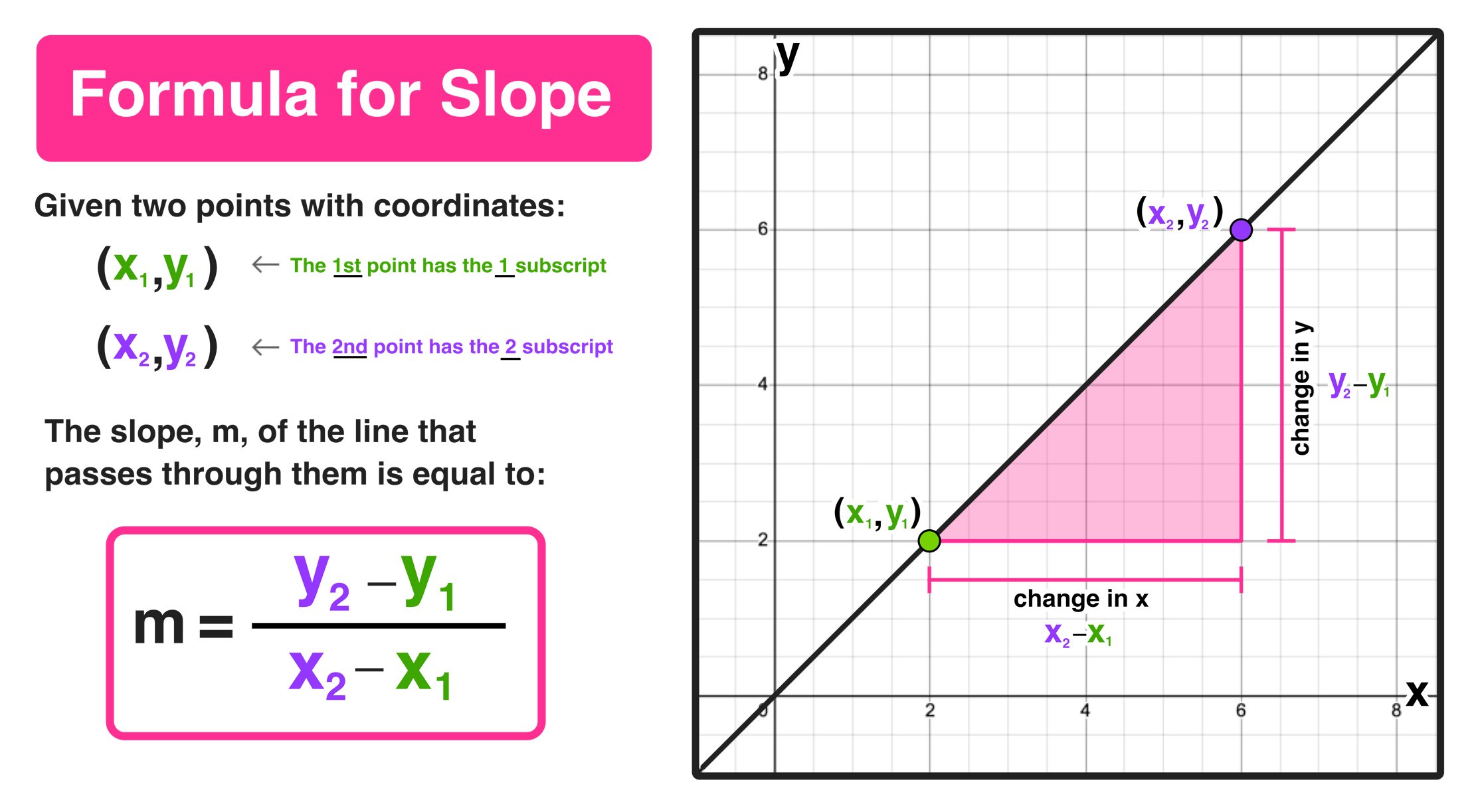
As the video explained, if we have two points on a line, Point 1 with coordinates and Point 2 with coordinates , we can calculate the slope, usually denoted by the letter .
The "rise" is the vertical change, .
The "run" is the horizontal change, .
The slope is the ratio of rise to run:
A Deeper Look: The Connection to Trigonometry
Given your background in trigonometry, you might find this connection interesting. The slope of a line has a direct relationship with the angle the line makes with the positive x-axis.
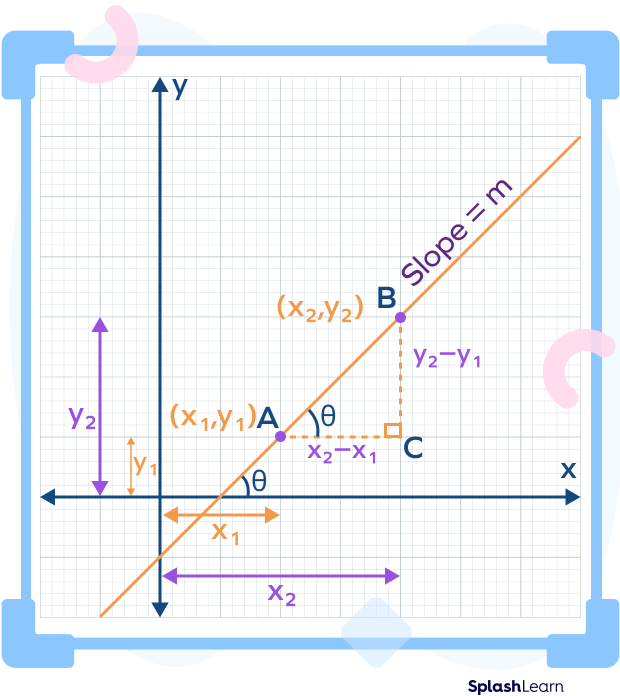
In the right-angled triangle shown in the diagram, the side opposite the angle is the rise (), and the side adjacent to it is the run (). From the definition of the tangent function in a right-angled triangle:
As you can see, this is exactly the same as our formula for slope. Therefore, the slope of a line is equal to the tangent of the angle it makes with the horizontal.
This provides a deeper geometric meaning to the concept of slope. It's not just a ratio, but a measure of the line's angle of inclination.
Calculating Slope: Examples
Now, let's put the formula into practice. The calculation is straightforward, but it's important to be careful with the order of operations and especially with negative signs.
A crucial point is consistency. It doesn't matter which point you label as Point 1 or Point 2, as long as you subtract the y-coordinates and x-coordinates in the same order.
Let's watch a few worked examples from the video "Finding The Slope Given 2 Points - Tons of Examples!" to see how this is applied.
Finding The Slope Given 2 Points - Tons of Examples!
Watch the first two examples in this video.
The first example shows a straightforward calculation. The second example demonstrates how to handle negative coordinates, which is a common source of error. Pay close attention to the sign changes.
Special Cases: Horizontal and Vertical Lines
What happens if the "rise" or the "run" is zero? This leads to two important special cases.
-
Horizontal Lines: All points on a horizontal line have the same y-coordinate. This means , so the rise .
The slope of any horizontal line is 0. This makes intuitive sense—a perfectly flat line has no steepness.
-
Vertical Lines: All points on a vertical line have the same x-coordinate. This means , so the run .
Division by zero is undefined. Therefore, the slope of any vertical line is undefined.
The same video resource explains these cases clearly.
Finding The Slope Given 2 Points - Tons of Examples!
Now, continue watching from where you left off.
This segment covers the calculation and graphical interpretation of the slope for horizontal lines (slope is 0) and vertical lines (slope is undefined).
Practice Problems
Now it's your turn. Use the formula to find the slope of the line passing through each pair of points.
- (2, 1) and (8, 4)
- (-1, 5) and (3, -3)
- (4, 7) and (-2, 7)
- (5, 1) and (5, 9)
Click to see the solutions
1. (2, 1) and (8, 4)
Let and .
The slope is .
2. (-1, 5) and (3, -3)
Let and .
The slope is .
3. (4, 7) and (-2, 7)
Let and .
The slope is 0. This is a horizontal line.
4. (5, 1) and (5, 9)
Let and .
The slope is undefined. This is a vertical line.
Conclusion
In this lesson, we established the fundamental concept of slope. We defined it as the ratio of vertical change (rise) to horizontal change (run) and mastered the formula for calculating it between two points. We also explored the direct connection between slope and the tangent of the line's angle of inclination, and we clarified the special cases of horizontal lines (slope 0) and vertical lines (undefined slope).
In our next lesson, we will move on to interpreting what the slope and another key feature, the y-intercept, tell us about a line in real-world scenarios. This will set the stage for writing the first and most common form of a linear equation.