Welcome to your first lesson in the Boomi platform course. Given your extensive background in the integration domain with platforms like MuleSoft, TIBCO, and AWS, we will move quickly past foundational integration concepts. Our focus will be on the specific architecture, capabilities, and strategic positioning of Boomi, aligning with your goals in solution architecture and pre-sales.
This introductory lesson provides a high-level overview of the Boomi Enterprise Platform. We will identify its core service offerings, which form the building blocks for the solutions you will later design. Understanding this landscape is the essential first step before we dive into the technical details of the runtime, development, and deployment in subsequent lessons.
The Boomi Platform: A Unified Architectural View
At its core, Boomi is a cloud-native, multi-tenant Integration Platform as a Service (iPaaS). This architectural foundation distinguishes it from many traditional, on-premise middleware stacks you may have worked with. The platform is designed as a single, unified environment for a variety of enterprise needs, not just application-to-application integration.
To begin, let's get a formal introduction to the platform's vision from Boomi's official documentation.
About the Boomi Enterprise Platform
This reading introduces the Boomi Enterprise Platform and its architectural principles.
Please read the initial section, About the Boomi Enterprise Platform. Then, continue to the section "What makes the Boomi Enterprise Platform superior" and read the descriptions of its key characteristics, from the multi-tenant architecture to crowd-sourcing. As you read, note how concepts like the lightweight runtime and metadata-driven configuration represent a different paradigm compared to installing and managing traditional integration software.
The key takeaway here is the concept of a single platform that centralizes development and management, while the actual execution can be distributed anywhere—in the cloud or on-premise. This hybrid capability is a cornerstone of Boomi's architecture, which we will explore in detail when we discuss the Atom runtime in the next module.
Core Service Offerings
The Boomi platform is not monolithic; it's a suite of services designed to address different aspects of enterprise connectivity and automation. The following diagram provides a great visual summary of these core components.
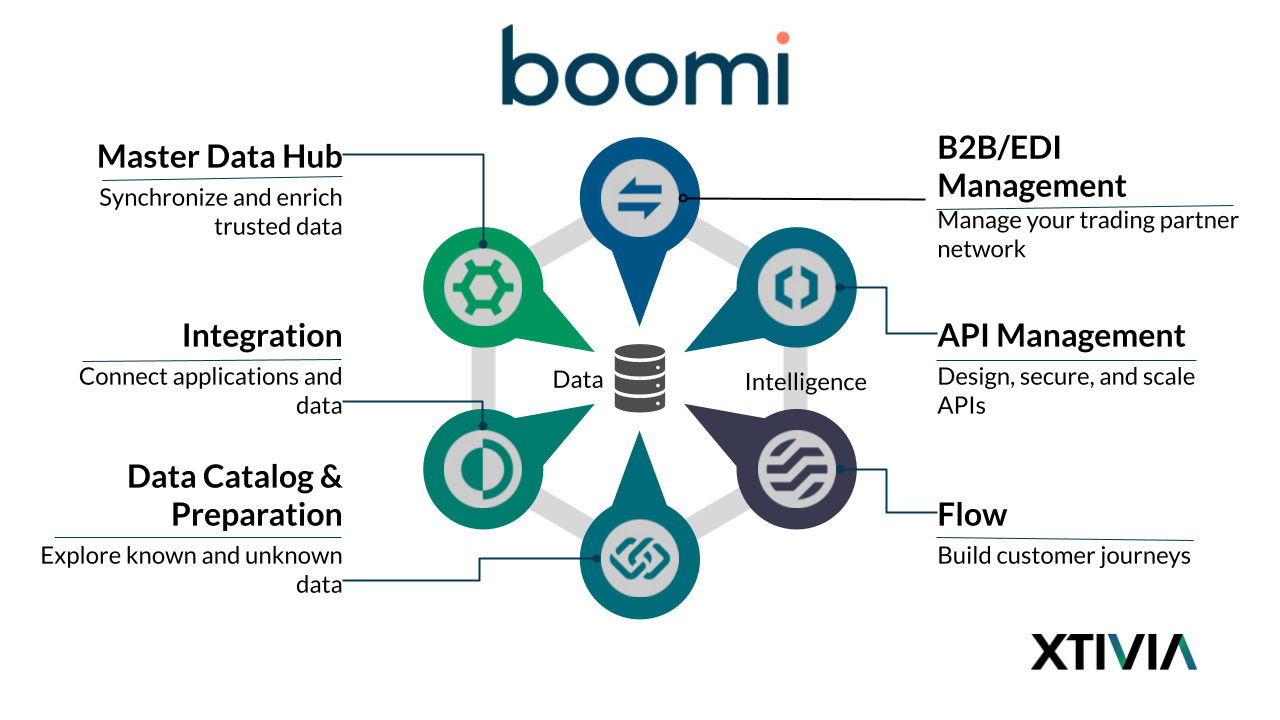
Let's break down each of the primary services mentioned in the learning outcome. For this, we'll use a clear, concise article that describes each component from a business and functional perspective.
Attain Partners Joins Forces with Boomi
This resource provides clear, segmented descriptions of each major Boomi service.
Please read the following sections from the article to understand the purpose of each service: Start with Boomi Integration, which is the heart of the platform. Next, read Boomi API Management. Consider how this compares conceptually to dedicated gateways like Kong or AWS API Gateway that you're familiar with. Then, review Boomi Master Data Hub (MDH) to understand its role in data governance. After that, read Boomi B2B/EDI Management. Finally, look at Boomi Flow to see how it addresses workflow automation.
Let's synthesize what you've just read, placing these services in the context of your experience and a solution architect's perspective.
-
Integration: This is the foundational iPaaS engine, often called "AtomSphere Integration." Its low-code, visual process designer is the central workbench. For someone with your background, you can think of this as the core orchestration and transformation engine, analogous to a Mule flow or a TIBCO BusinessWorks process, but with a different development paradigm focused on a browser-based UI and pre-built components.
-
API Management: This service provides the governance layer for exposing integrations as APIs. It includes an API Gateway for security and traffic control, and a Developer Portal for consumer engagement. Unlike standalone gateways like Kong, Boomi's API Management is intrinsically linked to the Integration service, allowing you to build, publish, and manage an API within a single platform. We'll perform a direct comparison with AWS API Gateway and Kong in a later module.
-
Master Data Hub (MDH): This is Boomi's Master Data Management (MDM) solution. Its purpose is to create and maintain "golden records" by consolidating, cleansing, and synchronizing data across disparate systems (e.g., Salesforce, SAP, NetSuite). From a solution design standpoint, you would propose MDH when a client's primary challenge is data consistency and establishing a single source of truth for key entities like "Customer," "Product," or "Employee."
-
B2B/EDI Management: This module specifically handles trading partner integration. It provides the necessary tools for managing EDI standards (like X12, EDIFACT), partner profiles, and secure document exchange. It's the Boomi equivalent of B2B capabilities you might have used in other stacks, purpose-built for supply chain and partner network integration.
-
Flow: This service is used for building simple applications and automating workflows that often involve human interaction. While the Integration service is for system-to-system automation, Flow is for system-to-human processes. A common use case is creating a simple web form that kicks off a backend integration process, or an approval workflow that requires a manager's input.
Other Platform Services
Beyond the five core services, Boomi's documentation lists a few others that round out the platform. It's useful to be aware of them for pre-sales and architectural discussions.
About the Boomi Enterprise Platform
This section from the official documentation lists all platform services, including newer and legacy ones.
Quickly scan the list under the heading Boomi Enterprise Platform services. Pay special attention to the note about Data Catalog and Preparation (DCP).
As you saw, there are other services like Event Streams (a managed message queuing service), Boomi AI, and Agentstudio. A key piece of information for you, especially in a pre-sales context, is the status of the Data Catalog and Preparation (DCP) service. It is no longer sold to new customers. Knowing such product lifecycle details is critical when architecting new solutions.
Conclusion
In this lesson, we established a foundational, architectural understanding of the Boomi platform and its primary components.
Key Takeaways:
- Boomi is a unified, cloud-native iPaaS designed to connect applications, data, and people.
- The core of the platform consists of five main services: Integration for core process orchestration, API Management for governing APIs, Master Data Hub for data consistency, B2B/EDI Management for trading partners, and Flow for workflow automation.
- These services are designed to work together within a single environment, offering a comprehensive solution rather than a collection of disparate tools.
Now that you have a map of the Boomi landscape, our next step is to explore the terrain. In the next lesson, we will familiarize ourselves with the Boomi AtomSphere UI, the central console where you build, deploy, and manage solutions using these services.