In our last session, we examined Boomi's commercial framework, understanding how its licensing and edition tiers are structured around connectors and capabilities. This knowledge is crucial for costing and positioning solutions. Now, we'll pivot from the "how much" to the "how it works" by diving into the fundamental architecture that sets Boomi apart.
This lesson directly addresses a core concept for any solution architect: contrasting Boomi's modern, metadata-driven cloud architecture with the traditional on-premise integration middleware you're familiar with from your work with TIBCO, IBM, and MuleSoft. Understanding this distinction is not just a technical exercise; it's the foundation for articulating Boomi's value proposition in pre-sales discussions, explaining its benefits in terms of agility, scalability, and Total Cost of Ownership (TCO).
By the end of this lesson, you will be able to clearly differentiate the two architectural paradigms and explain why Boomi's approach is purpose-built for the demands of modern, hybrid IT landscapes.
The Old Guard: Traditional On-Premise Middleware
Your experience with platforms like TIBCO BusinessWorks provides a strong foundation here. The dominant architectural pattern for the last two decades has been the Enterprise Service Bus (ESB). Let's formalize its characteristics and challenges to set a clear baseline for comparison.
What Is ESB? Modern iPaaS Alternatives - Boomi
This article from the Boomi blog provides an excellent overview of the ESB pattern and its limitations, setting the stage for why a new approach was needed.
Please read the following sections: What Is ESB (Enterprise Service Bus)?: This section defines the core concept and its original purpose. Focus on the description of its components (adapters, transformation/routing engines). How ESB Functions in Enterprise Architecture: Review this section to understand the operational mechanics. Pay attention to the descriptions of routing and orchestration and data transformation. Benefits of ESB Technology: Briefly skim this section to acknowledge the problems ESBs were designed to solve, such as centralized management and reducing point-to-point connections. Top Challenges of ESB Implementation: This is the most critical section. Read it carefully, paying close attention to the points on deployment complexity, limited cloud support, high TCO, and performance bottlenecks.
As you've likely experienced, the traditional ESB model is characterized by a few key traits:
- Monolithic & Centralized: A single, large software suite installed on-premise, acting as the central hub for all integrations.
- Infrastructure-Heavy: Requires dedicated servers, databases, and network configuration, leading to high upfront costs and significant maintenance overhead.
- Code-Intensive: While offering some graphical tooling, complex transformations, custom logic, and new connectivity often required specialized developers writing proprietary code or extensive configuration.
- Rigid Deployment Cycles: Changes typically involved packaging an entire application, deploying it to the server, and restarting services, which is a slow and risk-prone process.
This model was effective in the era of on-premise, monolithic applications. However, the rise of cloud applications, APIs, and the need for greater business agility exposed its fundamental limitations.
The New Paradigm: Boomi's Cloud-Native, Metadata-Driven Architecture
Boomi represents a paradigm shift. It's not just an "ESB in the cloud"; its architecture is fundamentally different. This architecture is built on two pillars: a distributed runtime model and a metadata-driven core.
1. Distributed Runtime: Separating Control and Execution
Unlike a monolithic ESB, Boomi decouples the development and management environment from the execution environment.
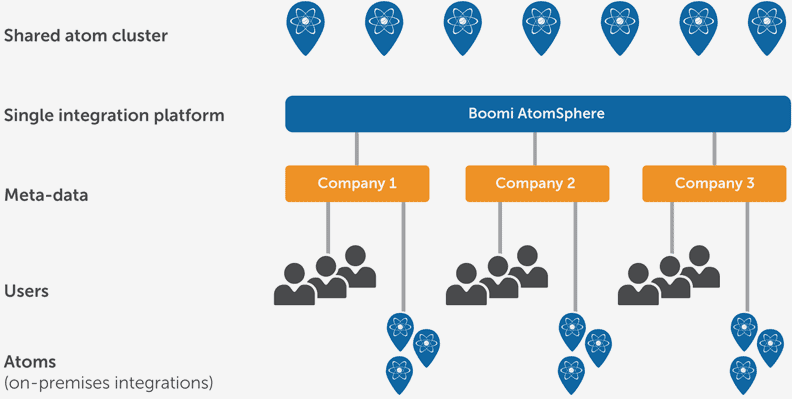
- Control Plane (Boomi AtomSphere Platform): This is the 100% cloud-based, multi-tenant UI where you build, deploy, and manage integrations. It's where the "brains" of the operation live.
- Data Plane (The Boomi Atom): This is the lightweight, dynamic runtime engine that actually executes your integration processes.
This separation is the key to Boomi's flexibility. The Atom is the workhorse, and it can be deployed anywhere: in Boomi's public cloud, in a private cloud (AWS, Azure), or on-premise behind a customer's firewall.
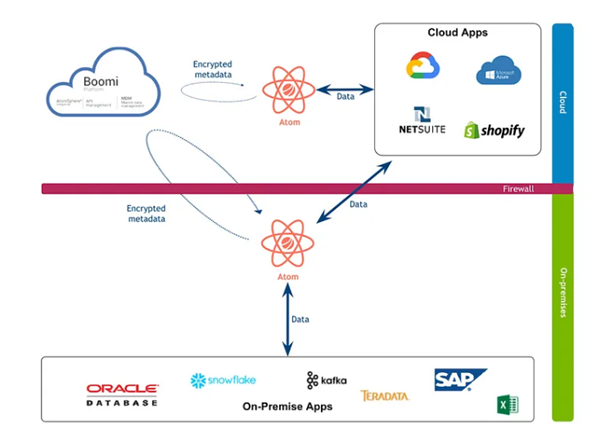
This distributed model provides the best of both worlds: centralized management from a single web UI, but distributed execution right where the data lives. This avoids the bottleneck of forcing all traffic through a central on-premise hub and elegantly solves the cloud-to-ground integration challenge.
The following article section provides a good summary of this architecture.
Boomi Integration Platform Explained: Features, Use Cases, and ...
This article from NeosAlpha provides a clear breakdown of Boomi's core architecture.
Read the section titled Core Architecture. Focus on understanding the distinction between an Atom, a Molecule, and an Atom Cloud, which we will explore in greater detail in the next module.
2. The Metadata-Driven Core
This is the most crucial and often misunderstood concept. In a traditional ESB, you are often generating and compiling code. In Boomi, you are creating metadata.
When you drag and drop shapes, configure connectors, and define mappings in the Boomi UI, you are not writing code that gets compiled. You are declaratively defining the "what" of your integration: what systems to connect to, what data to map, and what logic to follow. This definition is stored as XML metadata.
When you deploy a process, the Boomi platform doesn't send executable code to the Atom. It sends this compact metadata file. The Atom runtime is a pre-built engine whose sole job is to interpret this metadata and execute the "how" in a highly optimized way.
To deepen your understanding of this "what" vs. "how" separation, the following video offers a superb conceptual explanation.
What are Metadata Driven Architectures ?
This video from the "BigData Thoughts" channel explains the concept of metadata-driven architectures in a generic data context, which is perfectly analogous to Boomi's integration approach.
Please watch these two key segments: First, watch the section that compares this approach to declarative programming from the explanation. This highlights the critical distinction between defining "what" should be done (metadata) and "how" it should be done (the runtime engine). Next, watch the segment that outlines the advantages of this architecture. Note how benefits like uniformity, agility, and reduced development cycles directly counter the challenges of traditional ESBs.
This metadata-driven approach is what enables Boomi's key benefits:
- Agility: Changing an integration is as simple as updating the metadata in the UI and redeploying it to the Atom—a process that takes seconds, not hours.
- Low-Code: The platform abstracts the complex "how" into the Atom, allowing developers to focus on the business logic ("what").
- Consistency: Because the execution engine is standardized, integrations behave consistently regardless of where the Atom is deployed.
- Lower TCO: Less specialized coding knowledge is required, and maintenance is simplified because you're managing declarative models, not complex codebases.
The Contrast: ESB vs. Boomi's iPaaS
Let's summarize the contrast, framing it for the architectural and pre-sales discussions you'll be having.
| Feature | Traditional ESB (e.g., TIBCO BW 5.x) | Boomi iPaaS Architecture |
|---|---|---|
| Deployment Model | On-premise, monolithic server | Hybrid-cloud; distributed, lightweight runtimes (Atoms) |
| Architecture | Centralized hub-and-spoke. All traffic flows through a central engine. | Decoupled control plane (cloud) and data plane (Atom). Data stays where it needs to be. |
| Development | Code-intensive, often requiring specialized Java/proprietary language skills. | Metadata-driven, low-code. Focus on "what" (logic), not "how" (code). |
| Scalability | Vertical scaling (bigger servers). Can be a single point of failure. | Horizontal scaling (add more Atoms/Molecules). Elastic and resilient. |
| Connectivity | Adapters were often complex to install and configure. Poorly suited for modern REST/JSON APIs. | Pre-built, connector-based. Native support for cloud APIs and modern protocols. |
| Agility | Slow, risky deployment cycles (package, deploy, restart). | Rapid, low-risk deployments by pushing lightweight metadata to the runtime. |
| Maintenance | High overhead: patching, server management, infrastructure costs. | Low overhead: Platform is managed by Boomi. Runtimes are self-contained. |
Conclusion
In this lesson, we have drawn a clear line between two eras of integration architecture. You now understand that Boomi is not merely a cloud-hosted version of an ESB but represents a fundamental shift towards a distributed, metadata-driven model.
Key Takeaways:
- Traditional ESBs are monolithic, on-premise systems that, while powerful, are complex, costly, and ill-suited for the dynamic, hybrid nature of modern IT.
- Boomi's architecture decouples the control plane (the cloud platform where you design and manage) from the data plane (the lightweight Atom runtimes that execute processes).
- The metadata-driven approach means you define the what (the integration logic) in the UI, and the Atom interprets this metadata to handle the how (the execution).
- This modern architecture is the source of Boomi's core advantages: agility, scalability, lower TCO, and true hybrid deployment flexibility.
We've established the high-level architectural concepts and the critical role of the Atom. In our next lesson, we will begin Module 2 by taking a much closer look at the Atom itself, exploring the different deployment models (Atom, Molecule, and Atom Cloud) and their specific use cases for scalability and high availability.